Friday, July 17, 2015

Marie-Hélène Sambou


I have been under the weather all week, feeling rotten and physically broken, and trying my best to keep it all together under a polished veneer. It worked out splendidly, well...aside from the weeping on Monday night, and then again on Wednesday night.

I don't mind a little sadness every now and then. Especially when it's for no particular reason (other than simply being a psychic sponge and a hypersensitive organism navigating through an extroverted planet). It's moments like these when I reflect on my past and the people I have lost, some for the better, others, at great expense.

Do you have friends or acquaintances, people you have known and who have either brought sunshine or drastic change in your life, people that you often wonder about after many years of not having seen them? How difficulty would it be, you ask, in this age of social media, to not find someone you were looking for. You would be surprised.

I talked myself into making a list of these fascinating people. There are two that I would love to describe to you. I would also love to see them again but I know it would be a difficult quest. One of them, I will speak of now.

Marie-Hélène Sambou

That is her real name. I knew this lady for the first 10 years of my life when I lived in Dakar and in Nantes.  And then I moved to Australia with my parents and never saw her again.

Who was she?

In common parlance, Marie-Hélène was our 'bonne', which is what we French-speaking expats living in Senegal called our 'help'.

But she was more than that.

From what I remember, my grandmother appointed her from the time I was born, or perhaps earlier. She was a young woman from the southern region of Casamance, a region I wrote about here. She could not read nor write. She was a Christian minority in a country that was and is still predominantly Muslim and she was, to me, absolutely fascinating.

Marie-Hélène took care of me from the time I was a baby. When I was separated from my mum aged 10 months, until the age of 3, Marie-Hélène came with me to France and continued to care for me at my grandparents' home.

Oh these were pretty cool days.
Here I am running alongside her in my grandmother's garden in Nantes. I was her star, I reckon.


She braided my hair into rastas. She liked that.


She played with me.


You could probably say she was like a mum to me.

Later when we lived in Dakar, at my grandparents' home. She and another lady (her cousin, Therese Sambou) did everything for us - that is to say they catered for a family of 7: my grandparents, my parents, my sister, my brother and I.

They rose with the sun. They washed all laundry by hand, waited on us at meal times, they scrubbed, mopped, tidied our rooms, cooked most meals, washed dishes by hand, made errands at the market daily, and prepared all ingredients.

When I say they prepared all ingredients, you probably wonder what I am talking about. Don't we all prepare ingredients?

Not really. In Senegal, well back in those days, preparation is time consuming. There is no packaging at the market, aside from rolled newspaper sheets and canvas bags.  The only packaging you can expect is from imported products purchased in a Lebanese or French deli. It goes without saying that most food arrives home in its raw form.

So you bought a chicken? Good for you.  Now go home, kill the chicken, pluck it's feathers, disembowel it. You can ask someone to chop off its head for you at the marketplace but you still have to prepare it when you get home.

Same story for the fish that my dad would bring back from his fishing trips and that would lay in a pool of blood on the concrete kitchen floor - Marie-Hélène would gasp at its size (much to my dad's pride) then haul it up upon the sink, scrub off its scales with a metal brush, and proceed to chop it into large pieces.

The rice we bought was crawling with vermin, mostly dead from the pesticides.  Marie-Hélène had to sift through the rice manually to remove all insects. She did this every time we ate rice. And I can tell you that we ate rice almost every day.

I wrote about Marie-Hélène a few years back. I regularly miss her and wonder what she is up to. I feel sad knowing that I never got to have an adult conversation with her. I feel regret for all my brat behavior and for dobbing her in whenever I felt indignant or bullied by the authority she had to show to get me to shower, sleep, behave or just obey my parents.

Truth is she was just an angel and she worked so hard, so damn hard. I remember that when I was eight, and we were living in France before coming to Australia, I would often sleep with her. One reason was that I loved the way she smelled and I felt comforted by her.  But the other reason is that she was so entertaining. I pestered her non-stop to tell me stories of magic and sorcery from her native Casamance and she begged me to let her sleep but I loved her stories so much, loved the way she told them so much, that I couldn't resist asking for more. Sadly the next day, after having had little sleep, she was up at four working at her chores, while I curled up in bed without a care in the world. All this makes me sad and I miss her terribly.

Marie-Hélène always gave of herself, despite the volume of chores she had to carry through. She was also always there for me. When she left us to return to Senegal before we emigrated to Australia, I remember how much she cried. She had been in our family for years and it would have hurt her enormously to leave. Leave where? Back in Dakar, somewhere. Or maybe in her village, in Casamance...

Where? I have no idea where. And that is what hurts so much. I feel as though a part of me is gone.


Friday, July 10, 2015

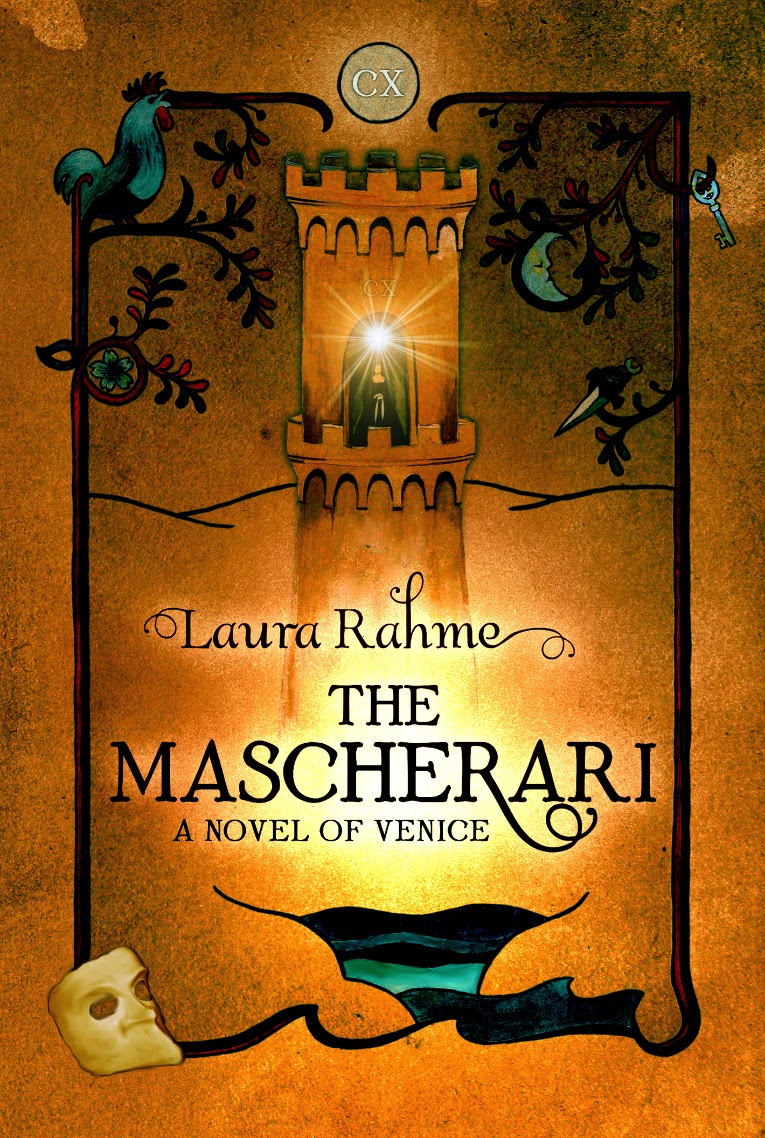
The Enigma of The Mascherari


Call me indulgent and self-absorbed but I have longed for this post - a reflection on a mystery, or rather, a mystery within a mystery.

I feared that if I didn't put down these thoughts, then one of my beloved creations would never be truly understood. I do not feel good when my readers miss deeper meanings. I feel awfully superficial. Please remember that I am an INFJ and I will weave complex detail and subtleties into my writing beyond the narrative.

 You see, I wrote The Mascherari with a single puzzle in mind, but over time, as I became absorbed into the main character and sensed the response that his journey evoked within him, an enigma of another kind was born. I felt that there had to be more to Antonio da Parma.

 ***This post contains spoilers from The Mascherari: A Novel of Venice.***


What is The Mascherari *really* about?

It tells the story of a child witch who is denounced and imprisoned secretly by the evil Council of Ten so that over six years, her supernatural powers may come to serve their political purposes. The ghost of her mother, also a witch, once a leader in the Covent of Diana, haunts our inquisitor, Antonio da Parma as this one investigates a series of grizzly murders while in Venice.

Antonio likes being haunted, he follows the clues avidly, until they help him solve the murders, unveil a sinister family secret, and discover the identity of the witch. They also lead him to the woman of his dreams. He finds the imprisoned witch, now a young woman, and together they form a new Cult of Diana in Benevento, Southern Italy.

At the end of the story, Antonio takes on the pagan deity role he was always destined to take and she becomes his consort, Jana.

You have to read back to the Etruscan origins of the Cult of Diana to understand that Antonio da Parma is actually the embodiment of the pagan God, Janus. In Etruscan mythology, Jana (Diana) is the moon goddess and is also the consort of Janus. In The Mascherari, Janus and Jana, have found each other.

When you read The Mascherari, remember along your journey, that Antonio is much more than he seems. Look for the clues, they are there. Not those of the immediate mystery, no...the other clues.

When I was working on The Mascherari, I once mentioned that I began to notice surrealistic streams of expression in my writing. If this book were a surrealism painting, a work of free association, associations that came not from me, but from the main character, then one would read clearly a series of Janus symbols throughout.

Janus the god of doors and doorways 

Janus having two faces, one looking forward and one looking back, was given the role of Guardian of Gates by both the Etruscans and the Romans.  Doors, passageways and archways are therefore associated with Janus.  His name is not far from the Etruscan word, janua, which means "door".
On numerous occasions, Antonio encounters doorways almost as though he is himself a doorkeeper.

There is the scene when he attempts to make a first visit to Catarina Contarini and he pauses before the Moor's head on the door, then the night scene when he knocks unsuccessfully at the mask maker's door, when he pushes the door to the mask maker's upstairs atelier, and later, when he stands at the foot of the tower in Constanziaca island and when he negotiates locked doors in the cancelleria while snooping in the secret archives of the Council of Ten.

Even in his dream, Antonio, the spirit of Janus, has a vision of a marble archway at the top of a hill.

Antonio's experiences abound with doors and passageways, evoking time and time again, the symbolism of Janus.

Janus as the Opener of Doors

For the Romans, Janus was given the dual titles of Patulcius (Opener) and Clusius (Closer). Janus was more often the Opener of doors, being portrayed with a key in his left hand.

It is then significant that Antonio da Parma's passage is rarely if ever impeded.

He picks at the lock of the mask maker's atelier without a moment's hesitation. He manages to fool the palace notary into giving him the keys to the palace archives and even when he is imprisoned by the Council of Ten and all freedom seems lost, a free passage out of the dungeons comes to him through none other than the Doge.

Antonio, like Janus, is an Opener of doors, because no door remains closed to him for too long.

This uncanny ability reaches its climax when Antonio and Esteban find themselves erring in a hedge maze on the island of Constanziaca. One needs to conceive each pathway in the maze as a two-way gate, a gate that remains figuratively closed until such time when the riddle of the maze is solved.
Antonio, true to his role as Opener of gates, steps up to the task, resolving the maze and deriving a path to the tower.

Janus the two faced god

There is a scene where Catarina Contarini, whose husband has been accused of sodomy and who is visited by our inquisitor, becomes almost frightened of Antonio. She writes, in her diary:

 "Such was his presence that even as he left, I felt as though he had eyes on the back of his head."

And again, when Antonio is strolling through the gardens of the Giudecca with Lorenzo Contarini, we find him pausing as he reflects before the statue of a two-faced god, as though drawn irrevocably.

Did you miss all that?

Janus who can see into the future and into the past

As Almoro Donato indicates time and time again, Antonio possesses a remarkable intuition - one that comes to the fore in the atelier where he has a sort of premonition for the violence that has taken place and the revenge that will take place. He sees the death of the mask maker (the past) just as he senses what is about to happen to the broker, Rolandino (the future).

I added a short couplet both in Italian and English throughout the book. It effectively summarises the power of Janus conferred to Antonio: his uncanny powers of seeing all, both in the world of the living and of the dead, to the left and to the right, behind him (the past) and ahead of him (the future).

Vide attraverso il mondo interno
e il mondo esterno,
a destra ea sinistra,
sopra e sotto,
prima di lui e dopo di lui.

It is just perfect.


Janus as a manifestation of Chaos

When Zara, the Castilian card reader, unveils the third card to reveal Antonio da Parma's near future, we find that it is card 16, La Torre.
This card, The Tower, is traditionally associated with chaos, sudden change and revolution. It is one and the same with the ancient nature of Janus who was seen as the god of transitions. Not only does this card reveal Antonio's future, but it also reveals his nature come to life.

And the Castilian card reader knows this well. Later, in his diary, Antonio who at this point seems to only have a subconscious notion of who he really is, will write:

 "Then she bowed to me as though - and this is strange- as though she had been blessed."

Zara bows to him, a true daughter of the cult.

In true surrealistic fashion, Antonio does eventually encounter a tower, much like on the card. It is an isolated fortress on the ancient island of Constanziaca. There, he will meet his witch, for the first time. In the tower, he is catapulted through a series of chaotic events, which seal his fate, leading him to his destiny.

The revolution has begun. Antonio da Parma, the servant of the Venetian Republic, albeit a reluctant one, the accomplice of tyranny, of oppression and of feudalism, finally discovers new meaning in the cult begun by the 13th century preacher Aradia, adept of Diana. Freedom, freedom for all.

As Janus, Antonio is a priest of the Cult, a true mystic, a pilgrim of Diana.

Throughout the story, Antonio navigates Venice as though in longing, seeking his grail, dreaming of her, the woman in his dreams.
Antonio is a pilgrim but he is also a latent priest of the Cult.
Remember Esteban's intense reaction after Antonio, having cleverly disguised himself as a priest, invents a plague infestation charade to ward off the naval inspectors from their illegal ship.
Antonio writes:

Then he turned to me, and his voice was a blend of curiosity and surprise. 'You play the part of the priest convincingly, Antonio. It was your best performance yet.'"

But the clever Esteban, as we know, has long derived Antonio mystical nature. He is undoubtedly a strong catalyst in Antonio's transformation. Remember this exchange as both of them schemed in the Piazza:

"Signor da Parma, in time, you may even discover yourself through one such costume."
"You mean, lose myself," I mocked, reaching for the wine pitcher.
"Oh no. I mean that the costume will liberate you, edge you closer to the reality of your being." 

Esteban has known all along. "Oh, I have known men like you, Antonio da Parma," he says, as he compares Antonio to the many pilgrims he has taken on his ship to the Levant.

Janus the God of Beginnings

For the Romans, Janus was also the God of beginnings, lending his name to the month of January. It is in January, on the 1st day of the month, that Antonio visits the young genius, Leon Battista Alberti who reveals to him, through his brilliant deciphering, the secret of The Council of Ten. Enlightened by this new knowledge, Antonio, who was already beginning to be wary of the Council, undergoes a rapid transformation. Inasmuch as January is the month of Janus, it is the month in which Antonio's agency into the Cult of Diana is catalysed.

Janus and Jana as one entity

In a more ancient Etruscan tradition, Janus/Jana existed not as two entities but as one and the same, an androgynous being, with qualities both masculine and feminine.


In The Mascherari there are allusions to this representation of Janus/Jana.  One of these is Antonio's sexuality which raises eyebrows on two occasions.

In the first occasion, when Antonio finds himself judged by a prostitute, he makes an interesting reflection. He writes:

"She saw through me, saw that I had not been with a woman since my wife died. But she is mistaken in her summation of me."

Could Antonio not be attracted to women then? On the contrary, shortly after his visit to the carampane district, Antonio has an intense carnal dream involving the prostitute which leaves no doubts as to his interest in women.

And yet later, when he meets another equally astute prostitute, she remarks, "You are an admirer of Esteban, I can see it. He is so handsome, isn't he?"
There is without a doubt a duality in Antonio's sexuality, one that does not go unseen.

But Antonio, as we shall see, is only one half of a whole being.  He is the half that will only be complete once he meets the witch, Elena.

We find that as he reaches the top of the tower where she is imprisoned, he stumbles upon his knees. Weakened and blinded, he experiences a jolt, like a bolt through his heart: he feels her own heartbeat. At this point, we might be tempted to attribute this physical shock to the after-effects of having breathed in the poisonous miasma of the labyrinth. But it is not so. Antonio has, at this moment, rejoined his other half. Janus and Jana are one.

Going further, Janus/Jana is a balance of masculine and feminine forces that transcend what we label as masculine and feminine.  Similarly, though Antonio has come to rescue Elena, this is no traditional knight and damsel encounter. In the struggles that ensue, it is Elena who will save both of them.  The idea being that both Janus and Jana need each other.

This belief is highlighted at the very end of the novel where I have referenced the teachings of Aradia:

"Everything which lives is of male and female essence. 
Do not exalt one without the other. 
Come to know both as to be complete."


Janus - God of Deceit, and of Dual Nature

The veritable enigma and one that escapes even me, is whether Antonio is in fact conscious of his nature and has chosen to conceal it to all, even to the writer who naively assumes that he remains unaware of it until the very end.

Has he fooled us all?

Remember his hatred of Carnivale and his longing for the peaceful hills of Tuscany? Has he really come all the way to Venice at the behest of the Council of Ten, or did he return on his own volition, because three years ago, he might have also seen her, the witch, and wanted to see her again now that his wife was dead.

We cannot know. But his private nature and his designs are kept intensely close.

He has told no one of his capacity to see ghosts. Even when Catarina Contarini tells him that if he had seen one, she would believe him, Antonio coldly replies, "I told you no such thing." Of course we, the readers know that he has, and it is perplexing that Catarina's warm reassurance, especially when Antonio is usually faced with skepticism, should be met so harshly.

Can we deduce, then, that Antonio, despite his writer's best intentions, is an unreliable narrator? Or as Esteban remarks, when he introduces Antonio to his crew, "One who keeps much to himself."

As Janus, god of deceit, can we expect anything less from him?

Despite the patrician's cold-blooded nature, we almost come to sympathize with Lorenzo Contarini's scathing final address to the man he has spied upon all the way down South, in Benevento:

"You almost had me fooled, avogadore, you two-faced consort of witches."


Tuesday, March 24, 2015

The Man in the Turkish Costume

Whenever I have felt disrespected or not listened to, despite my abilities and experience, I always think back to the wise Antoine de Saint-Exupéry and his anecdote from my favorite little book, The Little Prince. 

The narrator mentions that in 1909, some Turkish astronomer had once discovered an asteroid through his telescope. When he had tried to convince an International Astronomy Convention of the asteroid's existence, no one had believed him due to his Turkish costume.

Astronomer in a Turkish costume. 
The Little Prince

Thankfully, a Turkish dictator later imposed European dress onto his people.  The Turkish astronomer redid his presentation in 1920, dressed in an 'elegant' European costume and this time, everyone agreed with him.

This lightly humorous tale is not devoid of truth. Persuasion truly works this way. The social mechanisms at play underpin the whole gamut of human relations from the workplace to international diplomacy.

Appearance 

To begin, there is the appearance of the speaker. We tend to be more persuaded by those whose appearance match the culturally accepted image of their role.

Here, let's play a game.
When you think of a female engineer, what image comes to mind?
Think about it for a moment...

Oh, by the way, here's a female engineer. She was so brilliant that modern WiFi and Bluetooth depend heavily on her research.

Hedy Lamarr

I know of a few highly attractive female engineers but I will respect their privacy and not post photos here.

Needless to say, I can't think of a common 'look' that embodies some generally accepted 'image' of a female engineer. But apparently there is one. I suspect that an audience may not take a female engineer seriously unless she 'looks' the part. Whatever that is!

In our previous example, and from the point of view of the International Astronomy Convention - which likely might have been dominated by a European audience - the average generally accepted 'look' for a credible astronomer would have been: someone-who-doesn't-look-like-Ali-Baba. Sad but true.

Which brings me to credibility...

Credibility

Numerous factors influence credibility. An audience is constantly looking for signs that they can trust the veracity of their speaker's words and they will use whatever they can to ascertain that fact... Often the very signs they employ as proof of credibility are flimsy and scientifically unreliable.

One of the generally accepted hallmarks of credibility is how confidently a person speaks, how well they speak. That would be the difference between an introverted aloof person and an extrovert with years of Sales experience. Guess who sounds better?

Our Turkish astronomer probably had a heavy accent.

But I digress. Interestingly, studies have demonstrated that confidence and ability with speaking does not correlate with better outcomes in task performance.  In other words, good talkers and therefore, persuasive talkers, are not necessarily the best doers nor the most knowledgeable. I forgot which study that was but I remember smiling knowingly at it.

It goes without saying that credibility can be fabricated just as it can be destroyed. Don't believe me?

Credibility, these days, is the equivalent of buying 1 million likes on Facebook and appearing as though everyone in the planet wants to read your book or worship your art. Credibility is telling everyone what you did on a daily basis and ensuring they know you are indispensable, as opposed to working quietly and keeping much to yourself. Credibility is highlighting someone's faults, so that you appear more competent.
Seriously, credibility is a load of bull mainly because there are so many gullible people out there and I am one of them.  Some people are amazing at appearing credible. I am not one of those.

Ingroup / Outgroup

We come now to a crucial factor in persuasion: does the speaker come from the same background as their audience. Studies indicate that audiences are more likely persuaded by a speaker who shares the same background, that is, the same education level/ethnic background/family situation/sports club/religion, you name it, as their own.

Our Turkish astronomer with his very Turkish costume would have really stood out at the 1909 International Convention...
His predominantly European audience would have seen him as belonging to an 'outgroup'. He would not have been one of theirs, and therefore, whatever he had to say on the highly academic (and presumably European!) topic of astronomy would have been taken lightly or discredited.

It actually depends on the topic of discussion as to whether belonging to an 'outgroup' makes you persuasive or not. If you came from a Middle Eastern background, wore traditional clothing and talked at length to a Western Human Rights group about your experience with gender descrimination in your home country, everyone would listen to you wide-eyed and gobble up everything you said (probably because they want to...See Attitudes and Prejudices later in this post). Likewise, if you published a book on your experience (whether fabricated or not), it would sell rather well.

Having said all that, based on those studies, I can't help but smile when I reflect on my ideal audience. In order to be perceived as highly persuasive or competent, my audience would need to be of mixed background, preferably with some Asian and European blood, they would need to have had a university education and to sound Australian. Because I look highly Asian, an Asian audience would also do the trick.
In fact, whenever I have felt disrespected, it usually arose from not being listened to (or being judged/dismissed etc..) by a White person.

I am certain they were not racist, in fact they were probaby unaware of their own prejudices and their tendency to listen to and favor speakers from their own group. Am I guilty of the same tendencies? Of course.

Then there is the tendency to give authority to those in your ingroup. I often laugh (sarcastically of course) when I realise that, in Australia, the workplace hierarchy practically mirrors European colonial power relations. Little has changed.


Attitudes and Prejudices

Audiences have baggage.
Audiences develop a perception of their speaker that actually has little to do with the speaker but more to do with their own past experiences and beliefs.

For example, some audiences have been raised to pay attention to what a woman is saying, only if she is above 35 and sounds strict like a teacher. Audiences have been raised to not interrupt a man but talk all over a woman when she speaks. Audiences have been taught that a deep voice is to be listened to but a high pitch voice is a sign of a weak argument. Audiences can interpret your silences as 'not knowing', even when in reality, you might have a solid understanding but keep much to yourself. I could go on...

Audiences just naturally assume. They assume from the moment you walk in the room. In 1909 they saw our Turkish man in his Turkish costume and they already knew they would dismiss him before he even uttered a word.

Let me repeat that (because repetition helps an argument too!): audiences are people with baggage. They will judge you, invent things about you, project their own weaknesses onto you, attribute your actions to intentions you never had, attribute your actions to your ethnic background or religion, in short, audiences are people. Everyone does it.

The Art of Persuading - And Why I Don't Care

When I reached 35, about five years ago, I developed a non-caring attitude about whether or not I was perceived as persuasive.  My attitude was directly related to my understanding of the nature of audiences.

I learned that if I could not persuade an audience, it was simply because it was not meant to be.

These days, I try, I am myself and I deliver my message. If this does not work, then I move on. Because people will believe whatever the hell they want.

Let me repeat that. If a person thinks like you, is really moved by your message, by who you are, by what you stand for and shares a natural understanding with you, then you do not even have to try persuading them. The two of you will click.

If you are attempting to persuade, you are already lying.

I think the so-called art of persuasion is the realm of the conman. The conman is the political machine who can tap into the baggage of their audiences and connect with them, cleverly crafting their image/argument so that no baggage stands in their way.

And that's not what The Little Prince is about.

Thursday, February 19, 2015

Enfant Terrible


The year is 1960. We are in Val-de-Grâce, a French military hospital in Paris. A heavily sedated young man has just undergone electroshock therapy for a nervous breakdown.  He is a thin, shy, bespectacled and rather gentle looking lad - an alluring prey for his fellow conscripts.  Hazing - in the form of verbal assault, bullying, physical injury or humiliation can be found in any army, and in extreme cases, it even leads to death. The young man did not die but barely 20 days into his forced military service, he had already checked himself into hospital, suffering from hazing stress.
And now here he is.

That young man's name is Yves Saint Laurent. He is 24 years old.

Just a few years ago, at the age of 21, he had been chosen by the defunct Christian Dior to be head designer for the House of Dior. At 22, his "trapeze" dress collection was credited to have saved the House from financial downfall and his name had spread internationally.


And now here he is, enclosed in a grim hospital, living a nightmare that he will later credit as being the origin of his lifelong mental disorders and his drug addiction.
What has gone wrong?

He remembers what launched the nightmare. To have it all and to have lost it, almost overnight. This is what he faces now. This is the torment he endures. The dream has ended. Because the vultures of the fashion world are rarely at rest, and also because one cannot let such a young man as Saint Laurent dare as he pleases, especially when one wishes to protect the Maison Dior's conservative fashion traditions. Mais ou allons nous?
This is why, alarmed by the avant-garde youth, Marcel Broussac, owner of the Maison Dior, has, almost overnight, toppled the conscripted Yves Saint Laurent from his reign as head Dior designer and 'fired' him.

And now, here he is. He's learned of his dismissal.

Shock-induced seizures the doctors say (or do not say), can make you forget.
Temporary amnesia... But will he forget this?

Yves Saint Laurent in his late teens with Salvador Dali
Photo by Alecio de Andrade

Now there's a drug for you. It's a wondrous souvenir. Of the only drug one ever needs...

As he lay in hospital, other images might have haunted him. Images of his past.

Like this one:


Was he afraid then? He was 17. He had designed a cocktail dress for a fashion drawing competition in Paris and won first prize.  He had even beaten the young German student, Karl Lagerfield.

Everything - from his discovery by Michel de Brunhoff, editor-in-chief of the French edition of Vogue magazine, to his subsequent tutelage by Christian Dior whom he continually impressed - it all seemed like a dream come true.

And here he was.

The dream might have ended here. Saint Laurent had suffered a terrible fashion coup. Never mind the army hazing. When one is bullied at a young age at school for having homosexual tendencies, one has seen much already. But this is war. Not the Algerian War of Independence, mind you. It is war beween the House of Dior and Saint Laurent.

As Broussac would soon find out, one did not simply 'fire' the determined Yves Saint Laurent.
Especially when a man like entrepreneur Pierre Bergé had taken Saint Laurent under his wing and, one must add - to his bed.

The lucky star which once shone on the young designer when Christian Dior had chosen him to be his successor, still burned bright. After his eventual release from hospital, Saint Laurent successfully sued the House of Dior for breach of contract. Then, in 1961, blessed with funds from millionaire J. Mack Robinson, he and his romantic partner Pierre Bergé founded the fashion house that would revolutionize women's wardrobe. Yves Saint Laurent YSL was born. The rest is history.

Behind his slight almost ethereal appearance, was a man of will, passion and genius. He brought more than fashion to women, he gave them a celebration of style and pushed the limits of gendered clothing.

Born a Leo, on 1 August 1936, Yves Saint Laurent was certainly a creative force, a lover of the limelight with a colorful personality who worshiped the visual arts and worked extremely hard, often producing four collections a year. He was also competitive and within the fashion world, wanted to be what all Leos wish to be, The Best.

He was a huge influence to the likes of Tom Ford, Jean-Paul Gaultier and most designers cite him as a huge inspiration.

This year's Cesar ceremony on 20th February will see two biopics about Yves Saint Laurent compete for various awards. There is Bertrand Bonello's Saint Laurent which has garnered 10 nominations and Jalil Lespert's Yves Saint Laurent which has 7 nominations. The two leads, Gaspart Ulliel and Pierre Niney will vie for Best Actor.  Australians will have a chance to catch Yves Saint Laurent in the Alliance Francaise French Film Festival in March.


Poster for Jalil Lespert's Yves Saint Laurent 
starring Pierre Niney as the designer (I hope he wins!)

****

In 1999, YSL was taken over by Gucci, who asked Tom Ford to lead the prêt-a-porter collection while Yves Saint Laurent continued with haute couture designs.
In 2008, Yves Saint Laurent died of a brain tumor. He had long retired from the public eye.

Here are some facts about his amazing life and his enduring fashion legacy.


1960 - The leather jacket

Possibly empowered by the recognition of his own sexuality and wishing to liberate women (or project onto them), Yves Saint Laurent was the first designer to dress his runway models in a biker leather jacket.


1963 - The Cuissardes

Think Brigitte Bardot in leather thigh-high boots. Or even the later film, Barbarella, where Jane Fonda is squeezed in similarly tight cuissardes.

1963 saw Yves Saint Laurent's first invitation to women to cross gender roles. He is credited with bringing thigh-high leather boots to mainstream fashion. Actually he was not the first, but his famous crocodile-skin cuissardes are those that are most-remembered. Thigh-high boots - symbolic of pirates, conquistadores, adventurers and other men of action, carried a strong masculine image. To wear a pair of cuissardes is a woman's claim to instant virility. She becomes the agent of her own sexuality.

That's what Yves Saint Laurent was prepared to give women.


1966 - The Tuxedo

Highly influenced by noir films and the likes of Marlene Dietrich, Yves Saint Laurent gave women the tuxedo which blurred the lines between male and female yet again.


1967 - The Safari jacket and trouser suit

Yves Saint Laurent himself often donned the Safari jacket so it was only right that he be able to dress women in his image.

1968 - Transparent dress


A great favorite, where dark diaphanous fabric espouses lush black feathers and the sheerness reveals a woman in all her splendor. Yves Saint Laurent was a great fan of nudity.

He once said, "Over the years I have learned that what is important in a dress is the woman who is wearing it."


Drugs and Alcohol

Along with Dali and Andy Warhol, Yves Saint Laurent had no problems passing through the whimsical club entry requirements of Studio 54. He used cocaine frequently, suffered regular bouts of sadness and fits of temper and quite deserved the nickname of enfant terrible.

Much like a spoilt child, it was said that he was adept at manipulating others into forgiving his faults - so much so that nothing was ever refused him.

One should not refuse a Leo anything so it's only right...

Posing Nude

In 1971, Yves Saint Laurent, then in his glorious mid-thirties, posed nude and became the face of the first YSL Eau de Toilette for men, Pour Homme. Photography is by Jeanloup Sieff.


Other men's perfumes followed, notably Jazz and Kouros. There was a time in my teens when I could not go out with Lebanese male friends without inhaling Jazz. My dad wore Kouros.

I'm ashamed to say I wore Dior's Farenheit.
At least it was a gender crossing...


Ethnic Influences

Yves Saint Laurent is known as the first designer to introduce ethnic women into his runway.
Most of us would remember Iman, the beautiful Somali model who became known through him.

Yves Saint Laurent loved women of any nationality and of varying features. In his choice of models, he embraced departures from the standard beauty ideals of the time, preferring the exotic and often, the androgynous.

He dressed French celebrities Jeanne Moreau, Jean Marais, Isabelle Adjani and Arletty but it is his friendship with muse Catherine Deneuve for which he is most known.

The Orientalist

Like French painter and orientalist, Horace Vernet, who returned again and again to Egypt and Syria, wrote about his travels and felt comfortable in ethnic clothing, Yves Saint Laurent had a bond with Morrocco.

He liked nothing better than lounging in an oriental garb and was an avid collector of art.


Yves Saint Laurent's love for the Oriental probably had its roots in his childhood. He was born and raised in Oran, Algeria and only arrived in Paris at the age of 17.

He had two villas in Marrakech and a property in Normandy, France.

One can see his love for art and oriental decor in these photos from Villa Oasis in Marrakech.


You will not find the designer's tomb at the reputed Père Lachaise cemetery.  When Yves Saint Laurent passed away, his body was cremated and his ashes were scattered in the Majorelle Garden of Marrakech, Morocco.

French Bulldog

Oh yes, Yves Saint Laurent had a French bulldog.

Instant bonus points.


In his later years, he spent much of his time with his beloved dog, Moujik.


And finally,

He Looked amazing in glasses!!!


The dream lives on. Thank you Yves Saint Laurent for the style and for being you.


Monday, February 2, 2015

INFJ Musings


The more I age, the more my admiration is sparked by the quiet humility of those who have lived and who keep quiet about having lived. There is grace and modesty in true wisdom.

I love the greyness of age, with its nebulous thoughts, its gentle ideas that roam without ever seizing upon a truth. I love this refusal to reveal one’s experience, this silent resolve to let others learn and grow of themselves.

I love age. I love its contemplation, its determination to abstain from judgment, its compassion for others and its ability to step aside gracefully and just observe.

I think in the next years of my life, I shall be doing a lot of observing. Self-effacement is a joyous thing.

The more I age, the more astounded I am with the arrogance of youth, the self-sufficiency of those who judge and who by way of remarkable shortcuts of the mind, arrive to simplistic conclusions about all things.

Every day, the same song repeats and tires me.

Who am I? What am I thinking? Did you understand my motivations? I see by the judgment you pronounce and what you say to me that you err in your understanding and behold, this confidence you have, how it thrives, how your eloquent voice resounds to all who may hear and you, you really think you know me, that you know all. How do you do it?

I make no attempt to shift your assessment. I leave you with that understanding, the one you made, in your haste to judge, I leave you to maintain your erroneous belief because I know that it is the only thing you are capable of ever grasping. I do that to my detriment, even though it wounds my honor, but I live content in the belief that I will never have to explain myself to those who truly see me rather than project onto me.

Never mind all that. Be safe with your judgment and be content knowing that your judgment serves you. After all, it was designed to serve you and uphold all that you are. Your judgments are reflections of your soul, and the faster, the more nimble your mind is at forming them, the more ingrained your attitudes, the more unbending your spirit. You live for your judgment because through it, you assert your ephemeral self in the hope it will live forever.

But I love, love the ephemeral. I love the way it floats aimlessly, I love its caress and the thin veil that exists between it and nothingness. I am not afraid of nothingness, the abyss does not threaten my ego. I care little about having an opinion; I can settle with just feeling your soul.

Because I can feel your soul, did you know that?
I have eyes where the mind does not go.  Your motions are just memories to me.

All of this, it will mean nothing to you. How well you ground yourself to the concrete, I wish I could know it all, like you do. How do you do it?


As for me, vague I remain. And in this vagueness, there exists the universe, and within it, you and I, we are consumed and disappear.