Showing posts with label historical mystery set in Venice. Show all posts

Friday, July 10, 2015

The Enigma of The Mascherari


Call me indulgent and self-absorbed but I have longed for this post - a reflection on a mystery, or rather, a mystery within a mystery.

I feared that if I didn't put down these thoughts, then one of my beloved creations would never be truly understood. I do not feel good when my readers miss deeper meanings. I feel awfully superficial. Please remember that I am an INFJ and I will weave complex detail and subtleties into my writing beyond the narrative.

 You see, I wrote The Mascherari with a single puzzle in mind, but over time, as I became absorbed into the main character and sensed the response that his journey evoked within him, an enigma of another kind was born. I felt that there had to be more to Antonio da Parma.

 ***This post contains spoilers from The Mascherari: A Novel of Venice.***

What is The Mascherari *really* about?

It tells the story of a child witch who is denounced and imprisoned secretly by the evil Council of Ten so that over six years, her supernatural powers may come to serve their political purposes. The ghost of her mother, also a witch, once a leader in the Covent of Diana, haunts our inquisitor, Antonio da Parma as this one investigates a series of grizzly murders while in Venice.

Antonio likes being haunted, he follows the clues avidly, until they help him solve the murders, unveil a sinister family secret, and discover the identity of the witch. They also lead him to the woman of his dreams. He finds the imprisoned witch, now a young woman, and together they form a new Cult of Diana in Benevento, Southern Italy.

At the end of the story, Antonio takes on the pagan deity role he was always destined to take and she becomes his consort, Jana.

You have to read back to the Etruscan origins of the Cult of Diana to understand that Antonio da Parma is actually the embodiment of the pagan God, Janus. In Etruscan mythology, Jana (Diana) is the moon goddess and is also the consort of Janus. In The Mascherari, Janus and Jana, have found each other.

When you read The Mascherari, remember along your journey, that Antonio is much more than he seems. Look for the clues, they are there. Not those of the immediate mystery, no...the other clues.

When I was working on The Mascherari, I once mentioned that I began to notice surrealistic streams of expression in my writing. If this book were a surrealism painting, a work of free association, associations that came not from me, but from the main character, then one would read clearly a series of Janus symbols throughout.

Janus the god of doors and doorways 

Janus having two faces, one looking forward and one looking back, was given the role of Guardian of Gates by both the Etruscans and the Romans.  Doors, passageways and archways are therefore associated with Janus.  His name is not far from the Etruscan word, janua, which means "door".
On numerous occasions, Antonio encounters doorways almost as though he is himself a doorkeeper.

There is the scene when he attempts to make a first visit to Catarina Contarini and he pauses before the Moor's head on the door, then the night scene when he knocks unsuccessfully at the mask maker's door, when he pushes the door to the mask maker's upstairs atelier, and later, when he stands at the foot of the tower in Constanziaca island and when he negotiates locked doors in the cancelleria while snooping in the secret archives of the Council of Ten.

Even in his dream, Antonio, the spirit of Janus, has a vision of a marble archway at the top of a hill.

Antonio's experiences abound with doors and passageways, evoking time and time again, the symbolism of Janus.

Janus as the Opener of Doors

For the Romans, Janus was given the dual titles of Patulcius (Opener) and Clusius (Closer). Janus was more often the Opener of doors, being portrayed with a key in his left hand.

It is then significant that Antonio da Parma's passage is rarely if ever impeded.

He picks at the lock of the mask maker's atelier without a moment's hesitation. He manages to fool the palace notary into giving him the keys to the palace archives and even when he is imprisoned by the Council of Ten and all freedom seems lost, a free passage out of the dungeons comes to him through none other than the Doge.

Antonio, like Janus, is an Opener of doors, because no door remains closed to him for too long.

This uncanny ability reaches its climax when Antonio and Esteban find themselves erring in a hedge maze on the island of Constanziaca. One needs to conceive each pathway in the maze as a two-way gate, a gate that remains figuratively closed until such time when the riddle of the maze is solved.
Antonio, true to his role as Opener of gates, steps up to the task, resolving the maze and deriving a path to the tower.

Janus the two faced god

There is a scene where Catarina Contarini, whose husband has been accused of sodomy and who is visited by our inquisitor, becomes almost frightened of Antonio. She writes, in her diary:

 "Such was his presence that even as he left, I felt as though he had eyes on the back of his head."

And again, when Antonio is strolling through the gardens of the Giudecca with Lorenzo Contarini, we find him pausing as he reflects before the statue of a two-faced god, as though drawn irrevocably.

Did you miss all that?

Janus who can see into the future and into the past

As Almoro Donato indicates time and time again, Antonio possesses a remarkable intuition - one that comes to the fore in the atelier where he has a sort of premonition for the violence that has taken place and the revenge that will take place. He sees the death of the mask maker (the past) just as he senses what is about to happen to the broker, Rolandino (the future).

I added a short couplet both in Italian and English throughout the book. It effectively summarises the power of Janus conferred to Antonio: his uncanny powers of seeing all, both in the world of the living and of the dead, to the left and to the right, behind him (the past) and ahead of him (the future).

Vide attraverso il mondo interno
e il mondo esterno,
a destra ea sinistra,
sopra e sotto,
prima di lui e dopo di lui.

It is just perfect.


Janus as a manifestation of Chaos

When Zara, the Castilian card reader, unveils the third card to reveal Antonio da Parma's near future, we find that it is card 16, La Torre.
This card, The Tower, is traditionally associated with chaos, sudden change and revolution. It is one and the same with the ancient nature of Janus who was seen as the god of transitions. Not only does this card reveal Antonio's future, but it also reveals his nature come to life.

And the Castilian card reader knows this well. Later, in his diary, Antonio who at this point seems to only have a subconscious notion of who he really is, will write:

 "Then she bowed to me as though - and this is strange- as though she had been blessed."

Zara bows to him, a true daughter of the cult.

In true surrealistic fashion, Antonio does eventually encounter a tower, much like on the card. It is an isolated fortress on the ancient island of Constanziaca. There, he will meet his witch, for the first time. In the tower, he is catapulted through a series of chaotic events, which seal his fate, leading him to his destiny.

The revolution has begun. Antonio da Parma, the servant of the Venetian Republic, albeit a reluctant one, the accomplice of tyranny, of oppression and of feudalism, finally discovers new meaning in the cult begun by the 13th century preacher Aradia, adept of Diana. Freedom, freedom for all.

As Janus, Antonio is a priest of the Cult, a true mystic, a pilgrim of Diana.

Throughout the story, Antonio navigates Venice as though in longing, seeking his grail, dreaming of her, the woman in his dreams.
Antonio is a pilgrim but he is also a latent priest of the Cult.
Remember Esteban's intense reaction after Antonio, having cleverly disguised himself as a priest, invents a plague infestation charade to ward off the naval inspectors from their illegal ship.
Antonio writes:

Then he turned to me, and his voice was a blend of curiosity and surprise. 'You play the part of the priest convincingly, Antonio. It was your best performance yet.'"

But the clever Esteban, as we know, has long derived Antonio mystical nature. He is undoubtedly a strong catalyst in Antonio's transformation. Remember this exchange as both of them schemed in the Piazza:

"Signor da Parma, in time, you may even discover yourself through one such costume."
"You mean, lose myself," I mocked, reaching for the wine pitcher.
"Oh no. I mean that the costume will liberate you, edge you closer to the reality of your being." 

Esteban has known all along. "Oh, I have known men like you, Antonio da Parma," he says, as he compares Antonio to the many pilgrims he has taken on his ship to the Levant.

Janus the God of Beginnings

For the Romans, Janus was also the God of beginnings, lending his name to the month of January. It is in January, on the 1st day of the month, that Antonio visits the young genius, Leon Battista Alberti who reveals to him, through his brilliant deciphering, the secret of The Council of Ten. Enlightened by this new knowledge, Antonio, who was already beginning to be wary of the Council, undergoes a rapid transformation. Inasmuch as January is the month of Janus, it is the month in which Antonio's agency into the Cult of Diana is catalysed.

Janus and Jana as one entity

In a more ancient Etruscan tradition, Janus/Jana existed not as two entities but as one and the same, an androgynous being, with qualities both masculine and feminine.


In The Mascherari there are allusions to this representation of Janus/Jana.  One of these is Antonio's sexuality which raises eyebrows on two occasions.

In the first occasion, when Antonio finds himself judged by a prostitute, he makes an interesting reflection. He writes:

"She saw through me, saw that I had not been with a woman since my wife died. But she is mistaken in her summation of me."

Could Antonio not be attracted to women then? On the contrary, shortly after his visit to the carampane district, Antonio has an intense carnal dream involving the prostitute which leaves no doubts as to his interest in women.

And yet later, when he meets another equally astute prostitute, she remarks, "You are an admirer of Esteban, I can see it. He is so handsome, isn't he?"
There is without a doubt a duality in Antonio's sexuality, one that does not go unseen.

But Antonio, as we shall see, is only one half of a whole being.  He is the half that will only be complete once he meets the witch, Elena.

We find that as he reaches the top of the tower where she is imprisoned, he stumbles upon his knees. Weakened and blinded, he experiences a jolt, like a bolt through his heart: he feels her own heartbeat. At this point, we might be tempted to attribute this physical shock to the after-effects of having breathed in the poisonous miasma of the labyrinth. But it is not so. Antonio has, at this moment, rejoined his other half. Janus and Jana are one.

Going further, Janus/Jana is a balance of masculine and feminine forces that transcend what we label as masculine and feminine.  Similarly, though Antonio has come to rescue Elena, this is no traditional knight and damsel encounter. In the struggles that ensue, it is Elena who will save both of them.  The idea being that both Janus and Jana need each other.

This belief is highlighted at the very end of the novel where I have referenced the teachings of Aradia:

"Everything which lives is of male and female essence. 
Do not exalt one without the other. 
Come to know both as to be complete."


Janus - God of Deceit, and of Dual Nature

The veritable enigma and one that escapes even me, is whether Antonio is in fact conscious of his nature and has chosen to conceal it to all, even to the writer who naively assumes that he remains unaware of it until the very end.

Has he fooled us all?

Remember his hatred of Carnivale and his longing for the peaceful hills of Tuscany? Has he really come all the way to Venice at the behest of the Council of Ten, or did he return on his own volition, because three years ago, he might have also seen her, the witch, and wanted to see her again now that his wife was dead.

We cannot know. But his private nature and his designs are kept intensely close.

He has told no one of his capacity to see ghosts. Even when Catarina Contarini tells him that if he had seen one, she would believe him, Antonio coldly replies, "I told you no such thing." Of course we, the readers know that he has, and it is perplexing that Catarina's warm reassurance, especially when Antonio is usually faced with skepticism, should be met so harshly.

Can we deduce, then, that Antonio, despite his writer's best intentions, is an unreliable narrator? Or as Esteban remarks, when he introduces Antonio to his crew, "One who keeps much to himself."

As Janus, god of deceit, can we expect anything less from him?

Despite the patrician's cold-blooded nature, we almost come to sympathize with Lorenzo Contarini's scathing final address to the man he has spied upon all the way down South, in Benevento:

"You almost had me fooled, avogadore, you two-faced consort of witches."


Tuesday, January 6, 2015

La Befana - The Witches Come!


La Befana vien di notte
Con le scarpe tutte rotte
Con un sacco pien di doni
Da portare ai bimbi buoni

“La Befana comes by night, 
With her shoes all tattered and torn,
And a bag full of presents 
to deliver to good children.”


Happy La Befana to all! 

So what did you get? Sweets or a lump of coal?

Yes, today is La Befana, and in Italy over the eve of 6th January, an old witch has flown across and brought gifts to the little children. Centuries of folklore and ancient tradition has made this celebrated female figure as well known overseas as she is in her native Italy. 

Santa should be very worried, because we love her!

This year, to help you celebrate La Befana with all its magic and intrigue, I invite you to discover a time in late medieval Venice when La Befana was as present as she is today in people's minds.

The Mascherari: A Novel of Venice, a historical mystery with supernatural themes has just been released on paperback and should reach all Amazon* territories by the end of the week. The Mascherari is an epistolary novel set in 1422 from the Winter Solstice to La Befana. You can read more about it here.  

Priced at $14.99 USD with a gorgeous cover illustration created by designer Caryn Gillespie, it is a treasure to behold for now and years to come. 

*  Available next month from The Book Depository, Barnes & Noble and Angus & Robertson websites.


How would you like to own The Mascherari: A Novel of Venice for free? Then don't miss my Q & A at Unusual Historicals on 18th January 2015, where I will be speaking about the Venice of The Mascherari and giving away a FREE paperback copy to one lucky reader. Viva La Befana!

Below is an excerpt from The Mascherari: A Novel of Venice.


"Here, along the Grand Canal, a band of old men, as old as tradition demands, have scrubbed their skin with paint, strapped disfigurement upon their faces and donned their tattered witch’s costume.  Hideous they are with their crooked noses and wrinkled skin. Hirsute old hags, they would rouse fear if it were not for the cheerful tales spread of them. For everyone in Venezia awaits them now and only those children who have been bad ought to fear. 

Each of the five men holds a broom and steps inside a boat.  The race is soon to start, the race that will lead them to the Rialto.  And before long, the coarse haired witch rowers make their way in silence. They sweep with force toward San Marco, gliding beneath a clouded sun. A sinister sight they are these odd witches, hunched at the prow, their muscles tense where they ought to be frail, their vessels creeping forth through the gray winter mist. 

The witches come! These lagoon creatures ought to make one shiver. Instead, the costumed men in their boats are serenaded by cheers all along the canals.

In the Campo di Rialto, all Venezia bustles. Maffeo watches them all. He recounts them all. He has a brilliant memory, Maffeo. Doctors and lawyers in their black robes, move among the rich citizens toward the Bridge.  Velvet clad patrician merchants and tradesmen alike—the Arsenalotti in their red sashes and white shoes, the Nicolotti in black—all have brought their children with them to see the Regatta della Befana.  Many of them are masked men and women, still eager to enjoy Carnivale before the Lenten days begin.  It is a sinister sight, that of masked children of all ages, shrieking in the campo and singing La Befana songs, while their equally masked parents look on."


Sunday, August 10, 2014

Minotaur Fantasies


When I was a young girl, I was a huge fan of the French-Japanese animated production, Ulysses 31.

Two of my favorite Ulysses 31 episodes were, Ulysses and the Sirens and Ulysses and the Minotaur. All the episodes drew me into Greek mythology but these two stood out.

Read about Ulysses 31 and the Minotaur (or skip to the next section)

In this fantastic sci-fi version of the Greek tale, Theseus and Ariadne-who sports a punk-like androgynous blue hair style-are forbidden lovers a la Romeo and Juliet. Ariadne fails to persuade her father to spare Theseus; King Minos imprisons him in the labyrinth where he is fated to die at the hands of the Minotaur.
Luckily, Ariadne happens to be a super pilot; she boldly flies her vessel to the Minotaur planet in the hope of saving Theseus before this one is mauled by the Minotaur.

On her way, she meets our hero, Ulysses, who has been told-somewhat cryptically-by Aegeus that 'wherever his son, Theseus, is imprisoned lies the secret path back to planet Earth'.  Given that Ulysses is keen to return home, he decides to help Ariadne save Theseus.

Upon landing on Minotaur planet, Sheerka (think: Apple's Siri, but in command of Ulysses' spacecraft) warns them that it is a labyrinth where they will be easily lost. No kidding, Sheerka. The ever resourceful Ariadne happens to have a necklace, whose beads are none other than tiny geo-location emitters. The group uses these beads to track their journey into the labyrinth. Unfortunately, the labyrinth is a dynamic fortress with shifting walls and landscape, reminiscent of Alex Proyas' Dark City. So much for those beads.

Ulysses and Ariadne finally find Theseus and...come face to face with the trident-bearing blue-skinned Minotaur who looks very much like some Indian deity. A battle ensues. When all seems lost, Ulysses throws his laser saber to Theseus and this one finally defeats the Minotaur.

It is then that Ulysses realizes the meaning of Aegeus' words-the path to Earth was never to be found in Minotaur planet, but rather, was a secret possessed by the Minotaur himself. Ulysses feels stupid and misses out yet again on an opportunity to return to Earth. But, we, Ulysses 31 fans don't really care and we hope he remains stranded in space forever so that we can continue to watch this wonderful series.

You can watch the episode here. (In French)


My obsession for this episode was not surprising. Just like mermaids, labyrinths and mazes have fascinated for centuries. Thanks to the legend of Theseus and the Minotaur and to labyrinth engraved coins found at Knossos in Crete, one of the best known mazes in the Western world harks from the Minoan Kingdom. Lesser known are further depictions of ancient labyrinths, some carved into rocks, which have been found in Cornwall, India, Peru, Arizona, the island of Sardinia, Galicia in Spain, the UNESCO heritage listed rock drawings of Val Camonica in Northern Italy, and in Morocco.

The World's Largest Maze

This fascination for mazes has even led one man eccentric to build what will be the world's largest maze. Set to open in fall 2014 the maze of Fontanellato near Parma, Italy will be a 7 hectares, eight-pointed star-shaped labyrinth built entirely of bamboo plants with hedges growing as high as 5 meters. This giant labyrinth is the pet project of publisher, art collector and bibliophile, Franco Maria Ricci.
If you fancy a trip to Italy next year, why not hop past Parma and get lost among the bamboo hedges?

Italy's Amazing Mazes

But why stop at Parma? Take your pick. Among those countries with a history of mazes, Italy stands out today by having some of the most fascinating green mazes in the world.

Even in the 18th century, when Napoleon wasn't busy dismantling the Venetian Arsenale and appropriating the wealth of the Venetian navy, he made a visit to Villa Pisani (built for the Venetian family of St Stephan Pisani, starting in 1721), famous for its maze of boxwood hedges. Situated in the town of Stra, the Villa Pisani maze consists of 12 concentric rings with high hedges leading to a central tower. It is said that Napoleon ventured inside this maze and got himself lost. I wish he had stayed there forever.

Speaking of Venice, many history authors, including Peter Ackroyd, have written of its architecture as being labyrinthine. This is actually not a coincidence; let's take a look at the symbolism associated with mazes and some of their uses throughout history.

Baffling Evil Spirits

An ancient belief holds that evil spirits can only travel in a straight line. Perhaps this is what has led many medieval cities from Morocco (Fez, Marrakech), Greece, Spain and Italy to be constructed in roughly labyrinthine manner, with an intricate network of narrow streets some of which bend or end abruptly, others which join up in unpredictable ways. In 1999 while visiting the old town of Toledo, I myself became lost a number of times to the point of anxiety.

This complex architecture was presumably designed to ward off 'evil' and ensure the security of the local dwellers. More likely it was a strategy to aid residents in their defense against potential invasions, given that foreign attackers would more easily find themselves disoriented.

Here, the meaning associated with the labyrinth imagery is that of an 'impenetrable fortress' or a place heavily defended and which is not easily entered. The meaning extends beyond the legend of Theseus, to places like India. For example, Iranian geographer Abu'l-Rayhan Al-Biruni uses a labyrinth illustration in 1045 AD to depict the impenetrable Ravana fortress at Lanka, which according to the Ramayana epic was where the demon Ravana abducted Sita, wife of the hero Rama. Similarly, in the Byzantine period, the 13th century Islamic geographer, Al-Qazwini, made use of a labyrinth drawing to depict a map of Constantinople.


Roman Culture

The legend of Theseus and the Minotaur was very popular with the Romans and through their conquest, the iconography of the Minotaur and the Labyrinth were propagated in Northern Africa and throughout many places in the Mediterranean world. The cultural significance may have ranged from honoring a classical tale, to the idea of conquest, to bravery, to the slaying of bestiality which aligns with the military and imperialist principles of the Romans.

As far as slaying a half-bull creature, the slaying of the Minotaur is vividly reminiscent of the Cult of Mithraism which the Romans practiced. Here, Theseus effectively becomes the Persian entity, Mithras, and slays the bull.

Earliest known Mithraic monument
Rome, ca.98-99 A.D

The labyrinth legend may have also seeped into the 'popular' culture of the period where it hinted to danger, a guarded secret, or to the dwelling of someone less than hospitable. For exampe, in one excavated house in the ruins of Pompeii, one can read the engraved inscription, "Labyrinthus hic habitat Minotaurus" (The Labyrinth; here lives the Minotaur) which in this case sounds like "Beware of Dog". But who knows.


The Etruscans-also a people subjugated by the Romans and whose cultural influence in Italy has been traditionally overlooked as a result of Roman supremacy-already possessed labyrinth depictions in their own art.

For example, on the below Etruscan art strip found on the late 7th century Tragliatella pitcher, the labyrinth image has been labeled "Troy".  Here the labyrinth comes to symbolize once again the "impenetrable fortress" and hints to the battle at Troy.  Indeed, in some regions of antiquity,  labyrinths were known as “Troy towns” -in the sense that Troy had once been constructed to be impenetrable- and the legend held that at the center of the labyrinth, there resided, not a Minotaur but rather a young woman in need of rescue. This woman was commonly thought to be Helen of Troy.


But we will see, later in this article, how the heavy copulation imagery depicted to the far right has led to a wildly different suggestion for the Etruscan symbolism of the labyrinth. For now let's skip ahead to the Middle Ages.

Pilgrimages of the Soul

During the Middle Ages, large labyrinths became featured on the pavements of a number of cathedrals, notably throughout Italy and France. In this period, the labyrinth was conceived as a metaphor for the journey of life and the cleansing of the soul, leading to enlightenment. It was used as a penitent's journey for those who were too ill or too old to take part in the pilgrimage to the Holy City of Jerusalem and or to Santiago de Compostela in Spain.

The penitent would pray and move along the path of the labyrinth on his knees until he reached the center or had gone around a number of loops. It was thought that upon completing their designated path, the penitent had cleansed his or her soul and had attained spiritual growth. From a psychological point of view, this labyrinth metaphor provided a valuable means for meditating, relaxing and finding oneself purified.

Labyrinth Pavement in Chartres Cathedral, France


Getting Lost in Pleasure

The use of hedges in gardens date back to Roman times. In turn, garden mazes may have first been mentioned in 13th century in Belgium. Such mazes developed for entertainment purposes, allowing people to take long pleasurable strolls, engage in conversation, exercise, take part in secret courtships or play games. The patterns and shapes of these hedge mazes vary greatly.

Chateau de Villandry Gardens
Loire Valley, France


Recent Findings - The Maze as a Symbol of Femininity

I indicated earlier that there is possibly a different meaning to the Etruscan labyrinth, one which might hark back to an earlier Bronze Age period. This is indeed the argument of recent researchers.

A prehistoric cave painting of a labyrinth depicted in the Polyphemus Cave, found 9 km North of Trapani in northwest Sicily, has been dated to 3000 BC.  This painting, older than the rock carvings at Val Camonica (which at their earliest are from 1800 - 1000 BC) may well be the oldest known labyrinth in the world.

The labyrinth image is painted in red and measures approximately 50 cm in diameter. It lies in the ceiling of a niche in the cave. The original image is believed to have covered the entire niche vault and slanted down to the wall of the niche. Research suggests that the labyrinth bears a feminine significance - akin to a uterine or vulvar symbol. The use of red paint-which in Paleolithic and Neolithic periods was associated with blood and the color of the female reproductive organs, and therefore with birth and regeneration- also lends support to this claim.

Due to the position of the painting in the niche- which can best be seen while lying down- it has been suggested that the cave may have been a place of sexual ritual. This is to say that a couple would enter the niche, lie down and engage in procreation while gazing at the labyrinth figure above.

Similarly, the Etruscan labyrinth described earlier may be none other than a female uterus or a symbol of regeneration.  This suggestion is supported by the findings on the Tragliatella pitcher (shown in non-PG detail below) which depicts a couple making love beside the labyrinth symbol.


What do you think?

From the 31st Century to the 15th Century
Thanks to watching too many Ulysses 31 cartoons in my youth (and maybe following a bout of historical research), I couldn't help but feature a maze in my latest writing. Nothing fancy, but it's in there somewhere.


In the historical novel, The Mascherari,which is set in 15th century Venice, the characters become lost in a hedge maze in an island near Venice. While the maze remains fictional, the historical background renders it no less plausible.

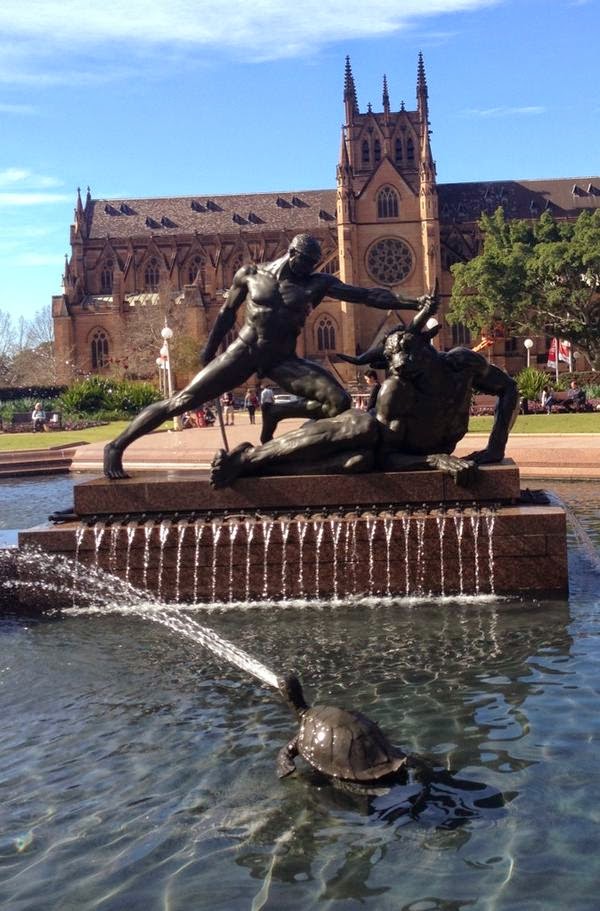
After writing The Mascherari, I took a visit to Hyde Park, in Sydney.
Unlike the glorious Italian mazes, Hyde Park is no labyrinth but it adjoins St Mary's Cathedral. In front of the cathedral is Archibald Fountain. Designed by French artist, François-Léon Sicard, and completed in 1926, it is a lavish fountain graced by three statues.

Two of these made me smile.

One is a statue of the Goddess Diana holding a bow. The other depicts Theseus slaying the Minotaur.

They were perfect.


More reading:

Rigoglioso, Marguerite, "The Oldest Labyrinth in the World? The Polyphemus Cave Painting." Caerdroia - The Journal of Mazes and Labyrinths. Volume 29, (1998):  pp 14-22. 


Wednesday, July 16, 2014

The Mascherari - Magdalena


In The Mascherari, my protagonist, Antonio da Parma, is haunted by visions of a beautiful and mysterious woman. Her name is Magdalena. For months after completing the novel, I pondered over Magdalena's features and over who I could best use to illustrate the raw quality of her beauty. I was pleasantly surprised when I chanced upon a photo of a long admired actress with an Italian origin.

Here it is, then; a portrait of Magdalena on canvas. It is based on a dark-haired version of the young Ornella Muti. She is perfect.


Chapter One


     Journal of Antonio da Parma

     He dreams on a gondola as it glides in silence.  Sound asleep, he lies, beneath a fiery dawn, while the palace’s Eastern wing rises above, and casts golden shadows upon his face.
     This is how I may have appeared to my guide as I drifted off, while he strained with the oar, drawing us closer to the Ducal stones, closer, beneath the towering Campanile, closer to this monstrous Republic of galleys with its islands and canals, into the heart of this lagoon fortress gilded by the sun’s first rays, and past her mansions of Istrian stone, whose glorious facades looked on, across a sea of silk and glistening foam.
     Curious, isn’t it?  How I saw her.
     I would see her differently now.
     Daughter of Venus, Venezia, you rose from nothingness. The memory of you…
     How could this not be my first diary entry?  For it was that day, as I arrived in Venezia, that I experienced my first vision.
     She was standing on the Rialto Bridge.  I write, standing, but now that I remember–and it is hard to recall after all that has transpired since–I think, yes... I think she was floating.  I swear that I never once saw her feet touch the ground.   I remember the fluttering hem of her gown and the way it thinned into a vaporous mist. I remember that I crossed myself and whispered the names of the saints upon seeing her face for the first time.
     She stood alone. She was watching me.
     And I, I saw only her.
     She seemed to have eluded the vanity of Venetian women.  Perhaps she did not live in our times. She cared not for the blonde locks they coveted, had not shaved her forehead in the new fashion, and wore no silk, nor jewelry.  Her hair–I crossed myself again–for it was night, and her black locks were like the manes of a strega; insolence upon her shoulders.
     Oh, the dark beauty of that face.
     I saw, even from afar, the longing eyes beneath their sultry lashes and the parting of her lips as she whispered.  She resembled those Southern women or perhaps those forbidden beauties of Constantinople into whose eyes one dares not stare too long, for fear of some lurking evil.
     It struck me at this instant. I ignore how, it struck me that this woman was a harbinger of some fateful event, one that I was soon to encounter, here, in Venezia.
     The sun rose, filtering light through the rios, casting flames upon her black hair. My gondolier’s vessel meandered through the lagoon.  Light shone on the Canal Grande.
     Still in dream, I gazed at her form but she drew away. No, she floated away, vanishing to the other side of the bridge. And as the morning rays bathed Rialto Market, not a trace of her remained.
     The loss of her wounded me.  Abandoned by the unsettling vision, I rose from my slumber.  I awoke to the stern Ducal Palace looming over our gondola.  It lay still.  As silent as its secrets.
     Later that morning, I spoke of my vision to Almoro Donato, member of the Consiglio dei Dieci.  He told me what I did not want to hear.
     “Antonio. Antonio, you grieve, my friend. But it must end. Yes, don’t you see? You must find a new wife, si?  With so much beauty in Venezia, a man like you—“
     “Basta.  I am already past the fourth decade. I care not for another wife.  It was not her I saw in the dream.  The woman, there was something about her—”
     But he interrupted me.  I think he has studied me carefully over the years. I suppose his position demanded it.  It was under his recommendations that Venezia had appointed me, a Florentine, for the second time. The Consiglio dei Dieci had a well-earned reputation for respecting nobody’s secrets and my employer was a master spy.  He gave me that look of wariness, that short disapproving glare which I remembered from years before.
     “Ah, Antonio, see how you drift again. Your preoccupations always lead you into visions. But remember your place, avogadore.  I will ask you to prepare for your future role within the commune, yes? We will have none of that in the Republic, will we?”
     He looked at me again.
     “Will we, Antonio?”
     I may have shrugged my shoulders, but the foreboding manner of his words taunted me, even then.
     As we crossed inside the palace’s entrance hall, I waved away my unpleasant feelings. I cast aside my dream.  Already Venezia tugged at my soul but I attributed my ill-feeling to his sermon.
     “Tommaso Mocenigo is very ill,” he explained, gesturing gravely toward the Doge apartments to our left. “He has been confined to bed for weeks already. When the New Year commences next March, do not be surprised if the patricians are called upon to appoint a new Doge. It is not known how many months Tommaso has to live but I feel his time is near.  And between you and me,” he whispered, “our young procurator, Francesco Foscari, would want this time to be nearer still.” He cleared his throat. “Antonio, the Consiglio would prefer it if you remained in Venezia until then.”
     I started. “Until March?”
     His eyes narrowed. I understood that I had little choice.
     I calculated that I would remain in Venezia until at least the commencement of Lent.
     And the realization struck me.
     Carnivale is upon us; diabolic days where madness surges and unfolds, unrelenting. Where the masses of Venezia, the popolani, forget themselves into debauchery and descend ever deeply into the odious core of their fettered being.  Carnivale, a season of obscene songs and erotic dance, when the masked rival for attention while making believe they are free.
     I never long so dearly for the rolling hills and scented valleys of Tuscany as when I find myself in the Republic during the infernal period of Carnivale.
     I refrained from sharing my thoughts and moved inside the Consiglio dei Dieci gathering room for my briefing.
     It was after my visit to the palace, when my gondolier had led our boat through the nation of Santa Croce, that I encountered the first abomination.


***


Monday, June 16, 2014

Swimming In the Collective Consciousness with Wojciech Kilar


As writers - artists, often we are let loose; we become searchers; we seek, swept on an endless trail of letters, ideas, music and images.

We hunger for more, enraptured by our quest; we seem to find ourselves, again and again, within the subtle interconnections between what we have loved, what we love, and what we grow to love.

The memory of what we have loved is re-ignited with every new discovery that we make, and there is enlightenment in this reunion with our nature.

But later we find, that our nature is not our own. Because by some unexplained happenstance, we flit back, we return, time and time again, to those who have inspired us, and there, through some subconscious force, we are awakened by them. By their side, we come to create.

In this pattern, the face of our obsessions slowly surfaces, and with it, the ties that bind us to those who have made us, come to be revealed.  It becomes evident that in this web, this collective consciousness, we have a place; snug, we fit. And those we look up to, are close, much closer than we could ever imagine.

Do you often experience this? As a writer? When all the stories, ideas, artwork, cinema or music that you have loved, and whose essence have shaped you, are somehow woven by the same thread. That everything you admire or that fascinates you, is related; magically.  That the more you look into these, the more you see that those obsessions are tightly bound.  That they have, not just one, not two, but numerous links between them, and that when all those inspirations are laid out, that you fit, in there, at the very center.

When you discover this center, you are surprised to discover that it is not yours alone. Your origin, those individuals whose art has imbued your psyche - you commune with them. They are there, by your side.

As a child, how I loved Jacques Prévert's and Paul Grimault's Le Roi et L'Oiseau. This 1980 French animation sets Hans Christian Andersen's The Shepherdess and the Chimney Sweep within a dystopian kingdom, ruled by a narcissistic despot.


It is the story of two fated lovers, who must try to save their relationship from the tyranny of a king enamored of the shepherdess. The surreal intrigue is compounded by the fact that it is the king's portrait who, having emerged from his own canvas and sent the real king to the dungeons, sets off a ruthless chase for the Shepherdess and the Chimney Sweep.

With the help of my favorite character, L'Oiseau - a gregarious and anti-authoritarian mockingbird who protects them at every turn - the couple flee through the canal city, a world reminiscent of a sci-fi Venice, where they are chased by a black-clad, sbirri-like secret police.


This animation, which borders between lyricism and social satire, was the joy of my childhood. It is deep, with levels that I am still discovering. Its imagery often evokes Salvador Dali landscapes, where unbearable emptiness stretches across intricate details of spires, bell towers, endless steps and mechanical contraptions, stirring with it, paranoia and anxiety. To think that Salvador Dali has been my favorite artist since my mid teens.

There is much to like about this surrealistic masterpiece of French cinema.  As an aside, my favorite scene takes place in a cell where the Chimney Sweep has been imprisoned by the King's men, and is about to be devoured by a pack of lions.  Seeing this, the mockingbird urges his fellow cell mate, a blind musician, born in an underground subculture and who has never seen the sun, to play a happy tune with his accordion so as to distract the lions. And so the music plays on.

But the mockingbird, a master storyteller, and fluent in several languages (including "Lion"!) has a plan.  As part of the 'entertainment', and still accompanied by the happy ballad of the blind accordion player, the mockingbird begins to recount the poor Chimney Sweep's tragic love story to the hungry felines. Together with sound effects, and heightened pathos, the bird tailors the story to match the lions' interests, until the beasts' indignation towards the King reaches a climax. They force open the cage and free all the prisoners, before marching towards the tyrant.

That's the Bird. Protector and Catalyst...


But the real jewel of Le Roi et L'Oiseau, and the soul of this post, is the astounding soundtrack, by Polish composer, Wojciech Kilar. His wonderful music is in my bones. It is part of me, just as Le Roi et L'Oiseau has seeped deep into my psyche.

Wojciech Kilar returns again, later in my life, as the composer for Francis Ford Coppola's Bram Stoker's Dracula (1992) and later, he brings his dark arts to Roman Polanski's The Ninth Gate (2000).

The Ninth Gate, a film based on the novel adaption of The Club Dumas, has been a vivid inspiration for my upcoming novel, The Mascherari. I remember watching the film and feeling irrevocably drawn to it, believing that I had always known it. It's a strange feeling that one. Then again, perhaps it is Kilar's music which holds the key to my memory.

Reflecting on The Mascherari, if I were to look into the face of Venice, in the manner I have drawn it, with The Council of Ten's shadow looming over my protagonist, with its secret police- its sbirri, at every turn, I come face to face with the menace I remember in Le Roi et L'Oiseau.  In my creation, I return to what I have known, and through this, I remember that Wojciech Kilar's haunting notes are never far.

Thank you Mr Kilar, for the music and for the inspiration.

Wojciech Kilar died in 29 December 2013. But his music lives on. 


Tuesday, June 10, 2014

The Mascherari - Left-Handers and Witches

I was born and raised a Roman Catholic, and in my teens, I attended a private Catholic school which had as its patron saint, a renown inquisitor of the name, Saint Dominic.

My school was not too strict but I do remember an incident that had me reconsider.  You must know that as a teenager, I was quite fond of reading out Tarot cards.

Ok, let's just let it all hang out, once and for all. I was, in fact, ruthlessly pagan.  I practiced anything, from graphology, palmistry, tarot card readings to astrology and numerology.  We didn't have the internet in those days - that is, no online apps that could automatically spit out charts upon entry of a birth date and time - I had to contend with a planetary almanac and my calculator, so that I could use my formidable mathematics skills (I did, in fact, top maths in my school) in order to map out my friends' and family members' astrological charts.

So that was me, outside school and homework. Wicked.

My Tarot 'self ' for my many Tarot readings.

And then The incident happened. One day, I was sitting with a couple of friends, in a dark corner of the school library. I began to lay out my Tarot cards (I had a Marseille pack) and to read out what I could of my friends' fortunes.  Little did I know that the librarian had spotted me. She at once began to scream and shoo me out of the library, telling me that I was a wicked girl, and that these cards were against the Christian religion, and that I was SINNING. Bla bla bla.

That was in 1991.

I can only let you imagine the illumination I felt later, at the age of 20, when I devoured Zoe Oldenbourg's magnificent, Massacre at Montségur, and came face to face with the injustice of the Cathar persecution, including, at the hands of Saint Dominic himself.

It seems, that during my school years, I had sided with the wrong guy by association, and I did not even know it! The tragedy...

Dominic (with a halo) and other Cistercian abbots 
crush helpless Cathars underfoot. As you do.


Sometimes things just click into place.

Writing my second novel, The Mascherari was immensely pleasurable. It was my opportunity to dive fearlessly into pursuits that have always been second nature to me, without guilt, without shame.  The Mascherari is a historical novel set in 1422 Venice.  It takes place between the Winter Solstice and La Befana.

While most of the research was historical, and had me delve into all aspects of Venetian society during the early 15th century, a certain component of the research covered esoteric subjects - like Tarot reading, the phases of the moon, Italian Stregheria, magical amulets, and even old Roman cults.


Today, I am pleased to announce that The Mascherari will be released on 13 August 2014, to coincide with International Left Handers Day.

I chose this date for several reasons.

In ancient and medieval times, in many parts of the world, left-handed people were traditionally associated with witchcraft and an evil nature.  The Catholic Church itself declared that left-handers were servants of the devil.  Such people would be sent to the bonfire. As it turns out, Joan of Arc’s supposed left-handedness was one of the justifications (among a few) that were employed to brand her a witch, until she was burnt at the stake.

In Italian, the word for left is 'sinistra', while in Latin, the word for Left-handed is 'sinestra'. Both words provide the root for our modern word, 'sinister', and I certainly hope my readers will enjoy a little of the sinister in The Mascherari.

13 August is perfect for another reason.

Not only is The Mascherari's author left-handed (and possibly a witch!) but 13 August, long before being declared International Left Handers Day in 1976, also happened to be, for centuries, the Feast Day of the Goddess Diana.

Just think. Diana is the Queen of all witches.

I wonder if the individuals who settled on 13 August as Left Handers Day were perfectly aware of the significance of this date when they chose it.  I have often speculated on whether their act was a perverted endorsement of the age old accusations of witchcraft laid upon left-handed people. "Yes, actually, we are all witches. You were right all along."

Hell, I'd go with that.

Monday, May 12, 2014

Renaissance Man


Do you often meet people who defy categorization? Those whose interests and talents are so varied that they baffle the mind? Most humans are so fond of classifying one another that they often find it strange, and even stupefying, when one of them seems to excel at a multitude of disciplines.

In some circles, we jokingly label these people, freaks. A more sober qualification might be, 'polymath'. If they reach world renown and professional recognition, we label them geniuses.

You may be familiar with What's My Line, in which contestants are blind folded and have to arrive at the identity of a guest after this one answers a series of questions about their abilities and achievements.  In one particular episode, the contestants were confronted with a most puzzling personality to identify.


For each discipline in which the personality was asked if they had achieved, the response was affirmative. The contestants grew increasingly more confused given their inability to easily associate the guest with a unique dimension of excellence.

"Is there anything this man has not done?" cried one of them, in gentle exasperation.

The personality of course, is Salvador Dali.

Is Dali the only personality with such multi-faceted talents? I do not believe so. I think the majority of individuals are capable of tremendous range, if and only if, they do not limit themselves cognitively into believing that they have found their niche. Self-categorization, or rather, the lack of, is in fact, what I believe is a defining factor of geniuses.

[Self-promotion alert] While writing my novel, The Mascherari, I have been on a glorious trip to 15th century Venice. I want to bring attention to one of the geniuses I met there.  Given the gender biases of the time, the terminology for describing these 'geniuses' revolves around men. And as the title of this post indicates, these multi-disciplinary freaks were then called, Renaissance Men.

There is something elegant and uplifting about being called a Renaissance Man, especially when one happens to be extremely handsome to boot. Leone Battista Alberti was one handsome man, as you can see from this statue of him located in Florence.


He was born Battista Alberti. Later, he changed his name to "Leone".  I ought to mention his birth date, 14 February 1404. Advocates of astrology will have probably noticed that Alberti was an Aquarian.

Hold that thought.

Fans of Leonardo da Vinci will also note that Alberti was several years da Vinci's senior. In fact, he is the bona fide early Renaissance Man, and was equaled to none, except da Vinci.

I believe that geniuses have a cognitive advantage. I do not mean that exclusively in the neurological sense. Their primary advantage is that they have an inherent belief that they can do anything if they set their minds to it. As it turns out, Alberti is credited with the following empowering quote,

"A man can do all things if he but wills them."

So why is this guy so special anyway?

Alberti was known as the prototype of a 'universal man'. His breadth of knowledge is truly remarkable. He was at ease in the fields of philosophy, mathematics, science, classical learning, and the arts. He wrote pamphlets or treatises on ethics, love, religion, sociology, law, mathematics, and different branches of the natural sciences. He also wrote verses which demonstrated his aptitude for the Classics. In the arts, he was versed in painting, sculpture, and architecture.

Painting
Alberti could paint and was a good artist however none of his paintings unfortunately survive.

Classical and Law education
Alberti, or should I say, Dr Alberti, was educated at the University of Bologna, where at the age of 24, he acquired a Doctorate in Canon law.

Writing
It is said that writings poured out of Alberti, in both Latin and the Vernacular languages of Italy. Alberti scripted and wrote many love poems, fables, Latin comedy and dialogues. He wrote treatises on sculpture, agriculture, law and a host of technical subjects.

He once wrote a ten-book treatise on the technical nature of how a city should be structured (Brisbane, take note). He detailed how water should be properly channeled, how work sites should be constructed, the types of materials to be used and the different kinds of buildings that should be positioned in suitable and ideal locations.

Sounds boring? Wait, there's more.

In 1435, Alberti wrote what is known as the first book on perspective. His book, De Pictura (On Painting), sets out rules for drawing a three-dimensional picture on a two-dimensional surface. Basing himself on the principles of perspective that had been demonstrated by Filippo Brunelleschi, Leon Battista Alberti produced a book that would later guide dozens of Renaissance artists in the creation of more realistic, perspectival artwork.

Music
Alberti composed music and was a reputed organist.

Astronomy, Cartography and Geography
Alberti produced a treatise on geography that laid out the rules for surveying and mapping a land area.  The instruments and methods he described pre-dated later geographical depictions of the 15th and 16th centuries which are noted for their advances in accuracy.

Architecture
Despite having had no formal architectural education, Leon Battista Alberti was known as the Father of Modern Architecture. He was the principal initiator of Renaissance art theory.
Among his work, he completed the Pitti Palace, the Temple of Malatesta at Rimini and the Church of Sant’ Andrea.  Before its later renovation, Alberti was commissioned to design the first Trevi Fountain in Rome.


Since I am particularly clueless in Music and Architecture, none of this excites me as much as what follows.

Cryptology and Mathematics
Remember - I mentioned that Alberti was an Aquarian, and Aquarians are traditionally known for their cutting-edge, technical minds. Given Alberti's impressive portfolio in various technical fields, it should be readily evident that, for once, astrology seems uncannily spot on in describing its subject.

But it is in the field of cryptology that Alberti truly shines as an Aquarian specimen. Here, we find the summit of his technical mastery and visionary mind. In our modern information technology age, we take for granted that technology can obfuscate our messages and encrypt our passwords, without paying so much attention to it. Consider, then, that long before the advent of computers, Alberti developed a type of cipher to which most of today’s systems of cryptography belong, and which is known as polyalphabetic substitution. It was called the Alberti cipher.
It turns out that Alberti is known today as the Father of Western Cryptology.

Brains are sexy. But men with secrets, even more so!

Secrets of the Vatican
Alberti had, since his twenties, been appointed to an ecclesiastic post and worked many years for the Vatican. One of his friends was pontifical secretary, Leonardo Dato. It has long been believed that it was Dato who spurred Alberti’s interest in cryptology.  At the time, both the Vatican and the Venice Republic were dabblers in secret communication inasmuch as they also engaged in intercepting and deciphering foreign messages.  Decipherers were employed both in the Vatican and in the Venice Republic - two cities which incidentally hold impressive archives (the Vatican has the largest archive in the Western world and Venice is not far behind.)

According to cryptology historian, David Kahn, Alberti was strolling in the Vatican gardens with Dato (what on earth were they doing), when this one asked him, “You’ve always been interested in these secrets of nature. What do you think of these decipherers? Have you tried your hand at it as much as you know how to?”
Alberti smiled. Alberti already knew that Dato’s duties included ciphers, yet he replied as though he ignored it, “You’re the head of the papal secretariat. Could it be that you had to use these things a few times in matters of great importance to His Holiness?”
“That’s why I brought it up,” replied Dato. “And because of the post I have, I want to be able to do it myself without having to use outside interpreters. For when they bring me letters in ciphers interpreted by spies, it’s no joking matter. So please – if you’ve thought up any new ideas having to do with this business, tell me about them.”

And this exchange is supposedly what enticed Alberti to deliver a cipher treatise around the age of 63. Think of it as an off-the-shelf cipher tool complete with a set of revolving discs which Signore Dato could play with to his heart's content.

New - Alberti Gadget

Ta da! Just like that, out of the blue. Unless...

Genius in the Making
What struck me about Alberti’s conversation with Dato, is that our Renaissance man already knew of Dato’s ciphering activities long before Dato admitted to them. To me, this awareness hints to Alberti’s inherent interest in matters of ciphering (just hanging around the Vatican would do that to you, I reckon).  Alberti’s attraction to solving problems, and to mathematics in general, arose long before he ever knew Dato, back when he was a twenty year old law student.  In those days, he used to find mathematics relaxing and even mentioned that it was a welcome break from studying law, which he said, taxed his memory.

Merging these ideas together, and working on the premise that one’s great work later in life often sprouts from seeds sown when one is much younger, I speculated at length on Leone Battista Alberti’s early life.


The Lost Years
Leone Battista Alberti appears briefly in my novel, The Mascherari. I wanted to pay homage to a man who, while born a wealthy banker’s son (the Alberti bank was known in the 14th century as greatly contributing to Florence’s wealth), flatly refused to work in banking, and focused instead on contributing to humanity in various fields. I also wanted to speculate on a challenging period in his life - a period where he lost his father, lost his inheritance to his uncle, and suffered illness even while studying.

What did Alberti do to survive during this time?

The Mascherari is set in 1422, at a time when Alberti was only 18 years old. That may seem young, but it did not stop me from advancing some bold theories about our 'universal' err, young man...

After all, with a genius of his caliber, anything may have been possible.


Aquarians and other geeks can delve into David Kahn's The Codebreakers: The Comprehensive History of Secret Communication. 


Friday, March 28, 2014

The Mascherari - A Novel of Venice


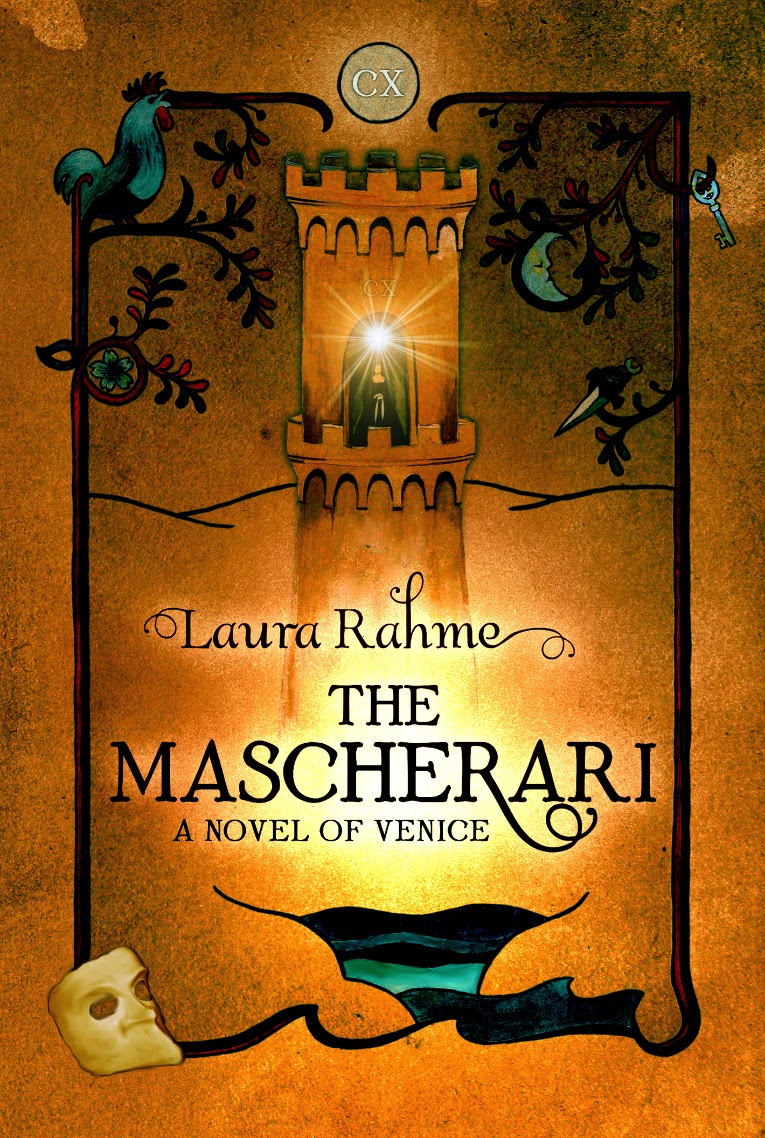
A ravishing cover for a story that is very dear to me. I really hope you like it. 

The elements you see - from the intricate medieval border, to the tower, the dark moon, and the lady with the mysterious light - all hold a meaning that is essential to my upcoming novel, The Mascherari.

For this historical mystery set in 15th century Venice, I was wary of infusing the cover with symbols that have become synonymous with romantic tourism and post-Napoleonic Venice. 

And so I shunned - the canals, the cliche gondolas, the masked carnival revelers, the Piazza, the Basilica of San Marco - all that was readily associated with what we know of Venetian tourism today. While these do feature in my story and were certainly present in the 15th century, I preferred to delve deeper.  So I sought new symbols from those that have been lost to history or have been absent from modern media images of Venice.

With the medieval-inspired imagery, I hoped to conjure a period of Venice that preceded the times of Casanova. 

A mask is portrayed, but it is not prominent. It is a traditional bauta, one of the most common masks from the period. As for the city's lagoon, it is hinted to with just a blue patch of water beneath the cover title.

It will be difficult to expand on the historical meaning of each symbol without revealing too much of the story...so I will look at color only.

Why the gold? 

The original image (not shown), with its pale parchment and light coloring is even more suited to 15th century Venice, but it does not lend itself well to ebook covers. In print, it would look fabulous, so I will preserve it for the Paperback version of the novel. 

I reviewed three versions of the ebook cover before settling on the gold. I loved the green version, which is shown below. 


To me, this dark green held a nauseating and malevolent quality, reminiscent of the evil in the narrative. I also thought it evoked what some authors have described as the Venetian 'miasma' - this fetid air that remains suspended over the lagoon on humid days and from which even Lord Byron was thought to have suffered. 
But the best part of the green, if you do read the story, is that it evokes the emotions of envy and jealousy. How very apt, I thought. 

For now though, I decided on the gold. While also being relevant to aspects of the novel, the gold is vivid, eye-catching and therefore more likely to attract attention in the online sphere. This is an important consideration for a self-publishing author especially when there are so many gorgeous outstanding covers out there.

One last detail...
Engraved on the tower and the hovering moon, are two letters. Shall I tell you what they stand for? Or perhaps you already know.