Showing posts with label writing. Show all posts

Sunday, June 6, 2021

Le Secret de Chantilly : le roman d'Antonin Carême

Je suis heureuse d'annoncer la parution, cet été, de mon roman historique, Le Secret de Chantilly. 

Dans Le Secret de Chantilly, le cuisinier Marie-Antoine Carême nous livre son conte de fées à travers larmes, joies, sortilèges, châteaux, pâtisseries, une touche de scandale, et toujours ce regard sur le prince de Talleyrand.

Personnage énigmatique, qui m'a tenue compagnie pendant si longtemps, Talleyrand prend vie dans ce roman où il joue un rôle principal, sans toutefois perdre de son mystique, nous laissant deviner jusqu'à la fin.

Née de mon grand amour pour la France et pour ce précieux don de l'amitié, c'est une histoire qui célèbre deux génies français : un cuisinier et un homme d'État.  Je l'avais d'abord écrite en Anglais avant de comprendre qu'il me fallait absolument une version française. Les deux romans sortiront à quelque mois près, cette année. 

Je voudrais remercier le graphiste, Ross Robinson, pour le voyage que nous avons entrepris ensemble pour réaliser cette couverture qui incarne l'essence même de cette histoire. D'abord un fond de blanc - telle une nappe, tel l'immaculé de l'oubli, le blanc d'une toque ou de la merveilleuse crème Chantilly ; ce petit bouquet dont même les tons lilas sont symboliques de l'intrigue ; et enfin, ces filigranes et polices dorées qui ensemble reflètent le milieu où Marie-Antoine Carême évolue, et qui inspirent la magie d'une vie sans pareille, tel un véritable conte de fées.


Saturday, December 19, 2020

Calista - my first horror novel


When my mother was pregnant with me and living in Senegal, her favorite thing to do was head to the cinema and watch a horror movie. I often joke and tell her, while feigning admonishment, that the horrors she experienced as she rode on waves of suspense and scares would have chemically passed to me, her vulnerable foetus. In what drugged state would I have existed, I wonder, as I floated about in that cushy womb, dreading another traumatic rush of adrenaline... Would I have become as addicted as she was? Would I have ached for similar thrills in my youth to compensate for the loss of this potent mix of chemicals? And was this perhaps the reason why as a young child, I was fascinated by the macabre and why as early as four years of age, I sat quietly with my mum and grandmother, watching supernatural horror movies like The Entity and Audrey Rose? Mind you, I was not spared the ensuing nightmares, but then again, what we love is not necessarily good for us.

Years later, I married a horror screenwriter and while I know from observing him and his many horror filmmaker friends, that horror writers are the sweetest people on earth – counterintuitive but true – I also knew that it would be just a matter of time until I'd try my hand at a wicked tale. (Because I'm also very sweet like that.)

Sheridan Le Fanu, Arthur Machen, Charlotte Dacre, Stephen King, Mary Shelley, Anne Rice, Daphne du Maurier and Wilkie Collins, are writers I admire in the suspense/horror genre. I'm a lover of atmosphere and ambiguity so these authors have been my go-to for gaining inspiration and for that general feeling of, "whoa, I want to write like that". Apart from Stephen King and to a degree, Anne Rice, their material is also delightfully old-fashioned which suits my historical novelist bend. I also love nasty women in novels. My greatest scare in this department is still Madame de la Rougiere in Uncle Silas but Wilkie Collins and Charlotte Dacre have nothing to envy. 


For almost two years, I had been wanting to write a novel about a certain [secret] topic that is dear to me. It was my novel XX. I didn't know what it would be about but I knew it had to feature that topic.

While in Greece this year, a horror story came to me and suddenly it made so much sense to merge this wicked tale with my topic of choice, that I wondered why I hadn't thought of it earlier. So you could say that I decided then and there to write a horror novel as a vehicle for my pet topic. I'm really happy to have made that decision. (And Greece was fun too.) 

But when should it be set? And where? I looked up a period of Greek history that is distinct for its political situation, and decided based on this research that my novel would be set after the Greek War of Independence, and – due to some other logistic details that I will not reveal – well before 1853. I settled on the period between 1836 and 1850. This historical horror novel would take place in both England and Greece; a Victorian novel with a Greek influence!

I titled it, CALISTA, like my female character.

I've just about completed the first draft. It is shorter than all my other novels and definitely shorter than my debut novel, The Ming Storytellers which totalled at 610+ pages. For Calista, I had initially envisaged a novella but there was so much I wished to say that I realised it couldn't be less than 50k words. So a novel it is. 

I will be launching a cover early in the year but in the meantime, I'm loving this creepy experience. I'm right back in that womb, so to speak, the hormones are rushing in, and I've a devilish smile on my face.

See you next year.


Wednesday, June 10, 2020

Le Secret de Chantilly - Antonin Carême et Grimod de la Reynière


Alexandre Balthasar Grimod de la Reynière, cet aristocrate mal aimé de ses parents qui au temps de Napoléon, devint le premier critique gastronomique. Il publia des almanachs allant jusqu'à influencer la consommation des bourgeois dans tout l'Empire ainsi que celle des touristes Anglais.

Dans mon livre, Le Secret de Chantilly, il en fait voir bien des couleurs au jeune chef pâtissier, Antonin Carême. Informée par mes recherches, j'ai construit la psychologie de ce critique gourmand souffrant d'une difformité jugée impardonnable aux mains, et qui pour Carême, était bien l'ogre formidable dans son conte de fées imaginé. Même aujourd'hui, il faut le dire, les critiques sont souvent la terreur des artistes. 

Je travaille toujours sur la traduction de mon livre en Français, mais je voulais partager ce court extrait qui m'a beaucoup divertie car en l'écrivant, j'ai puisé dans mes expériences. Dans ma vie, je n'ai pas toujours su me défendre et parer la méchanceté quand elle était dirigée vers moi. Même si mon personnage préféré dans Le Secret de Chantilly reste toujours celui de Talleyrand, c'est le comportement de Carême qui reste pour moi plus familier.  

Alors allons-y,  à l'époque, la rue de la Paix s'appelait rue Napoléon...


Rue Napoléon


 C'était Grimod de la Reynière.

   « Monsieur Carême, lança-t-il en sortant ce cahier qu'il trainait partout sur lui. Je dois vous féliciter pour vos croquants aux amandes. Ils sont exquis. Croustillant à perfection. On ne trouverait pas dans tout Paris de confiseries plus délicieuses.

  — Vous devriez essayer le Croquembouche à la Chantilly, monsieur de la Reynière », j’entonnai, surpris par son manque d'esprit acerbe à cette occasion.

Comme j’étais dupe.

   « J'ai bien peur d’être un fervent admirateur des pâtisseries de Rouget, et je n'ai en revanche pas pris grand goût à la votre qui me semble, comment dire... plutôt lourde.

   — Lourde ? Ma pâte feuilletée ?   Je restai sans voix. « Allons, allons. La vexation est indigne de tout pâtissier. Mais que vois-je ici ? » Il regarda avec étonnement les meringues que j'avais façonnées. C'étaient d'élégantes formes pastel disposées en pyramide sur mon comptoir de marbre – en vert, en rose, et même des meringues violettes. Elles étaient magnifiques près de ma collection de petits fours.

  Je le vis inspecter les contours de chaque meringue et je m’en félicitais. Pour la première fois, je dévoilais ma dernière invention. Je ne m’encombrais plus de cet usage limité qu’était la cuillère pour former mes meringues. Celle-ci engendrait souvent des biscuits rocheux, et sans raffinement. Je les canalisais à présent. C'était révolutionnaire. Les panneaux de glace reflétaient l'ensemble de mon affichage, produisant un spectacle de lumières et de couleurs. De la Reynière prit des notes dans son journal. Je souris. J'avais alors oublié ses remarques précédentes sur ma pâte feuilletée.

  Je m’aventurai, soucieux de voir ma belle pâtisserie répertoriée dans sa liste d'établissements recommandés.

   « Vous préparez une entrée pour votre prochain almanach ? je m’entendis dire.


    — Il se peut, monsieur Carême. C’est fort possible. Je compile mon deuxième almanach que je publierai sous peu. Pourriez-vous me livrer une dizaine de ces meringues pour une prochaine session du Jury Dégustateur ? Mardi prochain ou peut-être le mardi suivant. Vous devrez effectuer la livraison avant quatre heures de l'après-midi au 8 avenue des Champs-Élysées. Je verrai ce que mes invités en pensent. »


   Il avait prononcé tout cela avec une arrogante attente. Il savait très bien que je ne pouvais pas refuser, car je serais tout de suite qualifié de désagréable, et exclu de toute mention dans son almanach. Et tout cela si ma boutique n'était pas d’abord salie à jamais par ses critiques meurtrières.

   « Certainement, monsieur De la Reynière. Et aimeriez-vous que je vous livre un assortiment de petits-fours ? » J'avais perfectionné ma crème aux violettes et pensais que lui et son jury l'apprécieraient.

  « Je ne peux pas dire que je m’enthousiasme pour votre pâtisserie, Carême », répéta-t-il en examinant la boutique et prenant note du décor.

   À ce moment, je sentis mon ressentiment bouillonner. Je me retrouvais piégé par un homme qui pouvait facilement ruiner ma réputation avec ses écrits. Mais je me contenais, luttant pour ne rien révéler de mes sentiments.

   Mais De la Reynière n’avait pas fini. Soudain, après un long contrôle de la boutique, il se tourna vers moi avec un regard suspect et, quelque peu perplexe, il porta le coup final.

   « Dites-moi, monsieur Carême, comment un garçon comme vous, venu de rien, arrive-t-il subitement sur la rue Napoléon ? Je trouve ça plutôt étrange.

   — Comment étrange ? Monsieur de la Reynière, je travaille la pâtisserie depuis cinq ans. J'ai travaillé six ans avant cela…

   — Oui, on me l’apprit. Dans une gargote.

  — M. Boucher de chez M. de Talleyrand ne m'aurait pas employé s'il ne m’en jugeait pas digne, rétorquai-je, sentant le sang rougir mes joues.

   — On voudrait le croire ! »

   Il semblait se moquer de moi à chaque mot.

  « N’allons pas prétendre, monsieur Carême, que monsieur de Talleyrand n'a rien à voir avec l'investissement dans votre boutique. Vous êtes tout simplement un jeune homme très chanceux. »

   Il me dévisagea avec une insolence insupportable.

  « Pourtant, je me demande ce qu'un homme de votre milieu pourrait jamais apporter à une gastronomie vieille de plusieurs centaines d'années et qui existe depuis des siècles dans des cercles beaucoup plus élevés. Comprenez-vous le sens de mes paroles ? Ce n'est pas dans une gargote que se fait la gastronomie.

  — C'est vrai, mais… j'ai étudié avec de grands pâtissiers, monsieur. J'ai appris plein… » Ma voix traîna. J'eus l'impression d'étouffer et aucun mot ne vint. Peut-être que De la Reynière avait raison.

   Il vit alors que je vacillais et que je n'étais pas fait pour ça. Cette fine repartie d'esprit en plein débat houleux – c'était son domaine. Il semblait gagner en confiance à chaque signe de doute qu'il voyait gravé sur mon visage.

  « Vous savez, monsieur Carême, je me demande encore pourquoi Talleyrand vous aiderait pour financer cette pâtisserie. C'est assez déroutant. Un homme comme Talleyrand est à peine connu pour son altruisme. On pourrait penser que vous étiez le talent que tout Paris dit que vous êtes ! Mais franchement, je ne le vois pas. »


Wednesday, May 20, 2020

Le Secret de Chantilly - Antonin Carême rencontre Boucher


Depuis plusieurs jours, je travaille sur la traduction de mon roman, Le Secret de Chantilly. Mi-conte, mi-roman historique, ce livre se base sur la vie du célèbre chef, Antonin Carême et sa relation avec l'énigmatique Talleyrand.

C'est merveilleux pour moi de voir cette histoire - qui d'ailleurs est bien Française, même si elle a été originalement conçue en anglais - prendre une toute nouvelle forme. Petit à petit, je découvre mes personnages pour la première fois, comme si le fait de leur rendre leur langue maternelle leur redonnait vie.

L'un de mes personnages préférés, c'est Boucher, le maitre d'hôtel de Talleyrand. Dans ce passage, qui est l'un de mes préférés, Antonin qui a seize ans rencontre Boucher pour la première fois.

Note: Pour l'instant la ponctuation suit les règles de dialogue anglais.

Un après-midi, alors que je me dirigeais chez M. Rose, Avice vint me trouver en disant :
  « Antonin, l’un de nos clients les plus estimés voudrait te voir. Il est dehors, près de la diligence. Tu dois aller lui parler tout de suite.
  — Maintenant ?
 — Oui, oui, dit Avice. Ne lui fais pas attendre. Il représente notre client le plus important. »
  Je me précipitai hors de Bailly, encore revêtu de mon tablier. Je vis un homme dans la quarantaine avec un visage rond et doux et une perruque poudrée. Je le reconnus pour l’avoir aperçu à plusieurs reprises auparavant, commandant des gâteaux pour des banquets ministériels. 
  C'était la première fois que j’avais l’occasion d’examiner ses vêtements de près. Sa chemise de lin était d’un tissage exquis, et une cravate blanche épousait son cou avec élégance. Avice n'avait pas menti; l'homme portait des chaussures à boucles et une longue veste mauve satinée. Il sentait la lavande et avait un air soigné comme je n'en avais jamais vu, même parmi les bourgeois qui accourraient régulièrement chez Bailly.
   « Monsieur Carême, me dit-il en s'approchant. Vous êtes bien le jeune homme qui livre des pâtisseries au Palais Royal ?
  — Oui. Oui, c'est moi. » J'essuyai mes mains sur mon tablier, l'air un peu déplacé. Je n'avais pas la moindre idée qui était cet homme ou ce qu’il voulait. Il semblait revenir d'une autre époque. Les gens portaient-ils encore ces culottes et ces bas de soie ?
  « Monsieur Avice me dit que vous vous dirigez vers vos cours de pâtisserie.
  — Oui monsieur, c'est sur rue Grange-Batelière.
  — Je marcherai avec vous », répondit l'étranger d’une voix aimable.
  Ses paroles s’écoulaient agréablement comme s'il fréquentait des nobles ou en était lui-même un des leurs.  Mille questions me traversaient la tête en remontant la rue Vivienne.
  « J'aime votre travail, monsieur Carême. Il me semble prometteur.
  — Merci monsieur ... monsieur ... »
  Il avait fait preuve d'un tel effacement, malgré son rang, qu'il ne s'était même pas encore présenté.
  « Boucheseiche, répondit-il. Vos pâtisseries – elles sont beaucoup plus légères que dans de nombreux établissements parisiens. Je l'ai tout de suite remarqué. Je dirais que ce sont parmi les meilleurs auxquelles j’ai goûté. Certaines améliorations pourraient être adoptées, certes, mais pour la plupart, je suis très impressionné. Est-ce que vous savez qui je suis ?
  — Non, monsieur Boucheseiche.
  — Il fut un temps où je dirigeais les cuisines de Louis Joseph de Bourbon, prince de Condé. Oh, c'était il y a des années, bien avant les événements du 14 juillet. Beaucoup de choses ont changé depuis. Le prince ne réside plus dans son château à Chantilly. Il est à présent en Angleterre. Mais pour avoir servi la maison Condé, je suis en quelque sorte le successeur de Vatel. »
  Il avait parlé doucement et sans emphase, mais je restais stupéfait par ses paroles, et mon enthousiasme eut raison de moi.
  « François Vatel ! J'ai lu beaucoup de choses au sujet de ce maître d'hôtel ! Il a servi Nicolas Foucquet ! C’était un grand chef qui inventa la crème Chantilly. »
  Le regard de M. Boucheseiche tomba sur moi. Il semblait m’évaluer et prit un air grave pour un instant. Je retrouvai aussitôt mon calme :
  « Je veux dire heu... c'est tellement... intéressant, monsieur Boucheseiche.
 — Appelez-moi Boucher. Monsieur Carême, vous vous trompez. Vatel n'a jamais inventé la crème Chantilly.
  — Ah bon ? » Je me sentis rougir.
  « Mais non. Pas du tout. »
 Boucheseiche sourit à son tour. Un silence incommode suivit alors qu'il m'examinait. À quoi pensait-il ? Je devais avoir l'air d'un idiot.
  Il sortit de sa longue réflexion. Ses yeux bleus se posèrent tendrement sur moi :
  « Un jour, murmura-t-il, je vous révèlerais peut-être le secret de Chantilly. »
 Et avant que je puisse me remettre de cette étrange remarque, Boucheseiche prononça ces mots magiques :
  « Seriez-vous intéressé à travailler pour moi, monsieur Carême ? Je supervise des banquets pour une personne d’une haute importance. Le monde que je vous propose de rejoindre est plus grand que tout ce que vous connaissez. Mais… qu’y a-t-il ? Vous ne vous sentez pas bien ? »
 Je m’étais arrêté de marcher. Je ne pouvais plus respirer. Je regardais Boucheseiche comme s'il était une vision de rêve.
  « Pardonnez-moi, monsieur Boucheseiche.
  — Boucher, rappela-t-il.
 — Pardonnez-moi, monsieur Boucher. C’est que… je sens que cela ne peut pas m’arriver à moi. C'est presque… presque comme dans les contes de fées. »
  Il me contempla en silence avant de dire : 
  « N'est-ce pas ? » Il reprit de plus belle, « La révolution, monsieur Carême ! Nous vivons à une époque qui évolue si vite. Vous étiez garçon de courses il y a quelques années… Et maintenant ! Maintenant, vous êtes sur rue Vivienne, et on vous mande de venir travailler avec Boucheseiche venu droit de la grande Maison Condé. Oui, vous avez bien raison. C'est semblable un conte de fées. »
  Son visage prit alors un aspect mélancolique. 
 « Et pourtant, souvent, ajouta-t-il sa voix teintée de regret, même les plus beaux contes de fées connaissent une fin tragique. Monsieur Carême, j'étais autrefois à l’emploi d’une princesse qui possédait tout, tout ce que son cœur désirait, et ce qui lui arriva, je prie le ciel, ne frappera jamais même les plus vilains laquais. »
  Il se redressa avec autre sourire généreux. 
  « C'est peut-être un peu trop pour vous aujourd'hui. Je vous laisse réfléchir à mon offre. Je reviendrai un autre jour pour vous parler d'éventuelles conditions d'emploi. Il y a beaucoup à faire et cela va prendre du temps. Nous ne nous presserons pas. Après tout, l'homme que j’ai l’honneur de servir aime bien prendre son temps. Au revoir, monsieur Carême. »
  Toujours le soufflé coupé, je regardai le mystérieux Boucher rejoindre sa calèche, alors qu’il me laissait dans tous mes états devant le seuil de chez M. Rose. Mon cœur n'avait jamais battu aussi vite. Je transpirais d’émotion, et pour le reste de l’après-midi, tous mes efforts pour me concentrer sur les leçons de massepain de M. Rose furent en vain.
 J’appris le nom de la princesse à laquelle Boucher avait fait allusion. La malheureuse princesse de Lamballe avait été mutilée par une foule violente pendant l'une des périodes les plus sombres de la révolution. Elle qui avait été mariée à l'homme le plus riche de France, du jour au lendemain, sa fortune avait basculé.
  C'était ce que Boucher avait essayé de dire. Que la révolution avait tout changé. Tous les tournants du destin étaient possibles.
  Pourtant, je n’arrivais toujours pas à comprendre. Comment un garçon de cuisine sorti d’une gargote, près de la barrière du Maine pourrait-il travailler avec un homme comme Boucher qui avait jadis connu une princesse ? Comment pourrait-il être instruit par ce maître d'hôtel qui avait autrefois servi la maison Condé ?
  L’arrivée subite de Boucheseiche dans ma vie était comme un rêve devenu réalité. Il apparut devant chez Bailly quand je m'y attendais le moins. Sa première visite fut brève, mais elle me bouleversa pendant des mois. Après avoir livré son message, il disparut aussi soudainement.
 Je ne le reverrais que l'année suivante quand il me conseilla de changer de boutique et de travailler avec Gendron. De cette façon, expliqua-t-il, je détiendrai plus de temps libre et je deviendrai pâtissier libéral.
 Un pâtissier libéral ! Moi ? Les idées tourbillonnaient dans ma tête à la perspective de cette nouvelle profession.
 De nombreux contes de fées ont une marraine dotée de pouvoirs magiques. Cendrillon en avait une. La Belle au Bois Dormant en avait plusieurs. Ces personnes apparaissent quand on s’y attend le moins, agitant leur baguette pour faire des tours de magie. Elles allègent les douleurs et offrent un nouveau lendemain. Elles créent quelque chose à partir d’un rien et vous laissent avec un sentiment d'incrédulité. 
Comment cela pouvait-il m'arriver ? L’avais-je mérité ?
  Après un peu plus d'un an chez Monsieur Bailly, Boucheseiche était devenu mon parrain. Mon conte serait aussi merveilleux que n'importe quel autre. 

Monday, February 10, 2020

The Silence of the Pirogue


No self-respecting author born in Senegal and with a blog called, Teranga and Sun, should omit to pen a novel set in their birth place. I am pleased to have begun a historical crime novel partly set in 1970s and 80s Dakar.

Western Africa is a such a world apart from the last thirty-four years of my life in Australia. Yet now that I am currently living in France, so close to the place of my birth, the memories of Senegal have flooded back.

A wonder it is, don't you think, that just as I commence a new life in Brittany in the home of my French ancestors, I find myself drawing from an older life in order to create.


No surprises, given you have read this post's title. My new novel is called The Silence of the Pirogue. A pirogue, in case you are not familiar, is a slender traditional Senegalese fishing boat. It is beautiful and very common along the Atlantic shores. And that's all I'll say!

I have two other novels in progress, though one is purely at embryonic pen-free stage and its title has not been announced... Hint: it is partly set in a beautiful island and it takes place in 17th century France. D'Artagnan might just make an appearance.

In the meantime, I am eagerly applying the last beta-feedback edits to The Secret of Chantilly. I have made a decision to query agents and publishers and hope to find a home for it. Wish me luck. I do tend to keep my affairs secret but it is no secret that I aim to get rejected many times this year.

2020 is off to a good start. After ten years of erring, and wondering-where-to-grow-roots, it is wonderful to not be renting a home anymore. I feel as though the last six years have been incredibly intense. I lived a double life. By this I don't only mean that I was split between my corporate job and my writing job, but I also led the other double life; the one where I had a current Australian home and a potential French home, and everything I did and planned was aimed at leaving one and reaching the other. Who else plans, ever secretly, and for that long? Talleyrand perhaps. :)

Writers need their own quiet place, unburdened by the yoke of the landlord who so often corrupts any good intention one has to write from the heart. And I think artists need their space even more, so they may fill it with pretty things and remain inspired. This year, 2020, is the year I am no longer in transit; I have a place to call my own. I can fill it with books, art and paint the walls any color I wish. What a joy.


Sunday, October 21, 2018

Goodbye for now


I have just turned 43 and more than ever, I discover that as a writer, nothing is more regrettable than two activities. 

One: revealing myself when my natural tendency is to opt for secrecy. I would choose evasiveness any time rather than divulge what I am writing or researching. In the past I always felt compelled to say something, describe anything, so as to justify the long writing silences and offer meaning for the months spent in incubation with nothing to show. I would share and share to prove that there was an idea being hatched, that I was authentic and that it was all true and there existed a work in progress. But I won't do that anymore. I don't need to prove myself.

My work is something I would rather not reveal until complete. Either way, when I shared a little in the past, I always sensed a lack of a connection with others about what I was trying to describe. Unless they actually ended up reading the entire completed book, it gave me an uneasy feeling that they had understood nothing. 

Nothing gives me less satisfaction than people knowing what I am up to when they don't really understand it. To make matters worse, given I am likely to remain purposefully enigmatic about the work in progress, then there is no point in speaking much of anything until the deed is done. 

Otherwise it is a waste of time. Which brings me to...

Two: spending time writing long emails, articles, marketing posts or any other self-promoting posts when I would rather be researching and writing; there is nothing wrong with author marketing and I respect it when it makes sense, but if it takes away from my current work in progress, especially when I am so limited in time, then I resent it. 

I feel reluctant to spend that precious commodity, time - there is enough piracy and unfair treatment of writers as it is without compounding the problem. Do you understand? I don't want to write for free unless I am aiding other writers by composing a review of their work. Our books are already cheapened every year as it is. 

I also feel indignant about being a person that I am not. I loathe the reputation that writers have acquired on Twitter or any other social platform - that of being self-promoting, constantly blasting others with posts about their work. It saddens me that it has come to this when in fact writers are the least likely to be self-promoting by default. Many writers chose that medium because they are introverts in the first place and don't enjoy the limelight. Yes, it is annoying to see writers continually rant about their books. Even I am annoyed by it, though I understand it. It doesn't come to mind to non-writers that we have no choice. If we remain quiet, we will not be read. Even those who are traditionally published are called to do their part in marketing. 

Why do writers have to promote themselves so much? You see, the nature of our medium works against us. To illustrate this, I will say, that today, especially today, the public is slow to take up a book from an unknown writer. A couple of readers might give you a chance but for this, they will need to accommodate you, squeeze you in between the known writers they adulate, make time for you. Time is crucial for readers. Why would they read you when they can read Dickens, Hugo, King. I am guilty of the same. I would drop any unknown writer to spend time with Wilkie Collins. But now a different medium like visual arts has an advantage. An unknown person can post a photo on Instagram and it will be seen by thousands because the eye cannot but see. Visual artists have an advantage because the mode of consumption for their work is instant. You cannot read, let alone comprehend, a 300 page book in the flash of a second, but you can effortlessly consume countless images in a matter of minutes. Hence why writers try to grab your attention. 

Anyway it has come to this. I don't want to be the self-promoting writer even if I will not judge others who choose to engage in marketing. But don't worry, I am not contrived. If I have something exciting to share, I will share it.

Since 2010, I have enjoyed posting in this blog - it was fabulous when there was time, but 2019 is going to prove demanding in so many areas of my life that I have no choice but to say goodbye...for now.


This is not the death of this blog. Or maybe it is...

Perhaps I'll start a new one. After all, this was the second blog after Les Nuits Masquées which I held since 2007. I can't believe that I have been blogging for 11 years. 


Saturday, August 4, 2018

Chantilly: A Tale of Carême


I wish I were setting off to the Hofburg Palace in romantic Vienna, but that will have to wait until 2020 when I am in Europe. For now, I am heading to friendly Brisbane where family waits. I have my fourth novel, CHANTILLY, on my Kindle and I can't wait to put on the hat of reader. I am bound to be horrified and realise that there is still much to do, but that's life. I can't see this novel being released for a while. Who knows, it might even be released in France. And so it should! It deserves to be born in France. Marie-Antoine Carême would demand nothing less. 

I have published only three novels, but each time it is the same. I dream up the cover long before the writing is polished. I imagine this book beside a tea set. It has a mint jacket, a familiar pastel hue in 19th century estates. That frivolous word, Chantilly, is a splash of white, its generous curves  dancing just above the middle of the cover.  Blush, peach and light pink flowers bloom across the page, perhaps just above the words "A Tale of Carême". Something like that. Would you have cake with that? Please do.

I've written a blurb too. My goodness, I am terrible. Who does that? 

So you pick up that taunting mint delight and flip to the back to read the blurb. A story about a chef, huh, you mutter as you twirl the tiniest golden spoon in your Assam tea. And hell, why not. 


"From rags to riches, an abandoned child from the worst back streets of Paris will rise to become France's first celebrity chef. 

A heartwarming story of friendship and cake, Marie-Antoine Carême's imagined biography has all the elements of a classic fairy tale.

From the finest patisseries of rue Vivienne, to the dreamlike chateau of Valençay, and all the way to the palaces of Vienna, Carême is swept up in an extraordinary journey, serving desserts for princesses and tsars alike.

But the man who invented the modern toque and revolutionised French cuisine is baffled when Mr Boucher, an ex-maître d'hôtel for the House of Condé, promises to reveal to him the secrets of Chantilly.

Along the way, to help him, is a downtrodden flower vendor, a crippled gastronomic critic, sequestered Spanish princes, and the richest man in France.

But it is the influence of one man that will remain as unforgettable as this wonderful tale.
Because in Carême's words, as in all fairy tales, there is always a prince."

There is always a prince.


A fairy tale, huh. A fairy tale about a 19th century chef. You lay the teaspoon on the pretty saucer. You take a sip and feel a warm rush. And then, it hits you. You realise that you would love a slice of that buttery sponge. And maybe lashings of Chantilly to go with it.

Please do.


Saturday, March 3, 2018

A Writer's Life


After jetsetting around Rome, Paris, Brittany, Capri and Sorrento in June last year, it was time to return to Sydney, and face the fact that the only reason I can afford international travel at all is because I am a corporate Techie, and not because I sell millions of books. Let's not kid ourselves, now.

I swallowed that pill and returned to my day job, back to what became a challenging six months project with Fairfax Media. As a Business Analyst/Iteration Manager (a hybrid word meaning, someone-who-doesn't-have-a-life), I embarked on the re-development and re-launch of two major sites, representing Australia's well-known news brands: The Age and The Sydney Morning Herald.

Rather than overwhelm you with descriptions of my Agile world with its sprints, its JIRA tickets, its endless meetings and the often maddening but always exciting digital media pace, I will simply say that despite the unrelenting whirlwind of my day job, I managed to actually make progress with another world, the gastronomic world of my fourth novel - set lavishly in the chateaux of Vienna and France, in the patisseries and alleys of Paris from the Left to the Right bank.


Chantilly: A Tale of Carême is my fourth book. It is a delightful, sentimental and passionate journey,  into the life of France's first celebrity chef, who began as a pâtissier but worked his way up as a master of French Haute Cuisine. More than a rags-to-riches fairy tale, which it is, it delves on overcoming one's personal demons, and on Antonin Carême's existence against a backdrop of political intrigue. It brings to life fascinating figures of the period, including the eccentric Grimod de la Reynière who was the first food critic, and a well-known Jewish banker who, while wanting acceptance from a Parisian social scene that had rejected him, managed to turn Carême into a celebrity.

Talleyrand: I love this guy

The book is also about an unlikely friendship. It explores Carême's surprising relationship with another great French man, the enigmatic Charles Maurice de Talleyrand-Périgord, Napoleon's foreign minister. Navigating in two different worlds, preoccupied with vastly different objectives, these two men will cross paths and each will learn from the other. Talleyrand has continued to perplex all historians who study him, and it is no surprise that research into his personality and psychology has taken most of my time. I am loving it.

And of course, it wouldn't be a book about a chef without it offering a glimpse into the culinary delights of the time, or highlighting the gastronomic inventions that swept early nineteenth century Europe. So I am having a ball, not only researching by reading Carême's own published works, but also pleasing my senses by indulging in cake whenever I can.

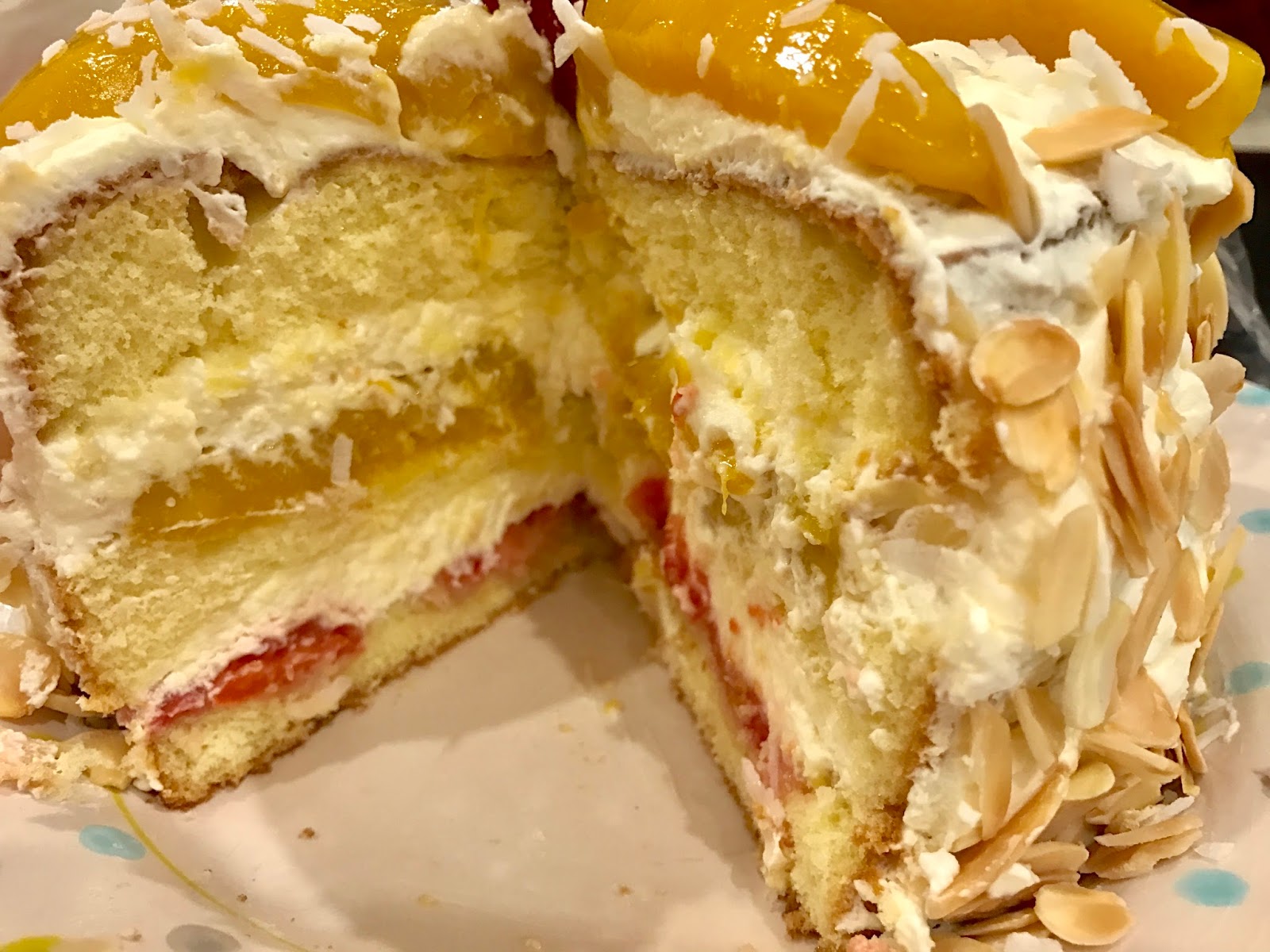
 I made this mango and strawberry Victorian Sponge and ate it all.

Any writer who pens a book like Julien's Terror has to battle their own demons. So even while flirting with pâtisseries and dancing the waltz in Vienna, I was lured, deliciously into another world - the darker world of MALEFICA. It seemed I could not step into the light without the darkness reaching out to engulf me.

So I went. Into the cold.

Valais landscape

Winter in Cologne. The majestic peaks of the Valais.

And I went further, into the lunar dark...

Into the mystical Nuragic caves of  Sardinia.

Ah yes, I am there. It's back to the 15th century.

Split between so many worlds I often feel that I might lose my mind. It's all there, at the same time, vying for space in my imagination. I look present but I am faraway, gripped by moving images, listening to the voices.

MALEFICA is my fifth novel. It is the fantastic sequel to The Mascherari: A Novel of Venice and it is part of a historical mystery trilogy that sees Antonio da Parma and the witch Elena as chief protagonists. My mind screams with excitement. There is still much research to be done but the concept has been alive in my imagination for over a year and the treatment is slowly taking shape.

You might think I stopped at two books. That the world of digital media strangled so many of my creative thoughts that I'd have no room for another story. Nope, that isn't so. I have also begun research on the third book in the trilogy. It will be called THE MASTER OF COLOGNE and will be set in France and Germany.

What has become clearer to me is that I need to be closer to Europe for my research. And so, because you only live once, I am planning to fly out of Australia and spend a sabbatical year (at least) in France where I would do nothing else but paint, write and travel to the places that have inspired my books. How does 2020 sound? In the meantime, it is another excuse to work hard and keep pumping out those JIRA tickets! Because books will simply not pay the bills. That's not what they are for.

So there it is, a glimpse into a writer's life. A psychotic universe of here and there, of doing something despite the fact it does not pay. Because you have to, right?

You just have to.


Thursday, November 30, 2017

The French Revolution: Brittany and the Vendée


Drownings of Nantes in 1793, Joseph Aubert (1882)


“We must exterminate all men who have taken arms against the Republic 
and strike down their fathers, their wives, their sisters and their children. 
The Vendée must become a national cemetery.” 
      – General Turreau

The French Revolution is generally accepted as covering the period 1789 to 1799, ending with Napoleon’s coup d’état and the dissolution of the Directory. Prior to the formation of the Directory government France was ruled by the National Convention headed by Robespierre. This period, aptly known as the Terror, lasted from September 1793 to July 1794. 

For Western France, in the region of the Vendée, the Terror was accompanied by bloody and religious civil war including a period of mass killings that some French historians have recently come to denounce as a genocide and which led to the decimation of a third of the inhabitants in the Vendée. 


In the Western town of Nantes the representative of the National Convention, Jean-Baptiste Carrier, was responsible for atrocities and massacres that defy imagination. 


In my latest novel, I was interested in portraying a female perspective for this turbulent period.


Origins of the Conflict


It is a misconception that aside from aristocrats and nobles all French people were in favor of the beheading of their king and queen. 

The inhabitants of Brittany and of the newly named region of Vendée (comprising parts of Brittany, Poitou and Anjou regions) were never in favor of the guillotining of their king, Louis XVI, on 21 January 1793. They were staunch royalists and deeply Catholic. The execution of King Louis was not well received. 


To compound the people’s outrage, the new Republic had not only nationalized church property, but it also outlawed all priests who refused to forsake their oath on the Holy Bible.  According to these new laws, priests now had to swear upon the Constitution. Those who resisted were labelled ‘refractory’ and banished from preaching. There were persecutions involving both priests and nuns. In worst cases such priests were hunted to death or murdered en masse, as happened in Nantes in December 1793 when hundreds of refractory priests were tied up, locked into a barge and drowned in the Loire River. 


Already unsettled, the Vendée peasants rose in arms against the Republic when in February 1793, the National Convention made a call for the conscription of 300000 unmarried men, from the age of 18 to 40 years. 


The people of the Vendée had already witnessed great injustices toward their beloved priests, whom they hid, but this new conscription law was the tipping point because it would have left thousands of peasants unable to fend for their families. Meanwhile they would be forced to enlist in support of a Republic they had come to see as tyrannical.


Determined to oppose the Republic, these men, often illiterate and attached to their land, elected nobles and landlords—local men whom they held in high esteem—to lead and train them in battle. The Great Vendéan Army was born. 


Initially this Great Army won many victories against the soldiers of the Republic, but from December 1793, its luck began to turn. From January to July 1794, Paris sent a giant army to sweep across the Vendée. Its orders were clear: annihilation with no quarters. 


The Infernal Columns


Children, women, the aged, even the sick and farm livestock were not spared from massacres. The Republican army practiced scorched-earth and sought to obey decrees from Paris aimed at starving or exterminating the population. 

The army possessed twenty columns led by several Republican generals. Some, like those commanded by General Grignon, were more cruel than others. These columns became known as the ‘infernal columns’ for the very hell they spawned. 


The living defend their dead. War of the Vendée. 
Georges Clairin, 19th century


The words pronounced by General François Joseph Westermann are powerful illustrations of the atrocities that followed: 


“There is no more Vendée. I have trampled the children to death with our horses, I have massacred the women, and they are no longer able to give birth to any brigands. I am not guilty of taking a single prisoner, I have exterminated them all… The roads are covered with corpses. There are so many of them at several places they form pyramids. The firing squads work incessantly… Brigands arrive who pretend that they will surrender as prisoners… but we are not taking any. One would be forced to feed them with the bread of liberty, but compassion is not a revolutionary virtue.” 


Writing the French Revolution 


In Julien’s Terror, my desire was to convey what might have been the experience of a young girl in these violent times. The journey begins when she is a spoilt child, daughter a well-to-do merchant, living on the prestigious Île Feydeau in the heart of Nantes. It follows her life after the Terror, when she is a spirited but destitute orphan. What she sees and lives in-between, and the aftermath of her horrendous psychological journey provide both drama and mystery, but more importantly, it casts a light on the hardships faced by many French women in this period.


My female character is barely nine when she loses her parents to Carrier’s butchery. She is reunited with relatives in war-torn Vendée, staying with them first in Montaigu, La Guyonnière and then later in Les Epesses—all communes that were swept by the infernal columns.


The Underground and the Hidden Places of the Vendée


What is less well-known about the conflict in Western France is how much the peasants’ knowledge of their natural surroundings supplied them with advantages for surviving the Republican army. Like the Viet Cong of Vietnam, the people of Brittany and Vendée crawled in secret undergrounds. They also waged a guerrilla war long before the word ‘guerilla’ officially surfaced, when Napoleonic French troops encountered fierce resistance in Spain.

As François Pagès describes in Secret History of the French revolution—the soldiers of the Catholic royalist army ceaselessly disappeared and then re-appeared to fight. The underground, the woods, the stones and the marshes in the West would conceal and then suddenly release hordes of former valets, brigands, priests, ex-nobles, and peasants. They were everywhere and yet they remained unseen. 


In his final novel, Quatre-Vingt Treize, Victor Hugo wrote of his father’s experience in the war against Breton royalists. He too mentions the forests that sheltered thousands of peasants in Brittany:


“The peasant had two points on which he leaned: the field which nourished him, the wood which concealed him.”


“There were wells, round and narrow, masked by coverings of stones and branches, the interior at first vertical, then horizontal, spreading out underground like funnels, and ending in dark chambers. [ ] The caves of Egypt held dead men, the caves of Brittany were filled with the living.”


“The subsoil of every forest was a sort of mad repose, pierced and traversed in all directions by a secret highway of minds, cells, and galleries. Each one of these blind cells could shelter five or six men.”


In Les Epesses, my female character follows her great-uncle, a giant Breton man who walks everywhere with his large wooden staff, and seems to know all the secrets of the underground. He hides his family in an underground cavern where they remain for months. 


As the infernal columns advance in the Vendée countryside, my character witnesses horrors beyond her years. Later she will hide in the secret Gralas forest, south of Nantes, and meet one of the most courageous men to lead the Vendée rebellion – General François Athanase de Charette de la Contrie (Charette). In Gralas, she will also discover the strong, independent women who fought to death alongside Charette, and one of these women will change her life forever.


"Liberty, Equality, Fraternity or Death" 
- the original motto of the French Republic


Further Reading:


1. Histoire secrète de la Révolution française depuis la convocation des notables jusqu' a la 

prise de l'ile de Malthe..., François Pagès, 1798.
2. Quatrevingt-treize, Victor Hugo, 1874.
3. Souterrains de Vendée, Laurent et Jérôme Triolet, Editions Ouest-France, 2013.
4. Colonnes Infernales - Wikipedia 
5. A French Genocide: The Vendée, Reynald Secher, University of Notre Dame Press, 2003.


Saturday, July 15, 2017

Julien's Terror as a Psychological Thriller - Between Rationalism and Superstition


Julien's Terror features various facets of the psychological thriller listed by Mecholsky1 including, apparent paranormal danger, a form of prolonged psychological torture, psychological trauma / memory losses and past traumas that revisit in the form of a new danger.

Julien, my main character, experiences a dread towards his wife, Marguerite which has as its origin: family trauma; the internalisation of a misogynistic mentality that would have been common in the 19th century; the internalisation of his own father's jealous paranoia towards Julien's mother; and finally the suppression of his own inner fears which rebound forcibly, manifesting into a terror. This is revealed during his final visit to fortune teller Marie Anne Lenormand, where Julien makes a powerful revelation about a crucial passage in his life.

The only person in the novel who appears fearless in the novel is Marguerite, adding to the aura of mystery and potency around her.

A young Marguerite Lafolye
Painting by Gustave Jean Jacquet (1846-1909)

For all his knowledge, engineering aptitude and cerebral prowess, Julien cannot decipher his own wife. Marguerite appears as an unknown entity. Mid-way into the novel, he considers her a liar, perhaps even a traitor. 

According to Mecholsky, this fear is key to the psychological thriller. He claims that this dread, that dangerous secrets lie beneath once-safe sectors of life is in fact an anxiety about the modern age and its implication. Despite living in an Age of Reason which had presumably enabled the French Revolution, despite having been rigorously schooled by the Ponts et Chausses, the Cartesian Julien is confronted with the limits of his knowledge. He knows nothing about Marguerite. Before him, is an unknowable being, one who reflects the unknowable mind in each and every one of us.

Aptly set in the French Revolution, Julien's Terror illustrates this modern dynamic that Mecholsky describes as having given birth to the psychological thriller - a modern anxiety (about the nature of the mind and the Self) existing through the Enlightenment struggle to subjugate myth and superstition by way of science and rationality. Marguerite is a Catholic royalist. Worse, she is of Breton descent. In the 19th and 20th centuries, the Bretons were considered not only filthy by the French, but also savage and backwards. Meanwhile, their 'blind' adherence to religion was seen as evidence of their superstitious minds. Julien's domination and abuse of Marguerite is a metaphor for this symbolic subjugation of the rational over superstition and myth. 

As modern anxiety would have it, Julien does not fare better through his actions - his anxiety only accrues and the enigma of Marguerite appears all the more horrifying.  It is only when Julien takes Marie Anne Lenormand's advice and considers the supernatural as a potential explanation for what is happening - at the cost of his cherished logic, only when he concedes that there may be forces he knows nothing about, and then pragmatically undertakes to confront these occult forces, can he achieve a solution.

Marie Anne Lenormand reading

In its resolution, however, Julien's Terror presents two opposing explanations for the reader that can be listed here briefly to avoid spoilers. The first explanation is grounded in rationalism, informed by a conversation with the physician Franz Anton Mesmer. Mesmer proposes a valid psychological theory, albeit one that had not been fully developed at the time, and which was only starting to be known in limited scientific circles, due to the rising cases observed and reported. 

The second explanation is supernatural. It confirms Marguerite's innate belief that she can see and converse with the dead. It suggests that there is something real about the myths in Breton folklore - they are not mere superstition. This explanation also implies that Marguerite, by way of a certain unique and harrowing childhood experience, now finds herself between two worlds - she lies in-between - and as such, she can channel the dead.

Les Lavendieres de la Nuit - Breton Folklore painting by 
Jean Edouard Yan Dargent (1824-1899)

At the conclusion of the novel, Julien rationalises what he has seen, to himself. He is never truly convinced about one explanation over the other, but he now understands that there is something strong and worthy of esteem in Marguerite. He is also made aware of his own past failings - though that is not to say that he has overcome them (an important point, if one is to understand his last vision in the Temple prison). He comes to cherish, admire and love Marguerite all the more. An ending like this was necessary to reconcile the couple after much conflict and to achieve a satisfying character arc for Julien. 

Despite Julien's own reckoning, I don't want underplay the tone of uncertainty that the final chapter creates - this fine line between the rational and the paranormal interpretations is the hallmark of the psychological thriller. We are not meant to know for certain. Some anxiety remains. 

The horror that Julien's Terror illustrates is both a facet of the period during which it is set (the French Revolution/ the Terror / the Vendée wars) and the repercussions this period had on the French population. 

Mecholsky indicates that the French revolution was a logical cultural goal of the Enlightenment, yet it resulted in horrific terror and murder, casting a pall over rationalism. Julien embodies this contradiction perfectly. He is both the most logically-minded character and the character that undergoes the most destructive and potentially sociopathic psychosis. Incidentally this is the reason the novel is named Julien's Terror.


Just as it opposes rationalism to superstition, Julien's Terror also highlights the ever present conflict between those French who embraced the Republic and were loyal to its tenets, and those French who pined for the Ancien Regime and espoused the royalist cause. This opposition is embodied by Julien and his wife Marguerite.

Julien is an upcoming bourgeois who has thrived in the new Republican order and accepted the Napoleonic age. He considers Napoleon his benefactor and the benefactor of France. Marguerite is a staunch royalist with a great disdain for the 'Corsican upstart' who has come to rule post-revolutionary France.

When I conceived a marriage between two unlike souls, I was partly cautious about its probability. I decided, among other character motivations, to employ a 'marriage of convenience' disclaimer - Julien marries the first woman offered to him to avoid serving in Napoleon's army so that he can instead become the engineer he had always dreamed of becoming. With this mindset, he spends no time evaluating her personality, background or values. By way of this disclaimer, I hoped no one would question such an unmatched pair. Still, I wondered how likely an alliance of this nature could have been. Could a republican at soul marry a royalist? 

I had no idea that this unlikely combination was in fact common. So common, that it existed in none other than author Victor Hugo's family2. The similarity struck me and I simply have to share it here.


Like Marguerite, Victor Hugo's mother was from Nantes. Like Marguerite, Sophie Hugo née Trébuchet, was from a royalist Breton family. And like Marguerite, Sophie did not share her husband's Napoleonic sentiments. Madame Hugo went so far as to shelter those who plotted against Napoleon's life. Meanwhile, Hugo's father, Joseph Léopold Sigisbert Hugo distinguished himself as a soldier in Napoleon's army, rising to a high position, notably at the battle of Marengo in 1800, acquiring the Legion of Honour in 1804. He also fought against guerillas in Spain from 1808 to 1810 a period during which the young Victor Hugo became acquainted with the Spanish language and learned to love the country.
Sadly, and unlike Marguerite and Julien, the Hugo couple's differences could not be resolved.

A final word about Julien's Terror. Mecholsky explains that novels like the psychological thriller and its early Gothic form have helped us disguise sources of anxiety, throughout the history of western culture since the 18th century. Quoting Fiedler, Mecholsky alludes to one of the tensions that such novels help us deal with: "a fear that in destroying the old ego-ideals of Church and State, the West has opened a way for the inruption of darkness..." I think this is perfect.  You see, as a psychological thriller, Julien's Terror happens to be set during and soon after the French revolution, that is to say a period where the power of the Monarchy and Church were toppled, leading perhaps to much anxiety and guilt...   Here then, Julien's Terror provides a coping mechanism for a fear that has presumably surged during the very period in which the novel is set.

Sources:

1. Kristopher Mecholsky, The Psychological Thrillerhttp://www.academia.edu/17484925/The_Psychological_Thriller_An_Overview, Accessed on 12 June, 2017.

2. Albert.W. Halsall, Victor Hugo and the Romantic Drama, University of Toronto Press, 1998.