Showing posts with label France. Show all posts

Monday, January 16, 2023

Le Secret de Chantilly - la biographie romancée du cuisinier Antonin Carême


Disponible à temps pour l'anniversaire de Talleyrand le 2 février 2023, cette nouvelle édition du Secret de Chantilly sera au rendez-vous pour la rentrée littéraire.

Chacune de ses pages revisitée avec amour et une nouvelle couverture aux couleurs de l'ancien régime : cette nouvelle édition sera en vente exclusivement sur Amazon. 

Description du livre :

Paris, 1792. Abandonné et livré à lui-même dans les rues de la capitale, Marie-Antoine Carême n’a que huit ans. Il s’aventure dans le monde de la restauration et au cours des années se distingue en pâtisserie.

Le mystérieux Boucheseiche, maître d’hôtel du ministre Charles Maurice de Talleyrand-Périgord, promet à Carême de lui révéler le Secret de Chantilly.

Devenu chef de cuisine au château de Valençay, Carême tombe sous le charme de l'énigmatique Talleyrand. Il se plonge dans un conte de fées – un tourbillon de princes, de princesses, de sortilèges, et de châteaux.
Pâtisserie et scandale sont au rendez-vous.

Mais lorsqu' advient la chute de Napoléon, tout bascule. Carême devrait-il encore se fier à Talleyrand, cet être insaisissable, ce diable boiteux pour qui personne ne paraît compter ?

Orphelin de la Terreur, génie assailli par le doute, Carême attendra des années avant de découvrir enfin, le Secret de Chantilly.

Ce roman est le récit d’un enfant qui releva le défi de sa naissance pour devenir une légende de la gastronomie française. Il raconte surtout l’amitié inimaginable entre deux êtres appartenant à deux mondes entièrement différents.

De Paris à Valençay, du congrès de Vienne à Londres, Carême nous fait voyager à travers ses aventures parfois piquantes, souvent teintées d’humour, mais qui incarnent la France – son histoire, son patrimoine et son grand art culinaire.


Le Secret de Chantilly est également disponible en anglais (paru 28 novembre 2021).


Wednesday, May 20, 2020

Le Secret de Chantilly - Antonin Carême rencontre Boucher


Depuis plusieurs jours, je travaille sur la traduction de mon roman, Le Secret de Chantilly. Mi-conte, mi-roman historique, ce livre se base sur la vie du célèbre chef, Antonin Carême et sa relation avec l'énigmatique Talleyrand.

C'est merveilleux pour moi de voir cette histoire - qui d'ailleurs est bien Française, même si elle a été originalement conçue en anglais - prendre une toute nouvelle forme. Petit à petit, je découvre mes personnages pour la première fois, comme si le fait de leur rendre leur langue maternelle leur redonnait vie.

L'un de mes personnages préférés, c'est Boucher, le maitre d'hôtel de Talleyrand. Dans ce passage, qui est l'un de mes préférés, Antonin qui a seize ans rencontre Boucher pour la première fois.

Note: Pour l'instant la ponctuation suit les règles de dialogue anglais.

Un après-midi, alors que je me dirigeais chez M. Rose, Avice vint me trouver en disant :
  « Antonin, l’un de nos clients les plus estimés voudrait te voir. Il est dehors, près de la diligence. Tu dois aller lui parler tout de suite.
  — Maintenant ?
 — Oui, oui, dit Avice. Ne lui fais pas attendre. Il représente notre client le plus important. »
  Je me précipitai hors de Bailly, encore revêtu de mon tablier. Je vis un homme dans la quarantaine avec un visage rond et doux et une perruque poudrée. Je le reconnus pour l’avoir aperçu à plusieurs reprises auparavant, commandant des gâteaux pour des banquets ministériels. 
  C'était la première fois que j’avais l’occasion d’examiner ses vêtements de près. Sa chemise de lin était d’un tissage exquis, et une cravate blanche épousait son cou avec élégance. Avice n'avait pas menti; l'homme portait des chaussures à boucles et une longue veste mauve satinée. Il sentait la lavande et avait un air soigné comme je n'en avais jamais vu, même parmi les bourgeois qui accourraient régulièrement chez Bailly.
   « Monsieur Carême, me dit-il en s'approchant. Vous êtes bien le jeune homme qui livre des pâtisseries au Palais Royal ?
  — Oui. Oui, c'est moi. » J'essuyai mes mains sur mon tablier, l'air un peu déplacé. Je n'avais pas la moindre idée qui était cet homme ou ce qu’il voulait. Il semblait revenir d'une autre époque. Les gens portaient-ils encore ces culottes et ces bas de soie ?
  « Monsieur Avice me dit que vous vous dirigez vers vos cours de pâtisserie.
  — Oui monsieur, c'est sur rue Grange-Batelière.
  — Je marcherai avec vous », répondit l'étranger d’une voix aimable.
  Ses paroles s’écoulaient agréablement comme s'il fréquentait des nobles ou en était lui-même un des leurs.  Mille questions me traversaient la tête en remontant la rue Vivienne.
  « J'aime votre travail, monsieur Carême. Il me semble prometteur.
  — Merci monsieur ... monsieur ... »
  Il avait fait preuve d'un tel effacement, malgré son rang, qu'il ne s'était même pas encore présenté.
  « Boucheseiche, répondit-il. Vos pâtisseries – elles sont beaucoup plus légères que dans de nombreux établissements parisiens. Je l'ai tout de suite remarqué. Je dirais que ce sont parmi les meilleurs auxquelles j’ai goûté. Certaines améliorations pourraient être adoptées, certes, mais pour la plupart, je suis très impressionné. Est-ce que vous savez qui je suis ?
  — Non, monsieur Boucheseiche.
  — Il fut un temps où je dirigeais les cuisines de Louis Joseph de Bourbon, prince de Condé. Oh, c'était il y a des années, bien avant les événements du 14 juillet. Beaucoup de choses ont changé depuis. Le prince ne réside plus dans son château à Chantilly. Il est à présent en Angleterre. Mais pour avoir servi la maison Condé, je suis en quelque sorte le successeur de Vatel. »
  Il avait parlé doucement et sans emphase, mais je restais stupéfait par ses paroles, et mon enthousiasme eut raison de moi.
  « François Vatel ! J'ai lu beaucoup de choses au sujet de ce maître d'hôtel ! Il a servi Nicolas Foucquet ! C’était un grand chef qui inventa la crème Chantilly. »
  Le regard de M. Boucheseiche tomba sur moi. Il semblait m’évaluer et prit un air grave pour un instant. Je retrouvai aussitôt mon calme :
  « Je veux dire heu... c'est tellement... intéressant, monsieur Boucheseiche.
 — Appelez-moi Boucher. Monsieur Carême, vous vous trompez. Vatel n'a jamais inventé la crème Chantilly.
  — Ah bon ? » Je me sentis rougir.
  « Mais non. Pas du tout. »
 Boucheseiche sourit à son tour. Un silence incommode suivit alors qu'il m'examinait. À quoi pensait-il ? Je devais avoir l'air d'un idiot.
  Il sortit de sa longue réflexion. Ses yeux bleus se posèrent tendrement sur moi :
  « Un jour, murmura-t-il, je vous révèlerais peut-être le secret de Chantilly. »
 Et avant que je puisse me remettre de cette étrange remarque, Boucheseiche prononça ces mots magiques :
  « Seriez-vous intéressé à travailler pour moi, monsieur Carême ? Je supervise des banquets pour une personne d’une haute importance. Le monde que je vous propose de rejoindre est plus grand que tout ce que vous connaissez. Mais… qu’y a-t-il ? Vous ne vous sentez pas bien ? »
 Je m’étais arrêté de marcher. Je ne pouvais plus respirer. Je regardais Boucheseiche comme s'il était une vision de rêve.
  « Pardonnez-moi, monsieur Boucheseiche.
  — Boucher, rappela-t-il.
 — Pardonnez-moi, monsieur Boucher. C’est que… je sens que cela ne peut pas m’arriver à moi. C'est presque… presque comme dans les contes de fées. »
  Il me contempla en silence avant de dire : 
  « N'est-ce pas ? » Il reprit de plus belle, « La révolution, monsieur Carême ! Nous vivons à une époque qui évolue si vite. Vous étiez garçon de courses il y a quelques années… Et maintenant ! Maintenant, vous êtes sur rue Vivienne, et on vous mande de venir travailler avec Boucheseiche venu droit de la grande Maison Condé. Oui, vous avez bien raison. C'est semblable un conte de fées. »
  Son visage prit alors un aspect mélancolique. 
 « Et pourtant, souvent, ajouta-t-il sa voix teintée de regret, même les plus beaux contes de fées connaissent une fin tragique. Monsieur Carême, j'étais autrefois à l’emploi d’une princesse qui possédait tout, tout ce que son cœur désirait, et ce qui lui arriva, je prie le ciel, ne frappera jamais même les plus vilains laquais. »
  Il se redressa avec autre sourire généreux. 
  « C'est peut-être un peu trop pour vous aujourd'hui. Je vous laisse réfléchir à mon offre. Je reviendrai un autre jour pour vous parler d'éventuelles conditions d'emploi. Il y a beaucoup à faire et cela va prendre du temps. Nous ne nous presserons pas. Après tout, l'homme que j’ai l’honneur de servir aime bien prendre son temps. Au revoir, monsieur Carême. »
  Toujours le soufflé coupé, je regardai le mystérieux Boucher rejoindre sa calèche, alors qu’il me laissait dans tous mes états devant le seuil de chez M. Rose. Mon cœur n'avait jamais battu aussi vite. Je transpirais d’émotion, et pour le reste de l’après-midi, tous mes efforts pour me concentrer sur les leçons de massepain de M. Rose furent en vain.
 J’appris le nom de la princesse à laquelle Boucher avait fait allusion. La malheureuse princesse de Lamballe avait été mutilée par une foule violente pendant l'une des périodes les plus sombres de la révolution. Elle qui avait été mariée à l'homme le plus riche de France, du jour au lendemain, sa fortune avait basculé.
  C'était ce que Boucher avait essayé de dire. Que la révolution avait tout changé. Tous les tournants du destin étaient possibles.
  Pourtant, je n’arrivais toujours pas à comprendre. Comment un garçon de cuisine sorti d’une gargote, près de la barrière du Maine pourrait-il travailler avec un homme comme Boucher qui avait jadis connu une princesse ? Comment pourrait-il être instruit par ce maître d'hôtel qui avait autrefois servi la maison Condé ?
  L’arrivée subite de Boucheseiche dans ma vie était comme un rêve devenu réalité. Il apparut devant chez Bailly quand je m'y attendais le moins. Sa première visite fut brève, mais elle me bouleversa pendant des mois. Après avoir livré son message, il disparut aussi soudainement.
 Je ne le reverrais que l'année suivante quand il me conseilla de changer de boutique et de travailler avec Gendron. De cette façon, expliqua-t-il, je détiendrai plus de temps libre et je deviendrai pâtissier libéral.
 Un pâtissier libéral ! Moi ? Les idées tourbillonnaient dans ma tête à la perspective de cette nouvelle profession.
 De nombreux contes de fées ont une marraine dotée de pouvoirs magiques. Cendrillon en avait une. La Belle au Bois Dormant en avait plusieurs. Ces personnes apparaissent quand on s’y attend le moins, agitant leur baguette pour faire des tours de magie. Elles allègent les douleurs et offrent un nouveau lendemain. Elles créent quelque chose à partir d’un rien et vous laissent avec un sentiment d'incrédulité. 
Comment cela pouvait-il m'arriver ? L’avais-je mérité ?
  Après un peu plus d'un an chez Monsieur Bailly, Boucheseiche était devenu mon parrain. Mon conte serait aussi merveilleux que n'importe quel autre. 

Thursday, August 22, 2019

Understanding Talleyrand

Talleyrand Portrait


This August I lost myself in Volume I of Talleyrand's Memoirs. One passage stood out and moved me to tears.

Whether are not you are familiar with the 19th century French statesman does not matter; this passage is worth knowing. It is a rare moment into the heart of the enigmatic Talleyrand who for years has baffled so many historians.

It took place in 1807. By then, as Napoleon's foreign minister, he had long been titled Prince of Benevento and gifted with the principality of Benevento, in southern Italy. He knew how to flatter and reason with the French emperor but there were limits to his influence of which the statesman was well aware.

In that year, Prussia had just been defeated by Napoleon's army. The Prince of Benevento attended deliberations at Tilsitt; these would decide the fate and treatment of fallen Prussia.

It so happens that there is another character in this story. It is Queen Louise of Prussia - that is, Louise of Mecklenburg-Strelitz.

Louise of Prussia

Queen Louise of Prussia deserves another post to herself. She was to die of a mysterious lung illness three years later, at the age of only 34. Centuries later, at the time of the Nazis, she would be revered as the epitome of all qualities that German women should aspire to. But it is 1807 and in this story, she is thirty-one years old and she is in a quandary.

Napoleon, famed for his misogyny wasted no time in alluding to the Queen of Prussia's infidelities - a gross slander given the Prussian King and Queen were very happy in their marriage. Meanwhile, Prussia faced potentially harsh economic sanctions after the war; it was up to the King to plead in favor of his country. But seeing that Louise was several months pregnant, he suggested that his wife should instead plead in favor of her people, in the hope that Napoleon, touched by this charming figure of maternity - one of the most beautiful women of the period - would soften somewhat and prove more conciliatory.

Louise hesitated. Why would she wish to appear before this emperor who had insulted her and placed public doubt on her virtue? She hoped that her husband was right. Perhaps if Napoleon saw first hand how kindly and honorable she truly was, he would retract his poor judgement of her character.

Recalling the events at Tilsitt, Talleyrand writes, "I was indignant of everything I saw and everything I heard but I was obliged to hide my indignation."

When she settled into her apartments at Tilsitt, Napoleon paid the Queen a visit. After flattering her beauty while she tried to pass on to other subjects, Napoleon turned to the King and said "How could you dare begin a war with me, I who had already conquered so many powerful nations?" The defeated King made no answer but looked upon Napoleon severely. It was Louise who replied on behalf of her husband. "Sire, it was permitted to the glory of Great Frederick II, to deceive us as to the extent of our powers; we were deceived; but it was so ordained."

Queen Louise of Prussia 
by Vigée Le Brun, 1801

Talleyrand writes that Louise's usage of the word 'glory' was, in his mind, fortunately placed. He found it superb. Evidently the word was not used to the glory of Napoleon, but rather to another Prussian king from a past century. Talleyrand, never shy of using wit to taunt Napoleon, reveals that he later repeated the Queen's phrase often times, until the piqued Napoleon told him one day, "I ignore what you find so pleasing about the Queen of Prussia's words; you would do well to speak of other things." Typical.

But returning to 1807.  All the efforts that Louise made to obtain concessions for her country were in vain. Napoleon remained inflexible. Losing half of her territory, Prussia was to enter many years of suffering, famine, and the state of things grew so severe that everywhere, women abandoned their children.

But it is Talleyrand's next revelation that moved me.
"I was indignant of everything I saw and everything I heard but I was obliged to hide my indignation. And so all my life, I will remain grateful that the Queen of Prussia, queen of another time, was willing to perceive this."
Willing to perceive - the phrase Talleyrand chooses is so important. One can readily perceive, that is one thing. But to permit oneself to perceive is, in Talleyrand's eyes, to take a step further. If one permits oneself to see, one is willing to go against one's convictions and to combat one's prejudices (in this case, prejudices against Napoleon's foreign minister; against the vanquishing French; against the enemy etc...) For Talleyrand, to be granted this understanding was a precious thing and he felt grateful for it.

He narrates the event at Tilsitt and the sentiments they evoked, in these terms,
"If upon reflecting on my life, many passages are tedious, I recall however with great sweetness the things she had the kindness to tell me, and those she almost confided in me, "Prince of Benevento," she said, the last time I had the honor of escorting her to her carriage, "there are only two people who regret that I came here: it is me and you. You are not upset, are you, that I shall take this opinion back with me?" The tears of tenderness and pride that I had in my eyes were my only response."
Louise had been unsuccessful in her quest and she knew that Napoleon would not help her country. She also still felt the emperor's insults. With those words, she admitted to Talleyrand, the French foreign minister, that she regretted having come to Tilsitt, and she confided also that she could see right through him: that he did not like what he had witnessed, and that he was filled with sorrow for her, and also wished she had not come at all.

When I read this passage, I was astounded by Talleyrand's sensitivity to having been understood. It seemed to him that this understanding, arising from another, especially in this extreme post-war moment, was a rare event, one he deemed important enough to feel grateful for.

But he felt much more than grateful. He was moved by Louise. I absolutely had to write about it and give it the attention it deserved because little or no emotion has ever been reported as having come from Talleyrand.

When trying to understand a person it is often insightful to know what it is that moves them, or brings tears to their eyes. I noted that during the entirety of Volume I, Talleyrand remains mostly unemotional. He is overwhelmingly cerebral. He displays warmth during only two instances: when he relates his relationship with the unfortunate Spanish princes sequestered at his chateau of Valençay, and when he narrates his encounter with Queen Louise of Prussia. The latter is the only time he mentions tears.

For Talleyrand, a man of mystery, a man so reserved and elusive that he would often be maligned, nothing would seem so precious than to be perceived kindly despite all appearances. For he was proud, that is certain.


Thursday, April 25, 2019

Review: Quatrevingt-treize by Victor Hugo


“Au-dessus de l'absolu révolutionnaire, il y a l'absolu humain.” 
"Beyond the revolutionary absolute, there is a human absolute."

To me, the above statement perfectly summarises the theme of this amazing book set in France's terror years during the French Revolution.

Written in 1874, Quatrevingt-treize is Victor Hugo's last novel. He was 72 years old when it was published. Consider that Hugo was only 29 when he published Notre Dame de Paris.

In Quatrevingt-treize, Hugo reprises the thorny question of what one should choose when faced with a moral decision. At the climax of this story, three men encounter situations that will challenge their core beliefs. Two of them choose to uphold humanitarian principles over and above any revolutionary concerns-even at the cost of their own lives or mission. The third, however, cannot override his convictions, and as a result, his conscience and his failure to act in a humanitarian manner will lead to his demise.

Illustration for Quatrevingt-treize
by Caumont, Robert (circa 1922 - 1924)

The third man, Cimourdain, also functions as an anti-Javert while meeting the same end as Javert.
At the end of Les Misérables, Inspector Javert, who has shown humanity in letting Jean Valjean escape, will suffer enormous cognitive dissonance; through his lenience, he has acted against the grain of his perceived moral duty and cannot reconcile his benevolent behavior with the opposing rigid lawful attitude. His subsequent suicide is a desperate means to escape from a fraught self-integrity.

On the other hand, in Quatrevingt-treize, the character, Cimourdain does not allow humanitarian concerns overtake duty; but here again, dissonance arises because deep down, his emotional attachment to Gauvain reminds him over and over again that he has made the wrong decision. Facing the impasse between his broken conscience and the duty he was forced to obey, Cimourdain takes the same deathly path as Javert.

Danton, Robespierre, and Marat at the wine shop
Quatrevingt-treize
Wood engraving by Paterson.

What is revealed in his writings is that Hugo was painfully conscious of moral dilemmas and of the human distress that surfaces when people are forced into a choice that offers no solution - whether the choice is in line or goes against strongly held beliefs. Could this have resulted from his upbringing? I mentioned this before in an earlier post - Victor Hugo's parents could not have been more at odds. Could this tension between opposites have created a domestic climate of guilt where every decision was fraught with anxiety?

It is easy to imagine it. His father, Joseph Léopold Hugo was loyal to the French army. In his earlier years, long before the family lived in Spain where his son spent his early childhood, Joseph Hugo had fought in Western France against Bretons rebels, or Chouans, as these were called. Meanwhile his mother, Sophie Hugo, a Breton royalist from Nantes was firmly against the revolutionaries - she sheltered counter-revolutionaries - like the Chouans.

Or perhaps, the tumultuous times during which the author's parents lived were filled with stories that later inspired Victor Hugo? I noted that while depicting the tragic war and violence pitting Chouans against Republication soldiers, Victor Hugo emerges from his narrator's voice and chooses to remind the reader of Quatrevingt-treize that his father fought this war. It is intimate and marked with emphasis.

No matter its origins or the inspiration behind it, I felt that, more strongly than in Les Misérables, Quatrevingt-treize is the author's attempt to reiterate that we are doomed if we hold on too tightly to our convictions. Fanaticism harms the human soul and the human absolute must prevail.

La Tourgue, 1835
llustration by Victor Hugo for Quatrevingt-treize

The book is beautifully written. Like L'Homme qui rit, each chapter stands alone as a masterpiece. Through Hugo's vivid descriptions, I was fascinated by the landscape of Brittany's forests and the extensive network of subterranean caves, some of which date to the 9th century. I found a book published on this same subject, and which covers the terrain in La Roche-sur-Yon, not far from where my uncle lives today. Curious about Western France's subterranean network, I began to research the underground caves of the Vendée and have since featured these in my historical novel, Julien's Terror.

Beyond the rich historical insights of Quatrevingt-treize and the author's deep understanding of moral conflicts, I enjoyed Victor Hugo's rendering of the Breton culture and his colorful, immersive writing. It was a pleasure to read this book and to rediscover my grandfather's homeland. It was enriching to be inspired and moved by this great author.


Friday, July 6, 2018

An Author's Rant


"Dwelling for months in the forest, in forced isolation, 
she had given birth to this masterful trickery of the mind."  
- Julien's Terror

For all those gentle Goodreads peeps who entered the latest Julien's Terror giveaway, and found themselves unlucky, fear not. I will be running a Bastille Day freebie.

For five days, from Thursday 12 July to Monday 16 July, Julien's Terror will be FREE on Amazon Kindle. This is for all Amazon territories, not just the US.

There were 1555 US entrants and three winners will soon receive their print copy. I have to admit I set up this giveaway in the hope that it would reach those with an interest in the setting and subject of the novel. I hope the winners will enjoy Julien's Terror and are kind enough to post a review on Amazon. (or Goodreads!)

Now bear with me as I want to share a glimpse into my latest novel.

While writing Julien's Terror, I couldn't help but notice something. A little background first. The story is set during the French Revolution, with focus on that narrow period from September 1793 to July 1794 called the Terror, and also during the years following the Terror, which saw the rise of Napoleon and the changing landscape of Paris.


It is erroneous to believe that after the fall of the Bastille on 14 July 1789, change happened overnight and that the people of Paris suffered no more hunger. The Declaration of Human Rights changed little economically. There were still bread shortages resulting from crop failures and extreme bad weather the years before. There was still inflation. In fact inflation worsened in 1795. Following the Terror, after years of social tension, of political and economic uncertainty, there was this surge, this desire for affordable pleasures.

All of a sudden, with the emerging bourgeois middle class, everyone in Paris began to take an interest in feasting like a king, in visiting newly emerging restaurants and cafes, and in feeling special through the consumption of a gastronomy that had once been the privilege of nobles.


It was also a time when the chefs who had once served aristocrats began to offer their creations to the wider public. And then something happened. Dalloyau, the famous pâtisserie chocolaterie, opened its first store on 101 rue du Faubourg Saint-Honoré. Back then, it was actually called "Maison de Gastronomie", the House of Gastronomy.

It so happens that in Julien's Terror, my main character, Marguerite visits this store to purchase cakes before something tragic and quite mysterious happens. But I'll say no more...


That same Dalloyau store still stands today in its refurbished glory. I ate a Mille-feuille there during my visit to Paris last year.  Dalloyau is also open in many parts of the world, including Japan and the Middle East. When the first store opened in Paris, in 1802, it was a sensation. For the first time in restaurateur history, customers could "take away". They could purchase cakes and bring them home to enjoy.

One man was paying attention. About a year later, in the winter of 1803-1804, he would open his own pâtisserie boutique on rue de la Paix. He used his boutique as a shop front for his rising popularity as a reputable pastry chef, and for creating his lavish pièces montées destined for diplomatic dinners.

That person was none other than 19th century chef, Marie-Antoine Carême. Carême is barely mentioned in Julien's Terror, because you see, I was saving him for later...like a dessert that I was not yet ready to share.

While writing Julien's Terror, I observed the workings of my mind at all times. What had I just written? First, the mysterious Marguerite enjoys Carême-inspired vols-au-vents at her wedding, then she orders cakes at Dalloyau in Paris, later she sits down at Caffè Florian in Venice, and last she savors a succulent strawberry tart during the traditional strawberry month of May. She really gets around this Marguerite. Julien's Terror is not a frivolous tale, I assure you. Yet those frivolous ideas were flowing, and I couldn't help but tune into them.

It was clear. I was obsessed with cakes.


I was not only obsessed, but I was seeing parallels between Napoleonic France's preoccupations with all that is pâtisserie and gastronomy, and our own present preoccupation with fine pâtisserie - especially high teas, but also pastel-colored maccarons, Croquembouche, the lot daintily presented on porcelain belonging in the 18th and 19th century. This nostalgia is no coincidence. We want to go back there! Wedding cakes today are taking on flower decorations like never before.  Old-fashioned flavours like lavender and violet have returned. That whipped-vanilla-cream word, Chantilly is now in vogue in the English speaking world. There is a resurgence for that sugary time, that sweet indulgence of the 19th century when all the ladies of Paris were aspiring to do exactly what Marie-Antoinette had infamously uttered (a gross exaggeration), and eagerly practising what she had hinted to when she told them, or so they think, to "eat cake".

That's when it struck me. That's when the idea for Chantilly: A Tale of Carême was born.


I am two-thirds of the way through the first draft and I've been eating cake like never before.

If Julien's Terror proves too macabre for some readers, then Chantilly will be a gently whipped delight. Both historical novels cover the Napoleonic period. But whereas Julien's Terror is often distressing, psychologically intriguing, and speaks of real life horrors, Chantilly is rich in sentimentality, a fairy tale written for the heart. And most of all, it celebrates friendship and gastronomy.

I can't wait to share it.


Wednesday, May 23, 2018

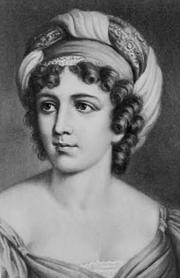
Madame de Staël - the woman who defied Napoleon


She excelled in the art of conversation, was a writer, a deep thinker and therefore agitator, and was possibly one of Napoleon's greatest enemies. In the early 19th century, while everyone in France submitted to Napoleon's will or else succumbed to his magnetic force, following him into war throughout Europe, one woman saw him for what he really was. Long before the #metoo age, Madame de Staël stands out as a formidable feminine force against the Napoleonic war machine.

In the first decade of the 19th century, Napoleon's censuring policy was at its peak. A special bureau kept an eye on printers, bookstores and newspapers. In 1800 Napoleon closed down sixty political newspapers, leaving just thirteen. In 1811 this was reduced to eight newspapers - almost all of these supporting him. By 1811 the number of publishing houses was limited by law to no more than eighty. Nothing that was unfavourable to the French Republic was tolerated in print. Madame de Staël's profound socio-political observations were seen as a threat to Napoleon's control of the French Empire.

In a time when the ideal woman had to be beautiful, bear children, but keep her ideas to herself, Germaine de Staël was not only out of line, she was a threat. She was not graceful, was quite loud, and liked nothing better than to tell people what she thought...about everything and in a well-spoken manner, whether this be on art, culture, politics or literature. De Staël published essays, books and letters that expounded on her rather modern views even if these opposed or criticised those held by Napoleon. It seemed that nothing would silence her.


In 1803 Napoleon banned Madame de Staël from being within forty leagues of Paris. Despite the fact that she often continued to sneak in and out of France, she found refuge at her chateau in Coppet, Switzerland. There, isolated from friends and often depressed, she held literary salons and invited her guests, many of them writers, to voice their ideas liberally. Napoleon was so wary of her that he had spies sent out to Coppet to intercept letters and continue to watch her.

In December 1806, while in Prussia, Napoleon wrote to his Police Minister, Fouché with no uncertain terms concerning de Staël's escapades into France, "Do not allow that hussy, Madame de Staël, near Paris." In case you might be thinking this was a bit of an in-joke, nope. Napoleon really did not wish de Staël to come near Paris. In March, he followed up on his previous letter with bolder instructions, "You must execute my commands and ensure that Madame de Staël is not allowed within forty leagues of Paris. That wicked intriguer will in time have to learn to take the wisest course." Was Napoleon obsessed with de Staël? Of course. No news is good news but he just could not cease thinking of her. In mid-April, the emperor wrote again with the words "It gives me pleasure that I have heard no more of Madame de Staël. If I take an interest it is because I have facts to back it up. That woman is a real crow..."

On the publication of her novel, Corinne (2006), literary minds lauded de Staël as a genius. Napoleonic press had none of it, and the Gazette de France wrote of the author, "A woman distinguished by qualities other than those proper to her sex is contrary to the laws of nature."


Not content with banishing de Staël and being endlessly preoccupied with her whereabouts, Napoleon later banned one of her novels. De l'Allemagne (1810) was a thorough study of Germany and its people. On its publication, Napoleon moved in, and five thousand copies soon to be released in France were destroyed.

But why was he opposed to the book, you might ask? At the time this novel was written, France and Germany had been at war and perhaps Napoleon had no wish to transform France's view of Germany because it would conflict with his political interests. Or perhaps he feared that the author might be praising Germany's intellectualism and culture at the expense of France. Yet again, being a keen writer himself, he might have been secretly envious of her literary prowess. Whatever the reason, the book became forbidden until 1813, at which time it was re-published and became a success. De l'Allemagne can be credited for improving cultural understanding between the two countries.

Madame de Staël believed that Napoleon was a ruthless tyrant who regarded individuals as pawns on a chessboard which he controlled. Long before everyone, well mostly everyone as we shall see, she saw right through him. After all this was a man who ended up leading France into war for over 15 years. Even Napoleon's foreign minister, the incredibly gifted Talleyrand who served multiple regimes and had a talent for survival, was early on made aware of Napoleon's unquenchable thirst for war. Charles-Maurice de Talleyrand and Germaine de Staël not only possessed a shared view on this psychological portrait of Napoleon, they had been friends. From the reign of Terror, they had remained in communication during their exile and beyond. Even if from 1800, Talleyrand was guilty of distancing himself from her in order to align himself with Napoleon's sentiments, in later years, he kept a room for Madame de Staël in his chateau at Valencay.


Taking it from biographer Maria Fairweather, de Staël can be credited for putting together the coalition that brought down Napoleon. An uber rich woman with influential contacts, her salons not only hosted dissident thoughts, but the writer Stendhal called her family home in Switzerland 'the general headquarters of European thought'. He does not exaggerate. Most of the important treaty negotiations between Russia and Sweden against Napoleon were conducted through Madame de Staël.

For all her brilliant intelligence, warmth, and courage as a writer, de Staël possessed an Achilles heel. It was that she was terrified of being alone and suffered much in her relationships. Not as beautiful as her friend, the celebrated Juliette Recamier, and aware of her clumsiness, she clung to people, and was as emotionally unstable as she was passionate. Her long time lover, Benjamin Constant, had once observed: "If she knew how to rule herself, she could rule the world." He tried in vain to leave her but was confronted with one emotional scene after the next. Having secretly wedded another woman, he found it difficult to reveal this to de Staël. When she found out, she ordered him back to Coppet. Benjamin Constant promised his new wife, Charlotte, that he would return, but he lingered at Coppet under de Staël's torrid emotions, their days alternating between heated debates and short-lived peace. Soon enough the neglected Charlotte tried to kill herself, not before alerting the couple of the fact, for full effect. They found her in time and revived her. Charlotte pleaded for Benjamin to return lest she would once again poison herself. At this Madame de Staël threatened to stab herself.

She may have lost her lover to Charlotte in the end, but de Staël had the last word with Napoleon. In her book, Dix Annees d'Exil (Ten Years in Exile), she devotes almost every page to recounting the details of her persecution and banishment, providing anecdotes about Napoleon's tempestuous, vulgar and egotistical character. Call it her #metoo moment, it is a work of revenge, of reckoning for years of suffering, and it brings to account a man who had fooled France but never fooled her.

What I most admire in Madame de Staël is her personal integrity and the courage to be herself when a military powerhouse of a man opposed her. She was in all likelihood incapable of being other than herself, despite censure and ostracism.

When he was about to meet her for the very first time, the German writer, Goethe received this letter from his friend Schiller, "Madame de Staël will appear to you as you have imagined her. Everything about her is of a piece: you will find not one thing in her which is disparate or false. That is why, in spite of the differences between her nature and ours, one is comfortable with her; one is disposed to listen to anything from her while wishing, at the same time, to tell her everything; she is the personification, as perfect as it is interesting, of the true French spirit."


Wednesday, March 28, 2018

La Guyonnière - an inspiration for my latest novel

Born in Hue, Vietnam, my Eurasian mother came to France for the very first time in 1955. She grew up in Paris and Nantes but warmly recalls memories of her summer holidays at her paternal grandparents' country home in Western France, in the area of La Guyonnière.


Her childhood was provincial in many ways.
She told me of how she would eat an entire Far Breton to herself, how she and the other children went cycling in the countryside, or else joyfully ate the ripe berries they had picked from the nearby groves.

It all sounded to me like an idyllic French holiday. I could imagine my mum in a summer dress and a little white apron, her hair parted in two braids alongside her moon-shaped face, her naturally tanned Eurasian skin basking in the French sunshine.

I learned from genealogy documents that my family's property in La Guyonnière extended for more than 100 hectares and was called La Roche-Thévenin. It had existed since at least the 14th century, passed down through my Bégaud ancestor.

Upon retirement, my great-grandfather, Pierre Candeau had become its guardian. Today, since passing on to his brothers and sisters, the property has been resold. It still exists but it is no longer part of my family's heritage. I don't know the current owner. I believe they often open the property to the public for commemoration of its history.

La Roche-Thévenin
Courtesy of Llann Wé 

When I wrote my latest novel, Julien's Terror, I stumbled upon the area of La Guyonnière again. It is an area east of Montaigu in the West of France, not far at all from Nantes. I had my characters spend some time there while traversing the Vendée. It was an accidental find.

I was actually researching the life of the Vendée general who, at the peak of France's revolutionary Terror, when extreme secularism saw the murder of priests and nuns, stood up valiantly to lead Vendée peasants against a government that tyrannised them.

From the rest of the world's point of view, Charette remains an unknown general despite being later praised by Napoleon for his genius military tactics. Charette was very much a leader of the people, and had been summoned by the peasants themselves who had had enough of mandatory conscription and the brutality against their priests. It is suggested that he practiced (invented?) guerilla warfare before the term became later known in Europe, following the Napoleonic wars in Spain.

It turned out that around the time when my novel takes place, there was such a thing called the Battle of La Guyonnière and it led to the capture of Charette. It took place in March 1796 when Charette had long lost hope and was living in hiding, from shelter to shelter. Seven months earlier, the defunct king's brother, the Comte d'Artois, who Charette had counted upon for bringing reinforcements, had decided he did not wish a part in the conflict, and had deserted him and the royalist cause, sailing back to England.

Now Charette was living on luck. He had even found refuge at one of my ancestors' home in Chavagne-en-Paillers. But in March 1796, his luck had run out. He was wounded and running for his life. Harrassed by General Hoche and progressively abandoned by his troops, Charette made way for La Guyonnière. From there, he and his men encountered a couple of the general's columns. They managed to escape to the woods of La Chabotterie until another larger column, this time led by General Travot, encircled them. All of Charette's men were killed, save for three. It was said the following exchange took place between Charette and Travot.

"Are you Charette?"
"Yes, it's me. Where is your commandant?"
"I am the commandant."
"You are Travot?"
"I am."
"About time. It is to you that I wanted to surrender," Charette replied, handing him his sword.

The Capture of Charette, Louis Joseph Watteau, 1796

Julien's Terror recounts the tragic fate of Charette following his capture, and how for several hours, to the sound of drums, he was paraded with great derision through the streets of Nantes. On 29 March 1796, exactly 222 years ago, he was shot on Place Viarme in Nantes.

Just as he had shown courage in the battle, he went bravely to his death. He refused to be blindfolded. He stood straight, and addressing the firing squad he designated the left side of his chest, calling out, "Soldiers, aim well. It is here that you must strike a brave man."

Charette's greatness is merely glimpsed in my novel but the landscape of the Vendée looms large both in my mind, and in this story which is so dear to my heart.

I can scarcely escape the pervasive presence of the Vendée in my family's history. One of my 19th century great-aunts was born south of Montaigu in the Brouzils, very near the forest where once Charette and thousands of Vendée peasants took refuge while infernal columns raged through Western France. La Guyonnière and its properties - La Roche-Thévenin, La Chausselière and La Friborgère - were all owned by my family. In the south of La Guyonnière, my ancestor, Pierre Charles Marie Gourraud de La Proustière had been mayor of Chavagne-en-Paillers, and his property brought refuge to Charette.

Despite this pervasive Vendée heritage, no one in the family speaks of it nor encouraged me to write Julien's Terror. I wrote it while knowing nothing of my family's strong roots in this Western region of France. While only one of my uncles now lives in the Vendée, in La Roche-sur-Yon, we are for the most part, scattered all over the world, from Corsica to Hawaii, from Norway to Australia.

I can't help but think it is no coincidence that of all places I could have written about, I returned to La Guyonnière and more broadly, to the Vendée, as though I was impelled by a collective memory, a spiritual energy that wished to be heard and take form.

We Bretons have a bond with the dead, so I'll take that. In memory of Charette.


Saturday, March 3, 2018

A Writer's Life


After jetsetting around Rome, Paris, Brittany, Capri and Sorrento in June last year, it was time to return to Sydney, and face the fact that the only reason I can afford international travel at all is because I am a corporate Techie, and not because I sell millions of books. Let's not kid ourselves, now.

I swallowed that pill and returned to my day job, back to what became a challenging six months project with Fairfax Media. As a Business Analyst/Iteration Manager (a hybrid word meaning, someone-who-doesn't-have-a-life), I embarked on the re-development and re-launch of two major sites, representing Australia's well-known news brands: The Age and The Sydney Morning Herald.

Rather than overwhelm you with descriptions of my Agile world with its sprints, its JIRA tickets, its endless meetings and the often maddening but always exciting digital media pace, I will simply say that despite the unrelenting whirlwind of my day job, I managed to actually make progress with another world, the gastronomic world of my fourth novel - set lavishly in the chateaux of Vienna and France, in the patisseries and alleys of Paris from the Left to the Right bank.


Chantilly: A Tale of Carême is my fourth book. It is a delightful, sentimental and passionate journey,  into the life of France's first celebrity chef, who began as a pâtissier but worked his way up as a master of French Haute Cuisine. More than a rags-to-riches fairy tale, which it is, it delves on overcoming one's personal demons, and on Antonin Carême's existence against a backdrop of political intrigue. It brings to life fascinating figures of the period, including the eccentric Grimod de la Reynière who was the first food critic, and a well-known Jewish banker who, while wanting acceptance from a Parisian social scene that had rejected him, managed to turn Carême into a celebrity.

Talleyrand: I love this guy

The book is also about an unlikely friendship. It explores Carême's surprising relationship with another great French man, the enigmatic Charles Maurice de Talleyrand-Périgord, Napoleon's foreign minister. Navigating in two different worlds, preoccupied with vastly different objectives, these two men will cross paths and each will learn from the other. Talleyrand has continued to perplex all historians who study him, and it is no surprise that research into his personality and psychology has taken most of my time. I am loving it.

And of course, it wouldn't be a book about a chef without it offering a glimpse into the culinary delights of the time, or highlighting the gastronomic inventions that swept early nineteenth century Europe. So I am having a ball, not only researching by reading Carême's own published works, but also pleasing my senses by indulging in cake whenever I can.

 I made this mango and strawberry Victorian Sponge and ate it all.

Any writer who pens a book like Julien's Terror has to battle their own demons. So even while flirting with pâtisseries and dancing the waltz in Vienna, I was lured, deliciously into another world - the darker world of MALEFICA. It seemed I could not step into the light without the darkness reaching out to engulf me.

So I went. Into the cold.

Valais landscape

Winter in Cologne. The majestic peaks of the Valais.

And I went further, into the lunar dark...

Into the mystical Nuragic caves of  Sardinia.

Ah yes, I am there. It's back to the 15th century.

Split between so many worlds I often feel that I might lose my mind. It's all there, at the same time, vying for space in my imagination. I look present but I am faraway, gripped by moving images, listening to the voices.

MALEFICA is my fifth novel. It is the fantastic sequel to The Mascherari: A Novel of Venice and it is part of a historical mystery trilogy that sees Antonio da Parma and the witch Elena as chief protagonists. My mind screams with excitement. There is still much research to be done but the concept has been alive in my imagination for over a year and the treatment is slowly taking shape.

You might think I stopped at two books. That the world of digital media strangled so many of my creative thoughts that I'd have no room for another story. Nope, that isn't so. I have also begun research on the third book in the trilogy. It will be called THE MASTER OF COLOGNE and will be set in France and Germany.

What has become clearer to me is that I need to be closer to Europe for my research. And so, because you only live once, I am planning to fly out of Australia and spend a sabbatical year (at least) in France where I would do nothing else but paint, write and travel to the places that have inspired my books. How does 2020 sound? In the meantime, it is another excuse to work hard and keep pumping out those JIRA tickets! Because books will simply not pay the bills. That's not what they are for.

So there it is, a glimpse into a writer's life. A psychotic universe of here and there, of doing something despite the fact it does not pay. Because you have to, right?

You just have to.


Thursday, November 30, 2017

The French Revolution: Brittany and the Vendée


Drownings of Nantes in 1793, Joseph Aubert (1882)


“We must exterminate all men who have taken arms against the Republic 
and strike down their fathers, their wives, their sisters and their children. 
The Vendée must become a national cemetery.” 
      – General Turreau

The French Revolution is generally accepted as covering the period 1789 to 1799, ending with Napoleon’s coup d’état and the dissolution of the Directory. Prior to the formation of the Directory government France was ruled by the National Convention headed by Robespierre. This period, aptly known as the Terror, lasted from September 1793 to July 1794. 

For Western France, in the region of the Vendée, the Terror was accompanied by bloody and religious civil war including a period of mass killings that some French historians have recently come to denounce as a genocide and which led to the decimation of a third of the inhabitants in the Vendée. 


In the Western town of Nantes the representative of the National Convention, Jean-Baptiste Carrier, was responsible for atrocities and massacres that defy imagination. 


In my latest novel, I was interested in portraying a female perspective for this turbulent period.


Origins of the Conflict


It is a misconception that aside from aristocrats and nobles all French people were in favor of the beheading of their king and queen. 

The inhabitants of Brittany and of the newly named region of Vendée (comprising parts of Brittany, Poitou and Anjou regions) were never in favor of the guillotining of their king, Louis XVI, on 21 January 1793. They were staunch royalists and deeply Catholic. The execution of King Louis was not well received. 


To compound the people’s outrage, the new Republic had not only nationalized church property, but it also outlawed all priests who refused to forsake their oath on the Holy Bible.  According to these new laws, priests now had to swear upon the Constitution. Those who resisted were labelled ‘refractory’ and banished from preaching. There were persecutions involving both priests and nuns. In worst cases such priests were hunted to death or murdered en masse, as happened in Nantes in December 1793 when hundreds of refractory priests were tied up, locked into a barge and drowned in the Loire River. 


Already unsettled, the Vendée peasants rose in arms against the Republic when in February 1793, the National Convention made a call for the conscription of 300000 unmarried men, from the age of 18 to 40 years. 


The people of the Vendée had already witnessed great injustices toward their beloved priests, whom they hid, but this new conscription law was the tipping point because it would have left thousands of peasants unable to fend for their families. Meanwhile they would be forced to enlist in support of a Republic they had come to see as tyrannical.


Determined to oppose the Republic, these men, often illiterate and attached to their land, elected nobles and landlords—local men whom they held in high esteem—to lead and train them in battle. The Great Vendéan Army was born. 


Initially this Great Army won many victories against the soldiers of the Republic, but from December 1793, its luck began to turn. From January to July 1794, Paris sent a giant army to sweep across the Vendée. Its orders were clear: annihilation with no quarters. 


The Infernal Columns


Children, women, the aged, even the sick and farm livestock were not spared from massacres. The Republican army practiced scorched-earth and sought to obey decrees from Paris aimed at starving or exterminating the population. 

The army possessed twenty columns led by several Republican generals. Some, like those commanded by General Grignon, were more cruel than others. These columns became known as the ‘infernal columns’ for the very hell they spawned. 


The living defend their dead. War of the Vendée. 
Georges Clairin, 19th century


The words pronounced by General François Joseph Westermann are powerful illustrations of the atrocities that followed: 


“There is no more Vendée. I have trampled the children to death with our horses, I have massacred the women, and they are no longer able to give birth to any brigands. I am not guilty of taking a single prisoner, I have exterminated them all… The roads are covered with corpses. There are so many of them at several places they form pyramids. The firing squads work incessantly… Brigands arrive who pretend that they will surrender as prisoners… but we are not taking any. One would be forced to feed them with the bread of liberty, but compassion is not a revolutionary virtue.” 


Writing the French Revolution 


In Julien’s Terror, my desire was to convey what might have been the experience of a young girl in these violent times. The journey begins when she is a spoilt child, daughter a well-to-do merchant, living on the prestigious Île Feydeau in the heart of Nantes. It follows her life after the Terror, when she is a spirited but destitute orphan. What she sees and lives in-between, and the aftermath of her horrendous psychological journey provide both drama and mystery, but more importantly, it casts a light on the hardships faced by many French women in this period.


My female character is barely nine when she loses her parents to Carrier’s butchery. She is reunited with relatives in war-torn Vendée, staying with them first in Montaigu, La Guyonnière and then later in Les Epesses—all communes that were swept by the infernal columns.


The Underground and the Hidden Places of the Vendée


What is less well-known about the conflict in Western France is how much the peasants’ knowledge of their natural surroundings supplied them with advantages for surviving the Republican army. Like the Viet Cong of Vietnam, the people of Brittany and Vendée crawled in secret undergrounds. They also waged a guerrilla war long before the word ‘guerilla’ officially surfaced, when Napoleonic French troops encountered fierce resistance in Spain.

As François Pagès describes in Secret History of the French revolution—the soldiers of the Catholic royalist army ceaselessly disappeared and then re-appeared to fight. The underground, the woods, the stones and the marshes in the West would conceal and then suddenly release hordes of former valets, brigands, priests, ex-nobles, and peasants. They were everywhere and yet they remained unseen. 


In his final novel, Quatre-Vingt Treize, Victor Hugo wrote of his father’s experience in the war against Breton royalists. He too mentions the forests that sheltered thousands of peasants in Brittany:


“The peasant had two points on which he leaned: the field which nourished him, the wood which concealed him.”


“There were wells, round and narrow, masked by coverings of stones and branches, the interior at first vertical, then horizontal, spreading out underground like funnels, and ending in dark chambers. [ ] The caves of Egypt held dead men, the caves of Brittany were filled with the living.”


“The subsoil of every forest was a sort of mad repose, pierced and traversed in all directions by a secret highway of minds, cells, and galleries. Each one of these blind cells could shelter five or six men.”


In Les Epesses, my female character follows her great-uncle, a giant Breton man who walks everywhere with his large wooden staff, and seems to know all the secrets of the underground. He hides his family in an underground cavern where they remain for months. 


As the infernal columns advance in the Vendée countryside, my character witnesses horrors beyond her years. Later she will hide in the secret Gralas forest, south of Nantes, and meet one of the most courageous men to lead the Vendée rebellion – General François Athanase de Charette de la Contrie (Charette). In Gralas, she will also discover the strong, independent women who fought to death alongside Charette, and one of these women will change her life forever.


"Liberty, Equality, Fraternity or Death" 
- the original motto of the French Republic


Further Reading:


1. Histoire secrète de la Révolution française depuis la convocation des notables jusqu' a la 

prise de l'ile de Malthe..., François Pagès, 1798.
2. Quatrevingt-treize, Victor Hugo, 1874.
3. Souterrains de Vendée, Laurent et Jérôme Triolet, Editions Ouest-France, 2013.
4. Colonnes Infernales - Wikipedia 
5. A French Genocide: The Vendée, Reynald Secher, University of Notre Dame Press, 2003.