Showing posts with label renaissance venice. Show all posts

Monday, May 12, 2014

Renaissance Man


Do you often meet people who defy categorization? Those whose interests and talents are so varied that they baffle the mind? Most humans are so fond of classifying one another that they often find it strange, and even stupefying, when one of them seems to excel at a multitude of disciplines.

In some circles, we jokingly label these people, freaks. A more sober qualification might be, 'polymath'. If they reach world renown and professional recognition, we label them geniuses.

You may be familiar with What's My Line, in which contestants are blind folded and have to arrive at the identity of a guest after this one answers a series of questions about their abilities and achievements.  In one particular episode, the contestants were confronted with a most puzzling personality to identify.


For each discipline in which the personality was asked if they had achieved, the response was affirmative. The contestants grew increasingly more confused given their inability to easily associate the guest with a unique dimension of excellence.

"Is there anything this man has not done?" cried one of them, in gentle exasperation.

The personality of course, is Salvador Dali.

Is Dali the only personality with such multi-faceted talents? I do not believe so. I think the majority of individuals are capable of tremendous range, if and only if, they do not limit themselves cognitively into believing that they have found their niche. Self-categorization, or rather, the lack of, is in fact, what I believe is a defining factor of geniuses.

[Self-promotion alert] While writing my novel, The Mascherari, I have been on a glorious trip to 15th century Venice. I want to bring attention to one of the geniuses I met there.  Given the gender biases of the time, the terminology for describing these 'geniuses' revolves around men. And as the title of this post indicates, these multi-disciplinary freaks were then called, Renaissance Men.

There is something elegant and uplifting about being called a Renaissance Man, especially when one happens to be extremely handsome to boot. Leone Battista Alberti was one handsome man, as you can see from this statue of him located in Florence.


He was born Battista Alberti. Later, he changed his name to "Leone".  I ought to mention his birth date, 14 February 1404. Advocates of astrology will have probably noticed that Alberti was an Aquarian.

Hold that thought.

Fans of Leonardo da Vinci will also note that Alberti was several years da Vinci's senior. In fact, he is the bona fide early Renaissance Man, and was equaled to none, except da Vinci.

I believe that geniuses have a cognitive advantage. I do not mean that exclusively in the neurological sense. Their primary advantage is that they have an inherent belief that they can do anything if they set their minds to it. As it turns out, Alberti is credited with the following empowering quote,

"A man can do all things if he but wills them."

So why is this guy so special anyway?

Alberti was known as the prototype of a 'universal man'. His breadth of knowledge is truly remarkable. He was at ease in the fields of philosophy, mathematics, science, classical learning, and the arts. He wrote pamphlets or treatises on ethics, love, religion, sociology, law, mathematics, and different branches of the natural sciences. He also wrote verses which demonstrated his aptitude for the Classics. In the arts, he was versed in painting, sculpture, and architecture.

Painting
Alberti could paint and was a good artist however none of his paintings unfortunately survive.

Classical and Law education
Alberti, or should I say, Dr Alberti, was educated at the University of Bologna, where at the age of 24, he acquired a Doctorate in Canon law.

Writing
It is said that writings poured out of Alberti, in both Latin and the Vernacular languages of Italy. Alberti scripted and wrote many love poems, fables, Latin comedy and dialogues. He wrote treatises on sculpture, agriculture, law and a host of technical subjects.

He once wrote a ten-book treatise on the technical nature of how a city should be structured (Brisbane, take note). He detailed how water should be properly channeled, how work sites should be constructed, the types of materials to be used and the different kinds of buildings that should be positioned in suitable and ideal locations.

Sounds boring? Wait, there's more.

In 1435, Alberti wrote what is known as the first book on perspective. His book, De Pictura (On Painting), sets out rules for drawing a three-dimensional picture on a two-dimensional surface. Basing himself on the principles of perspective that had been demonstrated by Filippo Brunelleschi, Leon Battista Alberti produced a book that would later guide dozens of Renaissance artists in the creation of more realistic, perspectival artwork.

Music
Alberti composed music and was a reputed organist.

Astronomy, Cartography and Geography
Alberti produced a treatise on geography that laid out the rules for surveying and mapping a land area.  The instruments and methods he described pre-dated later geographical depictions of the 15th and 16th centuries which are noted for their advances in accuracy.

Architecture
Despite having had no formal architectural education, Leon Battista Alberti was known as the Father of Modern Architecture. He was the principal initiator of Renaissance art theory.
Among his work, he completed the Pitti Palace, the Temple of Malatesta at Rimini and the Church of Sant’ Andrea.  Before its later renovation, Alberti was commissioned to design the first Trevi Fountain in Rome.


Since I am particularly clueless in Music and Architecture, none of this excites me as much as what follows.

Cryptology and Mathematics
Remember - I mentioned that Alberti was an Aquarian, and Aquarians are traditionally known for their cutting-edge, technical minds. Given Alberti's impressive portfolio in various technical fields, it should be readily evident that, for once, astrology seems uncannily spot on in describing its subject.

But it is in the field of cryptology that Alberti truly shines as an Aquarian specimen. Here, we find the summit of his technical mastery and visionary mind. In our modern information technology age, we take for granted that technology can obfuscate our messages and encrypt our passwords, without paying so much attention to it. Consider, then, that long before the advent of computers, Alberti developed a type of cipher to which most of today’s systems of cryptography belong, and which is known as polyalphabetic substitution. It was called the Alberti cipher.
It turns out that Alberti is known today as the Father of Western Cryptology.

Brains are sexy. But men with secrets, even more so!

Secrets of the Vatican
Alberti had, since his twenties, been appointed to an ecclesiastic post and worked many years for the Vatican. One of his friends was pontifical secretary, Leonardo Dato. It has long been believed that it was Dato who spurred Alberti’s interest in cryptology.  At the time, both the Vatican and the Venice Republic were dabblers in secret communication inasmuch as they also engaged in intercepting and deciphering foreign messages.  Decipherers were employed both in the Vatican and in the Venice Republic - two cities which incidentally hold impressive archives (the Vatican has the largest archive in the Western world and Venice is not far behind.)

According to cryptology historian, David Kahn, Alberti was strolling in the Vatican gardens with Dato (what on earth were they doing), when this one asked him, “You’ve always been interested in these secrets of nature. What do you think of these decipherers? Have you tried your hand at it as much as you know how to?”
Alberti smiled. Alberti already knew that Dato’s duties included ciphers, yet he replied as though he ignored it, “You’re the head of the papal secretariat. Could it be that you had to use these things a few times in matters of great importance to His Holiness?”
“That’s why I brought it up,” replied Dato. “And because of the post I have, I want to be able to do it myself without having to use outside interpreters. For when they bring me letters in ciphers interpreted by spies, it’s no joking matter. So please – if you’ve thought up any new ideas having to do with this business, tell me about them.”

And this exchange is supposedly what enticed Alberti to deliver a cipher treatise around the age of 63. Think of it as an off-the-shelf cipher tool complete with a set of revolving discs which Signore Dato could play with to his heart's content.

New - Alberti Gadget

Ta da! Just like that, out of the blue. Unless...

Genius in the Making
What struck me about Alberti’s conversation with Dato, is that our Renaissance man already knew of Dato’s ciphering activities long before Dato admitted to them. To me, this awareness hints to Alberti’s inherent interest in matters of ciphering (just hanging around the Vatican would do that to you, I reckon).  Alberti’s attraction to solving problems, and to mathematics in general, arose long before he ever knew Dato, back when he was a twenty year old law student.  In those days, he used to find mathematics relaxing and even mentioned that it was a welcome break from studying law, which he said, taxed his memory.

Merging these ideas together, and working on the premise that one’s great work later in life often sprouts from seeds sown when one is much younger, I speculated at length on Leone Battista Alberti’s early life.


The Lost Years
Leone Battista Alberti appears briefly in my novel, The Mascherari. I wanted to pay homage to a man who, while born a wealthy banker’s son (the Alberti bank was known in the 14th century as greatly contributing to Florence’s wealth), flatly refused to work in banking, and focused instead on contributing to humanity in various fields. I also wanted to speculate on a challenging period in his life - a period where he lost his father, lost his inheritance to his uncle, and suffered illness even while studying.

What did Alberti do to survive during this time?

The Mascherari is set in 1422, at a time when Alberti was only 18 years old. That may seem young, but it did not stop me from advancing some bold theories about our 'universal' err, young man...

After all, with a genius of his caliber, anything may have been possible.


Aquarians and other geeks can delve into David Kahn's The Codebreakers: The Comprehensive History of Secret Communication. 


Friday, September 6, 2013

La Grande Paura - The Great Fear

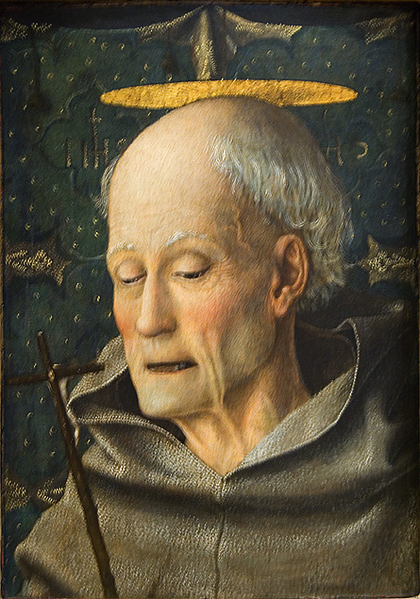
Saint Sebastian - patron saint of homosexuals

It was while researching the subject of sexual crime for my upcoming novel, The Mascherari, that I came across a period of repression that swept Late Medieval / Early Renaissance Italy.  This relatively unknown wave of persecutions and executions took place in 15th century Florence but also to a lesser extent in Venice. This phenomenon, which targeted men of homosexual disposition was known as la grande paura, The Great Fear.

To put this Great Fear in context, consider that during the period 1432 to 1502 in Florence, it has been estimated that as many as 17000 individuals were incriminated at least once for sodomy with 3000 convicted.  This is no small figure for a city with a then population of less than 50000.

The Great Fear took place at a time when Florence lay vulnerable following a number of repeated plague attacks. The Black Death of 1348 had swept away as many as 80000 Florentines in a population that was then 120000.  Serious plague outbreaks followed in 1363, 1364 and later in 1417, 1423/1424 and 1430.  In 1410, the population fell to its lowest, probably sparking fears about population numbers, and further consolidating any non-procreative sexual acts as threats to the city’s dwindling numbers.

But the rise in prosecutions can be attributed to more than just dwindling population numbers. In short, the Great Fear was fear of God's wrath.

Sodomy in Late Medieval Italy

In medieval parlance, sodomy was a broad term which for the Church, encompassed not only anal sex practices, but also masturbation, and any form of sexual activity – fellatio being an example – which did not lead to procreation.

In the 14th and 15th century, medieval Italy was no stranger to heterosexual anal sex. This practice was performed consciously between couples to avoid pregnancy.  For this reason, it was frowned upon by the Catholic Church for whom the sole purpose of sex was procreation.

But more vile in the eyes of the Catholic Church, was the sodomy inherent in homosexuality. This “abominable sin” was greatly feared because it posed the threat of inviting divine wrath.  While the term sodomy denounced any sexual acts that were deemed, then, as contra natura, or “contrary to nature”, it was usually the conspicuous act between two men which came to mind most of the time when people spoke the word.

Florence – the Great Sodom

The city of Florence was once considered as the modern Sodom. For much of the 14th and 15th century, Florentines more than their other Italian counterparts, had a reputation for engaging in what was then termed as the game in the behind. Venice, too, saw a rise in same-sex liaisons in the 15th century but this surge was thought to have sprung from Florence.

The Spread of the Great Fear

The rising intolerance towards homosexuals can almost be likened to the recent modern intolerance that took place in the late 1980s during which homosexuals were scapegoated for a raging and incurable disease which confounded physicians. Just as the spread of AIDs would focus the modern psyche on an “offending” subculture, so too did the scourge of bubonic plague experienced in the early 15th century bring about the scapegoating of homosexuals.


Bernardino di Siena

In the early 1420s, a particular religious preacher is notable for his spread of paranoia and his call to action against homosexuals. This man, Bernardino di Siena, preached at length in Siena and then later in Florence.

In short, Bernardino di Siena blamed sodomites for causing the plague. He believed that the plague was sent by God as punishment for the sins of sodomy. He also blamed population losses to sodomites’ apathy towards women, their reluctance to marry and their sterile sexual practices. “You don’t understand that this is the reason you have lost half your population over the last twenty-five years. Tuscany has the fewest people in any country in the world, solely on account of this vice,” he said.

In 1424, Bernardino di Siena launched a sermon in Florence during which he said, “For if they don’t marry they become sodomites. Make this a general rule: when you see a grown man in health who doesn’t have a wife, you can take this as an evil sign about him, especially if he hasn’t chosen for spiritual reasons to live in chastity.”  His remarks had a profound effect well into the later part of the century, in that most men of all ages who were later implicated in sodomy appear to have been unmarried.

While Bernardino can be applauded for denouncing such practices as the pimping of young boys by their fathers – often to procure themselves with privileges from the abducting party – or for warning parents about the potential dangers faced by their sons in a city where rape of boys was common, he nevertheless remains a disturbing figure for his stirring of hatred towards those men whose only crime was to favor other men.  In particular Bernardino painted sodomites as unstable, selfish and dangerous.  As explained earlier, he attributed anything that was unpredictable in the human experience – including the plague, wars and floods – to sodomy.

In his diatribes against what he called “feminised” men, he went as far as scolding mothers for dressing-up their sons to be too attractive.  He clearly suffered from an anxiety about gender distinctions. “They’re the beautiful color of hyacinth, these boys of yours become girls. Shame on you, fathers and mothers! [..] don’t send them out spruced up like maidens!” or even “Oh Silly, foolish woman, it appears you make your son look like yourself, so that to you he’s quite becoming: ‘Oh, isn’t he the handsome lad!’ and even ‘Isn’t he the pretty girl!’ “

His misogynistic beliefs also saw him advise mothers to lock up their sons indoors and only let out their daughters: he believed that even if their daughters were raped, it was “less evil” and therefore less offending to God then sodomy perpetrated on their sons.

Bernardino also accused Tuscans of being too lenient towards sodomites.  While in Florence, he praised examples of justice meted out to sodomites in other parts of Italy. He described how a man convicted of sodomy in Verona (then part of the Venice Republic) had been quartered and his limbs hung from the city gates; he noted that in both Genoa and Venice, sodomites were burnt.  In Venice, he taunted, they really applied justice.

In April 1424, as part of Lent, Bernardino gave a series of speeches against sodomy in which he called onto people to spit whenever they heard sodomy mentioned: “If they won’t change their ways otherwise, maybe they’ll change when they’re ridiculed. Spit hard!” On April 9, he roused the people by shouting, “To the fire! They are all sodomites! And you are in mortal sin if you try to help them!”

Prosecution prior to the Great Fear

While punishments against sodomy had previously existed in Florence, as Bernardino expounded, they were not as harsh as those in Venice.  The nature of the crime had long decided the conviction. For example, the rape of young boys or ‘giovanni’, was more severely punished than outright acts between two consenting male adults. The prosecution for a foreign man abusing local boys was even harsher.  Another consideration was whether the willing party was an ‘active’ or ‘passive’ partner, the ‘passive’ partner being usually fined. The amount of this fine rose with the boy’s age, reflecting a belief in the diminishing innocence of his act.  But for various social reason, it was often difficult to pursue certain individuals, and accusations did not often lead to punishment. To further cloud judicial matters, sodomy was well ingrained in every level of Florentine society including, no doubt, the higher levels of government.

Overall, prior to the 1430s, it appeared that sodomy did not attract much court attention.  According to Michael Rocke’s research of Florence judicial records dating from 1390 to 1410, only 33 persons were found convicted of cases involving sodomy, including 10 for attempting sodomy only. These cases dealt mostly on rape against young children. Very few individuals were condemned for consensual non-coercive relations. This was perhaps what Bernardino di Siena had termed as ‘lenient’.

The Signori di Notte’s Repression

In 1432, shortly after Bernardino’s inflamed sermons, the Florence regime finally appointed an institution, the Office of the Night, to “root out” sodomy.  This time, it was declared, there would be no lenience. The Office of the Night existed from 1432 to 1502 during which it administered a pervasive repression regime, targeting homosexuals.  In each year of the last four decades of the 15th century, an average of 400 people were implicated and 55 to 60 condemned for homosexual relations. Again this number is astounding considering the population at the time.

It was believed that the exercise of justice against sodomites would help appease God and prevent his wrath. Officials asserted that in such way, “the city and its upright citizens may be freed from all commotion, wars ended, plague abolished, enemy plots curbed” and so on.

The Officers of the Night operated through secret denunciations, calling onto the public to make accusations for which they did not require proof. As an incentive, accusers were offered financial rewards, calculated as a proportion of the convicted sodomite’s fine. Accusations were dropped in a box or tamburi affixed to churches in Florence and several nearby towns.  As would be expected, this system was not flawless. It was thought to lead to false accusations especially between enemies or between those still grieving old disputes.

The Night Officers also employed spies who ferreted out information and made their own accusations. Penalties ranged from various levels of fines to exile, interdiction from office, and at worst, execution.

Prosecutions in Venice

In Venice, the fear of sodomy was so great that the government body who took charge of prosecuting those suspected of homosexuality was no other than the same body of men entrusted with State security. This group of men, The Council of Ten, had enormous power which by 1430, equalled that of the Senate.

The so called Consiglio Dei Dieci were tasked with three main responsibilities: the peace and security of the Republic; the Venetian coinage; and the prevention of moral corruption, including sodomy.
In Venice, the punishment for sodomy was great, ranging from exile, maiming or burning.


As I found while researching for my novel, The Mascherari, the insidious powers of the Consiglio Dei Dieci often extended beyond the law and cannot be underestimated. The following case clearly exemplifies this idea.

In 1406 to 1407 a large group of homosexuals, including a number of young nobles and clergymen, were discovered by the Signori di Notte in Venice. Because the moral crime was serious and the penalty was burning, the Council of Ten stepped in.  However it was found that 16 or 17 Venetians from within the group were from the highest patrician families and so, the Council of Ten suppressed evidence and reduced the number of those executed to a minimum.

Still The Council of Ten made a concerted effort to “root out” the evil of sodomy.  For example, in 1455, it decreed that a certain number of places were to be placed under police surveillance since they were gathering places for sodomites. This included the porch of the Santa Maria Mater Domini church in the district of Santa Croce.

Again in 1460, the Council of Ten ordered physicians to send a report to the Council within 3 days after treating any man or woman whose anus had been damaged by sodomy…

But according to Rocke, the prosecutions seen in Florence far exceeded those in any other city on record, either in Italy or in Europe. In Venice for example, from 1426 to 1500, at a time roughly equivalent to the tenure of Florence’s Office of the Night, authorities prosecuted only 411 individuals and from 1406 to 1500, they convicted only 268.  In Genoa, only 5 persons were convicted from 1444 to 1500 while in Palermo, an estimated 100 men were executed for homosexual sodomy from 1567 to 1640.

Clearly the wave of repression experienced in Florence was unparalleled and remains a fascinating albeit disturbing subject of study.

Even more disturbing, at least for those who are more progressively minded, is that Bernardino di Siena, who actively preached against witchcraft and sodomy during the 15th century, is today a Catholic Saint.

___________________________________

A fantastic source of historical information for a subject that is given scant attention, Michael Rocke’s Forbidden Friendships – Homosexuality and Male Culture in Renaissance Florence was a valuable read for both my novel writing research and beyond. 


Tuesday, October 16, 2012

The Council of Ten

I seem to always return to the secret and the mystery within history.

I don't know why.

Some very pleasurable days ahead, wandering in Venice's sestieres, inventing the canals at dawn through the eyes of Antonio da Parma, my main character. In this flurry of research, underneath the silks and draped turbans, beyond the Venetian merchants, the glittery world of artisans and the orgiastic madness of Carnivale; past the putrid den of a Jewish physician who mulls over the sores of a decaying man, I am losing myself in historical works by masters before our time.  Victor Hugo's Angelo.... Lord Byron's The Two Foscari...
And a more sinister joy surges in me, that of encountering those I know. Or rather, I feel I know them well.

The Three Capi and those others...the Consiglio dei Dieci, who we call The Council of Ten.

Am I ready for the evil? The evil of Venice.

Why, yes. Of course.


"

Keep
Those maxims for your mass of scared mechanics,
Your merchants, your Dalmatian and Greek slaves,
Your tributaries, your dumb citizens,
And masked nobility, your sbirri, and
Your spies, your galley and your other slaves,
To whom your midnight carryings off and drownings,
Your dungeons next the palace roofs, or under
The water's level; your mysterious meetings,
And unknown dooms, and sudden executions,
Your "Bridge of Sighs," your strangling chamber, and 
Your torturing instruments, have made ye seem
The beings of another and worst world!
Keep such for them: I fear ye not. I know ye;"

                    - Marina, wife of Jacopo Foscari, to the Council of Ten,
                                                                in Lord Byron's The Two Foscari