The more I
age, the more my admiration is sparked by the quiet humility of those who have
lived and who keep quiet about having lived. There is grace and modesty in true
wisdom.
I love the
greyness of age, with its nebulous thoughts, its gentle ideas that roam without
ever seizing upon a truth. I love this refusal to reveal one’s experience, this
silent resolve to let others learn and grow of themselves.
I love age.
I love its contemplation, its determination to abstain from judgment, its
compassion for others and its ability to step aside gracefully and just
observe.
I think in the next years of my life, I shall be doing a lot of observing. Self-effacement is a
joyous thing.
The more I
age, the more astounded I am with the arrogance of youth, the self-sufficiency
of those who judge and who by way of remarkable shortcuts of the mind, arrive
to simplistic conclusions about all things.
Every day,
the same song repeats and tires me.
Who am I?
What am I thinking? Did you understand my motivations? I see by the judgment
you pronounce and what you say to me that you err in your understanding and
behold, this confidence you have, how it thrives, how your eloquent voice
resounds to all who may hear and you, you really think you know me, that you
know all. How do you do it?
I make no
attempt to shift your assessment. I leave you with that understanding, the
one you made, in your haste to judge, I leave you to maintain your erroneous
belief because I know that it is the only thing you are capable of ever grasping.
I do that to my detriment, even though it wounds my honor, but I live content in the
belief that I will never have to explain myself to those who truly see me
rather than project onto me.
Never mind all that. Be safe with your judgment and be content knowing that your judgment serves you. After all, it was designed to serve you and uphold all that you
are. Your judgments are reflections of your soul, and the faster, the more
nimble your mind is at forming them, the more ingrained your attitudes, the
more unbending your spirit. You live for your judgment because through it, you
assert your ephemeral self in the hope it will live forever.
But I love,
love the ephemeral. I love the way it floats aimlessly, I love its caress and
the thin veil that exists between it and nothingness. I am not afraid of
nothingness, the abyss does not threaten my ego. I care little about having an
opinion; I can settle with just feeling your soul.
Because I
can feel your soul, did you know that?
I have eyes
where the mind does not go. Your motions
are just memories to me.
All of
this, it will mean nothing to you. How well you ground yourself to the concrete,
I wish I could know it all, like you do. How do you do it?
As for me,
vague I remain. And in this vagueness, there exists the universe, and within it,
you and I, we are consumed and disappear.
Yes, today is La Befana, and in Italy over the eve of 6th January, an old witch has flown across and brought gifts to the little children. Centuries of folklore and ancient tradition has made this celebrated female figure as well known overseas as she is in her native Italy.
Santa should be very worried, because we love her!
This year, to help you celebrate La Befana with all its magic and intrigue, I invite you to discover a time in late medieval Venice when La Befana was as present as she is today in people's minds.
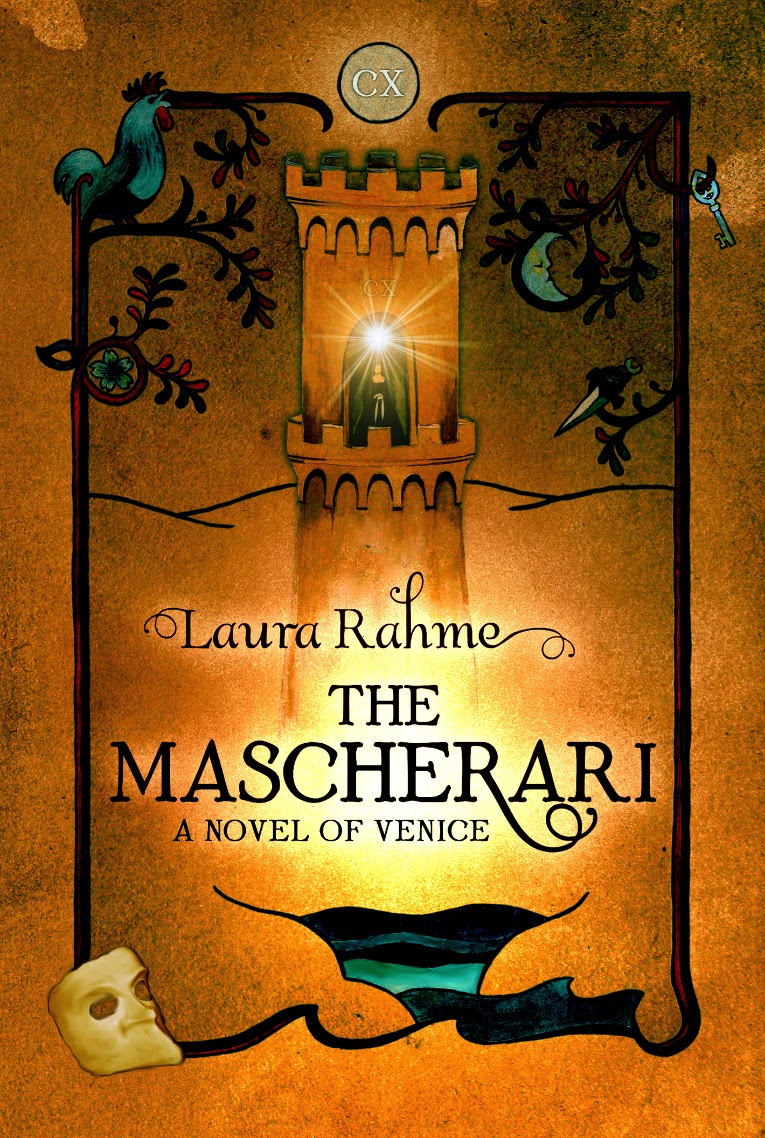
The Mascherari: A Novel of Venice, a historical mystery with supernatural themes has just been released on paperback and should reach all Amazon* territories by the end of the week. The Mascherari is an epistolary novel set in 1422 from the Winter Solstice to La Befana. You can read more about it here.
Priced at $14.99 USD with a gorgeous cover illustration created by designer Caryn Gillespie, it is a treasure to behold for now and years to come.
* Available next month from The Book Depository, Barnes & Noble and Angus & Robertson websites.
How would you like to own The Mascherari: A Novel of Venice for free? Then don't miss my Q & A at Unusual Historicals on 18th January 2015, where I will be speaking about the Venice of The Mascherari and giving away a FREE paperback copy to one lucky reader. Viva La Befana!
Below is an excerpt from The Mascherari: A Novel of Venice.
"Here, along the Grand Canal, a band of old men, as old as tradition demands, have scrubbed their skin with paint, strapped disfigurement upon their faces and donned their tattered witch’s costume. Hideous they are with their crooked noses and wrinkled skin. Hirsute old hags, they would rouse fear if it were not for the cheerful tales spread of them. For everyone in Venezia awaits them now and only those children who have been bad ought to fear.
Each of the five men holds a broom and steps inside a boat. The race is soon to start, the race that will lead them to the Rialto. And before long, the coarse haired witch rowers make their way in silence. They sweep with force toward San Marco, gliding beneath a clouded sun. A sinister sight they are these odd witches, hunched at the prow, their muscles tense where they ought to be frail, their vessels creeping forth through the gray winter mist.
The witches come! These lagoon creatures ought to make one shiver. Instead, the costumed men in their boats are serenaded by cheers all along the canals.
In the Campo di Rialto, all Venezia bustles. Maffeo watches them all. He recounts them all. He has a brilliant memory, Maffeo. Doctors and lawyers in their black robes, move among the rich citizens toward the Bridge. Velvet clad patrician merchants and tradesmen alike—the Arsenalotti in their red sashes and white shoes, the Nicolotti in black—all have brought their children with them to see the Regatta della Befana. Many of them are masked men and women, still eager to enjoy Carnivale before the Lenten days begin. It is a sinister sight, that of masked children of all ages, shrieking in the campo and singing La Befana songs, while their equally masked parents look on."
Tommaso Mocenigo was Doge of Venice from 1414 right up to his death from a long illness in 1423.
Mocenigo was an admiral and merchant by profession. He traded in pepper with Syria. Prior to being Doge, he was Duke of Candia (the Venetian name for the island of Crete) and in 1405 was named Procurator of San Marco. In his younger years he was also elected to the Council of Ten, Venice's highly secretive security body.
Under his reign, he encouraged commerce, and Venice's dominion over the sea was at its apogee. It is said that knowing well that he would be too ill to benefit from a new palace, he organised for the reconstruction of the ducal palace, then known as the Ziani Palace, and commenced the library of Venice.
Prior to his death, in 1423, Mocenigo made an impassioned plea to his Pregadi (Senate) warning them against electing Francesco Foscari as his successor. The brazen and military minded Foscari, he said, would ruin Venice. The main difference between these two men was that Foscari favored military expansion into terrafirma, while Mocenigo was all about the sea and peaceful trade.
Mocenigo is buried in the Basilica dei Santi Giovanni e Paolo.
Tomb of Mocenigo
Various excerpts from The Mascherari: A Novel of Venice, featuring Doge Mocenigo.
“Tommaso
Mocenigo is very ill,” he explained, gesturing gravely toward the Doge
apartments to our left. “He has been confined to bed for weeks already. When
the New Year commences next March, do not be surprised if the patricians are
called upon to appoint a new Doge. It is not known how many months Tommaso has
to live but I feel his time is near. And
between you and me,” he whispered, “our young procurator, Francesco Foscari*,
would want this time to be nearer still.” - Almoro Donato from the Council of Ten
As
the door opened, I saw that it was a much afflicted man, pale in face with a
thin aquiline nose and eyes so transparently gray that they seemed to belong to
another world. By the sunken cheeks on his pallid face I took him to be at
least eighty in years.
“Bonna notte,” he began, his frail voice,
at first, barely audible. - Antonio da Parma describes his encounter with Doge Mocenigo
“I
understand you, Antonio.” His voice rose. “In the words of our great Petrarch,
‘you wish to go beyond the fire that
burns you’. I see it in your
eyes. This sentiment you have, that
something must be, I know it well. I
know how it devours and urges.
“Then I will ask you to
yield to what must be. Pay heed to your
inner voice, as I do mine. Let it guide
you to your destiny. - Tommaso Mocenigo in The Mascherari: A Novel of Venice
“I
bid you go, Antonio. Pray for me, your Doge, that I may persuade my Pregadi and
save Venezia from the wars Francesco Foscari would have her wage upon my death.
You do that for me, Antonio?” - Tommaso Mocenigo in The Mascherari: A Novel of Venice _____*Francesco Foscari - was elected Doge shortly after Tommaso Mocenigo's death. Despite the tradition of electing patricians who were at least 60 years of age, Francesco was only 49 when he became Doge.
I haven't written much on life for a while and it leaves one to wonder whether I may have gotten lost somewhere in 15th century Venice, while scribing The Mascherari. Fear not, the twenty-first century is well and truly my reality.
I think.
Since the end of 2014 is looming fast, I thought it might be a good idea to express my gratitude for the wonderful things that are coming my way next year.
Because 2015 sure promises to be a freaking ride!
January
So firstly, The Mascherari will be available on Paperback. (Did I say this post would only be about 'life'? Too bad. I lied.) 356 pages of time travel set in 15th C Venice on cream paper. I am working hard at it right now.
With this, can I say how grateful I am for having writer friends? I counted over twenty on Facebook the other day and felt truly blessed. It's wonderful to connect with like-minded people who love history, love writing and go through the same hardships, the same fears, the same hopes and damn, who just love reading! And to think that three years ago, I only had a couple writer friends. I love the surprises that life brings along the way.
Since I am on the topic of books, I'll mention another historical novel. This time it's one classic beast written by an Australian journalist in the 19th century. For the Term of His Natural Life is one of the darkest novels I've read and it's very much in my mind at the moment as I'll be heading to Tasmania (where the novel is set) in early January and am looking forward to visiting Hobart and Port Arthur.
This is a huge deal for me. In my twenty-nine years in Australia, since arriving at aged 10, I've never seen Tasmania. I can't wait! What a great start to the year.
March
Still on the subject of books and writing and writers, I am very much looking forward to attending the first Historical Novel Society Australasia Conference and to meeting some special, talented people. Oh my goodness, and I get to meet Colin Falconer in the flesh! That's TheColin Falconer who has written over 30 books and is one of my favorite historical novelists and an AMAZING human being.
May
2015 is also doubly special as I'll be tying the knot with my partner of over 5 years. Oh my Lord Poseidon, that's like, 6 months away...
I've not even got a dress.
We have chosen the venue in Brisbane so that's a start. I am on the lookout for a good photographer but I'm not too worried: given my partner's background is film, the reception will likely be the equivalent of a large film crew. No kidding. That includes my lovely friend make-up artist, Billie Weston.
She did this to me five years ago:
I am fondly looking forward to my wedding day (that I haven't really planned yet...) and to seeing my friends again.
Because you know what? I do have an invite list. Invite lists are always a pain when you are young but when you are turning 40 next year (oh my God, did I say that?), invite lists are easy. The only difficult part is that I'll be missing out on the presence of so many people who live overseas and who I've never met in person and only wish I could.
You reach an age where it becomes obvious who you want in your life and who you want to share your special experiences with.
Which brings me to the inevitable...
October
I am indeed turning 40 next year. There's no turning back. I'll never wear 9-inch heels again. (Ok, maybe just a little bit.)
Like, WOW.
Me? Cute little me? Asian shorty me? 40 years old. Like, Wow.
I remember as a kid when someone told me they were 40. I would think they were ancient. (Like bloody old.)
And now I think, are you kidding, that's just the start of my adventure! :)
Because another upcoming joy for 2015 is Summer. Summer and all the love I have for this wonderful seaside place called Coogee and which has been my home for over 14 months.
I am immensely grateful to live in a place I could only dream of ten years ago. Grateful, for every walk I take along the magical ocean and every sunset and wave that paint a picture perfect landscape every second of the day.
I can't tell you how much I love this place.
And having unveiled sun-bathed Coogee, I'll get to the point. The point, the point, the point, is that...
And I feel a little embarrassed revealing this,
This summer, thanks to this shopping-porn-of-a-site called SammyDress, I actually have a bikini to wear for each day of the week. How cool is that? I have aSky blue and leopard print bikini, a flimsy orange bikini that would make a Brazilian babe salivate, a classic white andred striped bikini, a halter neck snake-skin bikini, a very 80s dark green bikini with gold metal rings, a bling (and wog-ish) Gold & Black bikini, and a hippie style pastel print bikini. I'm all set!
Because you only freaking live once!
And there comes the icing on the cake: I also know what I'm getting for Xmas. These are the funnest and least pretentious presents I've ever received because let's face it: weddings are expensive.
So present number one is swimming goggles - to see underwater and swim and shit. (And like, for pretending I'm a mermaid in my orange bikini while swimming around Coogee. It all makes sense now!)
And present number two - is a blowtorch.
With butane gas.
So that I can burn the shit out of my creme brulee.
Because I am SO making crème brûlée all over 2015.
When I was a young girl, I was a huge fan of the French-Japanese animated production, Ulysses 31.
Two of my favorite Ulysses 31 episodes were, Ulysses and the Sirens and Ulysses and the Minotaur. All the episodes drew me into Greek mythology but these two stood out.
Read about Ulysses 31 and the Minotaur (or skip to the next section)
In this fantastic sci-fi version of the Greek tale, Theseus and Ariadne-who sports a punk-like androgynous blue hair style-are forbidden lovers a la Romeo and Juliet. Ariadne fails to persuade her father to spare Theseus; King Minos imprisons him in the labyrinth where he is fated to die at the hands of the Minotaur.
Luckily, Ariadne happens to be a super pilot; she boldly flies her vessel to the Minotaur planet in the hope of saving Theseus before this one is mauled by the Minotaur.
On her way, she meets our hero, Ulysses, who has been told-somewhat cryptically-by Aegeus that 'wherever his son, Theseus, is imprisoned lies the secret path back to planet Earth'. Given that Ulysses is keen to return home, he decides to help Ariadne save Theseus.
Upon landing on Minotaur planet, Sheerka (think: Apple's Siri, but in command of Ulysses' spacecraft) warns them that it is a labyrinth where they will be easily lost. No kidding, Sheerka. The ever resourceful Ariadne happens to have a necklace, whose beads are none other than tiny geo-location emitters. The group uses these beads to track their journey into the labyrinth. Unfortunately, the labyrinth is a dynamic fortress with shifting walls and landscape, reminiscent of Alex Proyas' Dark City. So much for those beads.
Ulysses and Ariadne finally find Theseus and...come face to face with the trident-bearing blue-skinned Minotaur who looks very much like some Indian deity. A battle ensues. When all seems lost, Ulysses throws his laser saber to Theseus and this one finally defeats the Minotaur.
It is then that Ulysses realizes the meaning of Aegeus' words-the path to Earth was never to be found in Minotaur planet, but rather, was a secret possessed by the Minotaur himself. Ulysses feels stupid and misses out yet again on an opportunity to return to Earth. But, we, Ulysses 31 fans don't really care and we hope he remains stranded in space forever so that we can continue to watch this wonderful series.
You can watch the episode here. (In French)
My obsession for this episode was not surprising. Just like mermaids, labyrinths and mazes have fascinated for centuries. Thanks to the legend of Theseus and the Minotaur and to labyrinth engraved coins found at Knossos in Crete, one of the best known mazes in the Western world harks from the Minoan Kingdom. Lesser known are further depictions of ancient labyrinths, some carved into rocks, which have been found in Cornwall, India, Peru, Arizona, the island of Sardinia, Galicia in Spain, the UNESCO heritage listed rock drawings of Val Camonica in Northern Italy, and in Morocco.
The World's Largest Maze
This fascination for mazes has even led one man eccentric to build what will be the world's largest maze. Set to open in fall 2014 the maze of Fontanellato near Parma, Italy will be a 7 hectares, eight-pointed star-shaped labyrinth built entirely of bamboo plants with hedges growing as high as 5 meters. This giant labyrinth is the pet project of publisher, art collector and bibliophile, Franco Maria Ricci.
If you fancy a trip to Italy next year, why not hop past Parma and get lost among the bamboo hedges?
Italy's Amazing Mazes
But why stop at Parma? Take your pick. Among those countries with a history of mazes, Italy stands out today by having some of the most fascinating green mazes in the world.
Even in the 18th century, when Napoleon wasn't busy dismantling the Venetian Arsenale and appropriating the wealth of the Venetian navy, he made a visit to Villa Pisani (built for the Venetian family of St Stephan Pisani, starting in 1721), famous for its maze of boxwood hedges. Situated in the town of Stra, the Villa Pisani maze consists of 12 concentric rings with high hedges leading to a central tower. It is said that Napoleon ventured inside this maze and got himself lost. I wish he had stayed there forever.
Speaking of Venice, many history authors, including Peter Ackroyd, have written of its architecture as being labyrinthine. This is actually not a coincidence; let's take a look at the symbolism associated with mazes and some of their uses throughout history.
Baffling Evil Spirits
An ancient belief holds that evil spirits can only travel in a straight line. Perhaps this is what has led many medieval cities from Morocco (Fez, Marrakech), Greece, Spain and Italy to be constructed in roughly labyrinthine manner, with an intricate network of narrow streets some of which bend or end abruptly, others which join up in unpredictable ways. In 1999 while visiting the old town of Toledo, I myself became lost a number of times to the point of anxiety.
This complex architecture was presumably designed to ward off 'evil' and ensure the security of the local dwellers. More likely it was a strategy to aid residents in their defense against potential invasions, given that foreign attackers would more easily find themselves disoriented.
Here, the meaning associated with the labyrinth imagery is that of an 'impenetrable fortress' or a place heavily defended and which is not easily entered. The meaning extends beyond the legend of Theseus, to places like India. For example, Iranian geographer Abu'l-Rayhan Al-Biruni uses a labyrinth illustration in 1045 AD to depict the impenetrable Ravana fortress at Lanka, which according to the Ramayana epic was where the demon Ravana abducted Sita, wife of the hero Rama. Similarly, in the Byzantine period, the 13th century Islamic geographer, Al-Qazwini, made use of a labyrinth drawing to depict a map of Constantinople.
Roman Culture
The legend of Theseus and the Minotaur was very popular with the Romans and through their conquest, the iconography of the Minotaur and the Labyrinth were propagated in Northern Africa and throughout many places in the Mediterranean world. The cultural significance may have ranged from honoring a classical tale, to the idea of conquest, to bravery, to the slaying of bestiality which aligns with the military and imperialist principles of the Romans.
As far as slaying a half-bull creature, the slaying of the Minotaur is vividly reminiscent of the Cult of Mithraism which the Romans practiced. Here, Theseus effectively becomes the Persian entity, Mithras, and slays the bull.
Earliest known Mithraic monument
Rome, ca.98-99 A.D
The labyrinth legend may have also seeped into the 'popular' culture of the period where it hinted to danger, a guarded secret, or to the dwelling of someone less than hospitable. For exampe, in one excavated house in the ruins of Pompeii, one can read the engraved inscription, "Labyrinthus hic habitat Minotaurus" (The Labyrinth; here lives the Minotaur) which in this case sounds like "Beware of Dog". But who knows.
The Etruscans-also a people subjugated by the Romans and whose cultural influence in Italy has been traditionally overlooked as a result of Roman supremacy-already possessed labyrinth depictions in their own art.
For example, on the below Etruscan art strip found on the late 7th century Tragliatella pitcher, the labyrinth image has been labeled "Troy". Here the labyrinth comes to symbolize once again the "impenetrable fortress" and hints to the battle at Troy. Indeed, in some regions of antiquity, labyrinths were known as “Troy towns” -in the sense that Troy had once been constructed to be impenetrable- and the legend held that at the center of the labyrinth, there resided, not a Minotaur but rather a young woman in need of rescue. This woman was commonly thought to be Helen of Troy.
But we will see, later in this article, how the heavy copulation imagery depicted to the far right has led to a wildly different suggestion for the Etruscan symbolism of the labyrinth. For now let's skip ahead to the Middle Ages.
Pilgrimages of the Soul
During the Middle Ages, large labyrinths became featured on the pavements of a number of cathedrals, notably throughout Italy and France. In this period, the labyrinth was conceived as a metaphor for the journey of life and the cleansing of the soul, leading to enlightenment. It was used as a penitent's journey for those who were too ill or too old to take part in the pilgrimage to the Holy City of Jerusalem and or to Santiago de Compostela in Spain.
The penitent would pray and move along the path of the labyrinth on his knees until he reached the center or had gone around a number of loops. It was thought that upon completing their designated path, the penitent had cleansed his or her soul and had attained spiritual growth. From a psychological point of view, this labyrinth metaphor provided a valuable means for meditating, relaxing and finding oneself purified.
Labyrinth Pavement in Chartres Cathedral, France
Getting Lost in Pleasure
The use of hedges in gardens date back to Roman times. In turn, garden mazes may have first been mentioned in 13th century in Belgium. Such mazes developed for entertainment purposes, allowing people to take long pleasurable strolls, engage in conversation, exercise, take part in secret courtships or play games. The patterns and shapes of these hedge mazes vary greatly.
Chateau de Villandry Gardens
Loire Valley, France
Recent Findings - The Maze as a Symbol of Femininity
I indicated earlier that there is possibly a different meaning to the Etruscan labyrinth, one which might hark back to an earlier Bronze Age period. This is indeed the argument of recent researchers.
A prehistoric cave painting of a labyrinth depicted in the Polyphemus Cave, found 9 km North of Trapani in northwest Sicily, has been dated to 3000 BC. This painting, older than the rock carvings at Val Camonica (which at their earliest are from 1800 - 1000 BC) may well be the oldest known labyrinth in the world.
The labyrinth image is painted in red and measures approximately 50 cm in diameter. It lies in the ceiling of a niche in the cave. The original image is believed to have covered the entire niche vault and slanted down to the wall of the niche. Research suggests that the labyrinth bears a feminine significance - akin to a uterine or vulvar symbol. The use of red paint-which in Paleolithic and Neolithic periods was associated with blood and the color of the female reproductive organs, and therefore with birth and regeneration- also lends support to this claim.
Due to the position of the painting in the niche- which can best be seen while lying down- it has been suggested that the cave may have been a place of sexual ritual. This is to say that a couple would enter the niche, lie down and engage in procreation while gazing at the labyrinth figure above.
Similarly, the Etruscan labyrinth described earlier may be none other than a female uterus or a symbol of regeneration. This suggestion is supported by the findings on the Tragliatella pitcher (shown in non-PG detail below) which depicts a couple making love beside the labyrinth symbol.
What do you think?
From the 31st Century to the 15th Century
Thanks to watching too many Ulysses 31 cartoons in my youth (and maybe following a bout of historical research), I couldn't help but feature a maze in my latest writing. Nothing fancy, but it's in there somewhere.
In the historical novel, The Mascherari,which is set in 15th century Venice, the characters become lost in a hedge maze in an island near Venice. While the maze remains fictional, the historical background renders it no less plausible.
After writing The Mascherari, I took a visit to Hyde Park, in Sydney.
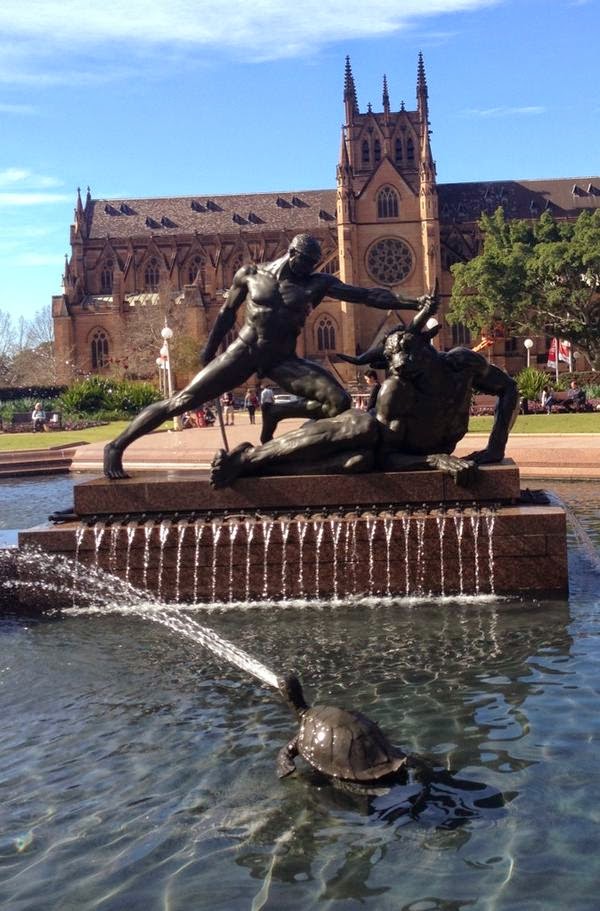
Unlike the glorious Italian mazes, Hyde Park is no labyrinth but it adjoins St Mary's Cathedral. In front of the cathedral is Archibald Fountain. Designed by French artist, François-Léon Sicard, and completed in 1926, it is a lavish fountain graced by three statues.
Two of these made me smile.
One is a statue of the Goddess Diana holding a bow. The other depicts Theseus slaying the Minotaur.
They were perfect.
More reading: Rigoglioso, Marguerite, "The Oldest Labyrinth in the World? The Polyphemus Cave Painting." Caerdroia - The Journal of Mazes and Labyrinths. Volume 29, (1998): pp 14-22.